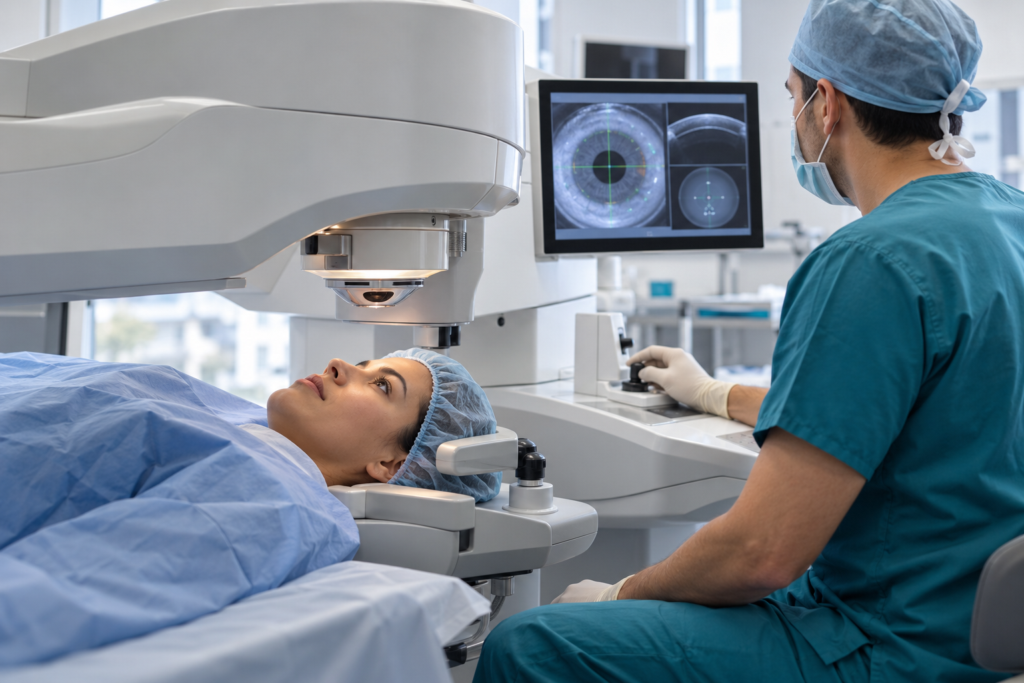
SMILE pro is not a different operation from SMILE. It performs the same small-incision procedure using a newer laser platform, VISUMAX 800, which received FDA approval in January 2024.
Compared with earlier SMILE, SMILE pro offers a faster laser step and additional tools to assist the surgeon with alignment. I prefer the newer platform primarily because the shorter laser phase reduces the time the patient needs to remain still during lenticule creation.
This article explores SMILE pro in more detail, explaining how its features affect the treatment process and what they mean for the patient experience and visual outcomes.
Table of Contents
What Is SMILE pro, And How Is It Related To SMILE?
SMILE involves creating a thin piece of tissue, called a lenticule, within the cornea and removing it through a small incision to reshape the cornea. SMILE pro retains that core operation, including the surgeon’s manual separation and removal of the lenticule.
The distinction is between platform generations: the earlier VisuMax system and the newer VISUMAX 800 with SMILE pro software. The newer system delivers the laser treatment more quickly and provides additional alignment assistance.
| Part of treatment | Earlier SMILE platform | SMILE pro |
| Core operation | Small-incision lenticule extraction. | The same underlying operation. |
| Laser-created lenticule step | A longer laser-delivery phase (about 25-30 seconds). | A shorter laser-delivery phase (ZEISS claims under 10 seconds). |
| Alignment | More dependent on manual positioning and the operator’s workflow. | Additional computer-assisted centration and rotational-alignment tools. |
| Surgeon-dependent work | Selection, planning, positioning, and manual extraction. | These responsibilities remain. |
| US regulatory status | FDA approved for SMILE in 2016, with astigmatism treatment added in 2018. | VISUMAX 800 received FDA approval in 2024 through a device-design supplement. |
| Candidacy and recovery | Require individual assessment and postoperative care. | Same candidacy assessment and expected recovery as SMILE. |
| Final vision | Depends on the eye, planning, treatment, and healing. | Comparable to SMILE in early comparative studies. |
What The Shorter Laser Step Changes During SMILE pro
During laser delivery, suction helps maintain the eye’s position against the treatment interface. ZEISS claims the VISUMAX 800 laser step takes under 10 seconds. In one comparative study, measured laser times were about 10-11 seconds with VISUMAX 800, compared with 27-30 seconds on the earlier platform. This shortens the period during which the patient needs to remain still.
A study of 4,000 SMILE procedures on the earlier platform found that most recorded suction-loss events occurred during later stages of laser cutting, after the initial lenticule-interface cut. Shorter laser delivery reduces the time during which an interruption could occur. That is the main reason I prefer SMILE pro.
An interruption in suction does not necessarily mean SMILE must be abandoned. Depending on when it occurs, it may be possible to reposition the eye and resume treatment. In some cases, your surgeon may switch to another procedure, such as PRK.
How SMILE pro Helps With Eye Alignment
Alignment involves both placing the treatment in the intended position and accounting for rotation of the eye. Rotational alignment is particularly relevant when treating astigmatism, because the direction of correction matters.
With SMILE pro, ZEISS offers two assistance functions: CentraLign, which assists centration, and OcuLign, which assists treatment-pattern rotation to account for cyclotorsion, or rotation of the eye.
For patients, this means the surgeon has added guidance to center the treatment and align the astigmatism correction with the eye’s position once you are lying down.
What Still Depends On The Surgeon During SMILE pro?
One of the most important parts of treatment remains obtaining the correct prescription measurement, or refraction. The surgeon determines whether SMILE is appropriate for your eyes and what correction to plan.
The continuing clinical and surgical responsibilities include:
- Procedure selection: deciding whether SMILE fits the eye and the patient’s goals.
- Measurement and planning: interpreting the prescription and examination findings to plan treatment.
- Positioning and alignment: placing the eye correctly and checking the intended treatment position.
- Lenticule separation and removal: manually completing the tissue-removal part of the operation.
- Intraoperative judgment: responding appropriately if a step is interrupted or requires additional care.
Laser time is not a measure of the entire operation’s complexity. While the SMILE pro platform makes the laser phase more efficient, it still leaves other essential work in the surgeon’s hands.
Our SMILE Eye Surgery Techniques guide explains the complete sequence in more detail.
Does SMILE pro Mean Better Vision, Broader Candidacy, Or Faster Recovery?
Final Vision
Comparative research does not justify promising better vision simply because the newer platform is used. In a 2024 matched study from a single clinic in Korea, visual and refractive results were similar between platforms at one and six months. One combined measure of optical irregularity, total higher-order aberrations, was lower with VISUMAX 800 at one month, although none of the individual aberrations measured differed significantly.
A 2025 US study also found that results were similar between the two platforms at three months. It compared small groups of patients treated in different years, so it cannot show that one machine is better than the other.
These studies describe particular patients, settings, and follow-up periods. A technical advantage in one measurement is not the same as proof that every patient will notice sharper vision. Refer our SMILE results guide to understand more about visual quality and longer-term expectations.
Candidacy And Recovery
In my counseling, the platform upgrade does not change candidacy or early recovery. The same decision still needs to be made about whether SMILE is appropriate for the patient’s eyes. A quicker laser phase is not a reason to proceed in an unsuitable eye.
Likewise, shorter laser delivery does not establish faster biological healing. Follow the recovery instructions provided for your treatment rather than assuming that the newer platform removes restrictions or follow-up. The SMILE Recovery Timeline covers the stages after treatment without confusing them with laser time.
What FDA Approval Means For SMILE pro In The United States
In the US, SMILE is FDA approved for nearsightedness with or without astigmatism, in adults 22 and older. However, device approval and individual suitability are separate considerations. FDA approval authorizes a specified use; it does not establish better vision than the earlier platform or extend to every feature advertised internationally. Your surgeon assesses the applicable US labeling alongside your examination findings to determine whether SMILE pro is appropriate for your eyes.
Discussing SMILE pro With Your Surgeon
If you are interested in SMILE pro, bring your questions to the consultation. Ask which platform will be used, how the surgeon works with it, and why SMILE is recommended for your eyes. I welcome patients sharing what they have read so we can discuss their expectations and the proposed treatment together.
Frequently Asked Questions About SMILE pro
Can I Ask For SMILE pro Specifically?
Yes. It is reasonable to ask which platform a practice uses and to discuss what you have read about it. While asking for SMILE pro does not establish suitability, it can help you understand the proposed treatment and the reasons behind it.
Will SMILE pro Feel Different From Earlier SMILE?
Not necessarily. Patients may not recognize a platform-generation difference unless it is explained to them. A shorter laser phase can be useful during treatment without creating a dramatic change in what every patient feels. It should not be presented as a guarantee of less pressure, discomfort, or anxiety.
Does A Laser Step Under Ten Seconds Mean The Whole Procedure Takes That Long?
No. ZEISS’s figure refers to lenticule creation for myopic treatment with a 6.5 mm optical zone. Positioning, docking, and manual lenticule removal are separate parts of the procedure. Your total visit and recovery are not measured by that laser specification.
What Should I Ask A Practice About SMILE pro?
Ask which laser platform is used, what experience the surgeon has with it, which steps remain manual, and what evidence supports any claim of better results. Those questions help distinguish a concrete workflow improvement from a broader promise the evidence may not support.
About the Author