
If you have undergone Small Incision Lenticule Extraction (SMILE) and one eye seems clearer than the other, or your vision was better yesterday than it is today, you are probably trying to figure out whether this is still normal. Most of the anxiety I see after SMILE does not come from a dangerous complication. It comes from the fact that the surgeon knows what is normal during recovery, and the patient usually does not.
The internet often makes early recovery look worse than it usually is. People who recover uneventfully from laser vision correction procedures, such as SMILE, often stop posting and move on with their lives. People who are worried, frustrated, or fixated on a symptom keep searching, keep comparing, and keep writing about it. So if you are doom-scrolling recovery stories right now, it is worth knowing that what is most visible online is not always what is most typical.
This article discusses the healing phase: what tends to be normal, what usually improves next, and when it makes sense to call your surgeon during the recovery phase.
Table of Contents
What Recovery Actually Means After SMILE
One reason the SMILE recovery timeline can feel confusing is that patients often use the word “recovery” to mean different things during the post-surgery recovery process.
There is functional recovery, which means you can get through your day, see well enough to work, use your phone, move around comfortably, and generally return to your daily routine. Then there is fully settled recovery, which means the visual quality feels stable, supports clear vision, and no longer seems to change from one day to the next. Each of these are different milestones.
Many patients are functional quite quickly after SMILE. That does not mean the eyes are fully settled by the next morning. I usually tell patients to expect several weeks of continued settling rather than overnight perfection. Most find that how they actually feel outpaces what they feared. For many people, the first burst of initial recovery is fast. The finer settling of sharpness and surface comfort can continue over the first few days and weeks.
Early fluctuation is not the same thing as final visual quality. If you want a deeper look at what vision typically feels like once healing is fully behind you, I discuss that in SMILE Eye Surgery Results: How Long Does SMILE Last?. Here, the question is narrower and more immediate: what is normal while the eyes are still settling after this laser eye surgery.
The First 24 Hours After SMILE
The first day after SMILE is often better than patients fear, but it is not always as visually clean as they hoped.
What is commonly normal in the first 24 hours:
- blurry or hazy vision
- tearing
- light sensitivity
- a scratchy or foreign-body sensation
- mild asymmetry between the two eyes
If the surgeon told you before you left the clinic that everything looked routine, then symptoms like these are usually part of normal early healing and not unusual side effects of the SMILE procedure.
What usually improves next is comfort first, then clarity. The scratchy feeling often eases quickly. Tearing settles. Light sensitivity improves. Vision may still look a little cloudy or milky before it sharpens.
This is also the phase where people start worrying that they are “behind” because they are not seeing 20/20 immediately. That is not a useful way to judge the first day. The more important question is whether what you are experiencing fits the usual pattern of early recovery. In most cases, it does.
Days 2 Through 7: Why Recovery Can Feel Uneven
The first week is where many patients begin to panic, not because recovery is necessarily going badly, but because it stops feeling linear.
This is the stage where I most often hear:
- “It seemed better yesterday.”
- “Why is it blurrier today?”
- “I thought it would be perfect by now.”
The simplest way to explain the first week is this: recovery can be two steps forward, one step back.
That does not mean something has gone wrong. It usually means the eyes are still responding to the normal mix of healing, dryness, drops, blinking patterns, and surface variability. The first week is not always a straight climb toward perfect clarity. A good day followed by a slightly blurrier day can still be part of normal healing.
This is also when patients start testing daily function. They go back to desk work. They spend time on screens. They drive. They read. They cook. They work out. If something feels slightly off in one of those settings, they often start worrying that the result is off track. That conclusion is usually premature, especially in the first few days of the recovery time.
In most patients, the first week is exactly when vision is good enough to function but not yet consistent enough to stop being noticed. That mismatch is what makes the first week emotionally difficult.
One Eye Is Clearer Than the Other After SMILE: Is That Normal?
Yes, often it is.
One-eye asymmetry is one of the most common reasons people search for a SMILE recovery timeline in the first place. They notice that one eye seems sharper, more comfortable, or more “normal” than the other, and they assume that means something is wrong with the lagging eye.
The first thing to know is that the difference can be visual, sensory, or both. One eye may look a little clearer. One eye may feel drier or more aware of blinking. One eye may simply seem slower to settle.
The second thing to know is that patients often make this feel worse by self-testing. They cover one eye, compare. Then they cover the other, compare again. Then they repeat the process every few minutes. That loop increases anxiety much faster than it increases understanding.
The visual system is designed to use both eyes together. Most patients function much better binocularly than they do when they isolate each eye and start auditing them separately. So if one eye seems a little behind early on, the best response is usually not more monocular testing. It is time, lubrication when needed, and using the eyes together.
Asymmetry becomes worth flagging to the surgeon if:
- the difference is clearly worsening
- it remains meaningfully bothersome beyond the early healing window
- it is accompanied by symptoms that feel off-pattern rather than merely uneven
Weeks 2 Through 4: Why Some Patients Still Feel Unsettled
This is the part of the SMILE recovery timeline that can be most psychologically difficult.
By week 2, patients are often expecting the process to feel finished. They are functioning. They are back to work. They are doing most of what they normally do. So if vision still feels slightly dry, slightly variable, or not quite as crisp as they imagined, they can start interpreting that as failure.
It usually is not.
Weeks 2 through 4 are often about refinement rather than dramatic change. Sharpness may still improve. Comfort may continue improving. Consistency may get better before the absolute best moments of clarity do.
This is also the point where the question changes from “Can I function?” to “Why does this still not feel completely settled?” The answer is that the early part of recovery happened quickly, but the final polish takes longer.
What is still settling in this window is often not just raw sharpness. It is tear-film stability, surface comfort, and the consistency of the visual experience across the day. A patient may be seeing quite well in the morning, then feel blurrier on a screen by late afternoon. Or they may feel almost normal outdoors, perhaps even while wearing sunglasses, but still notice dryness or mild variability indoors. This pattern can be frustrating, but it is common.
This is also the stage where ocular surface disease becomes especially relevant. If there was pre-existing dryness before surgery, or if the post-op drops have irritated the surface of the cornea, weeks 2 through 4 are often when that becomes the main explanation for lingering blur or inconsistency. That does not mean every unresolved symptom is “just dryness,” but it does mean the surface is often the first thing to think about before assuming the surgery result is off.
When should patience turn into a recheck?
If symptoms are clearly worsening rather than plateauing, if one eye remains meaningfully different in a way that affects daily function, or if a persistent prescription difference still seems to be present as week 4 approaches, that is worth discussing with your surgeon.
Not perfect yet is not the same as off track.
SMILE Recovery Timeline at a Glance
| Stage | What Often Feels Normal | What Usually Improves Next | When to Check In |
| First 24 hours | Blur, haze, tearing, light sensitivity, scratchiness, mild asymmetry | Comfort first, then early clarity | If symptoms feel sharply off-pattern or clearly worse than expected |
| Days2-7 | Fluctuation, one eye ahead of the other, blurrier days after clearer ones, screen fatigue | More stable comfort and more reliable day-to-day function | If the difference is worsening rather than settling, or if anxiety remains high enough that you need reassurance |
| Weeks 2-4 | Lingering dryness, variable sharpness, “why is this not finished yet?” anxiety | Better consistency, surface comfort, and sharper moments lasting longer | If symptoms are clearly worsening, if one eye remains meaningfully different, or if a prescription difference still seems present as week 4 approaches |
Dryness, Steroid Drops, and Why Vision Can Feel Worse Before It Feels Better
If there is one theme I would want patients to understand during SMILE recovery, it is this: dryness can make vision feel much worse than the surgery result actually is during the healing process.
That dryness can come from more than one place.
Some patients already had ocular surface disease before surgery. Many contact lens wearers come to SMILE precisely because their lenses were drying out the eyes and making day-to-day vision less reliable. When that is the case, SMILE can remove the contact lens burden, but it does not magically erase the underlying dry eye on day one.
Then there are the post-op drops themselves. Steroid and antibiotic eye drops are important in early healing, but the preservative load in some of them can temporarily worsen surface irritation and make the eyes feel drier. When that happens, patients often think the procedure made their vision regress. What they are actually seeing is the effect of the ocular surface on visual quality.
This is why a patient can feel blurrier, drier, or less comfortable on a given day even when the deeper healing is moving in the right direction.
The practical implication is important: if you already had contact-lens dry eye before surgery, or if your surface tends to be sensitive, your dry eye regimen still matters during SMILE recovery. The post-op drops do not replace that conversation. In some patients, lubricating eye drops and the broader dry eye treatment plan need to be managed together. In cases where surface symptoms persist, dry eye treatment may still be part of the recovery plan and the overall protection of eye health.
Common SMILE Recovery Symptoms and What They Usually Mean
The table below gives a quick way to interpret common symptoms during SMILE recovery. It is not a substitute for surgeon guidance, but it can help you interpret what you are feeling.
| Symptom | What It Usually Means | Typical Pattern |
| Blur or haze | Early healing, surface dryness, or normal settling | Often most noticeable early, then gradually improves |
| Vision better yesterday than today | Fluctuation from dryness, drops, or surface instability | Common in the first week |
| One eye clearer than the other | Uneven but routine healing, or different surface behavior between the eyes | Usually improves with time |
| Scratchy or foreign-body sensation | Surface irritation from early healing | Often settles quickly |
| Light sensitivity | Common early post-op response | Usually improves over days |
| Screen fatigue | Reduced blink rate and surface dryness | Often improves with lubrication and time |
| Glare, halos, or unstable night vision | Surface issues or early adaptation | Often softens as healing continues |
The goal is not to diagnose yourself from a table. It is to stop assuming that every uncomfortable or imperfect sensation means something serious.
Returning to Work, Screens, Driving, Exercise, and Daily Life
Most patients return to normal daily activities relatively quickly after SMILE. That is one of the reasons this minimally invasive vision correction procedure appeals to people with active routines.
But “returning quickly” should not be confused with “nothing matters” or “all instructions are irrelevant.”
Desk work and screen use are often possible as early as day 1 or 2, and many patients can manage a significant improvement in their daily routine by the next day, but the limiting factor is usually comfort, not safety. If screens feel tiring or blur seems to increase while working, it often points back to dryness and reduced blinking rather than damage from the screen itself.
Driving depends less on a fixed calendar day and more on whether you personally see clearly enough to do it safely, but many patients who are recovering routinely are comfortable within a few days. Others need a little longer. Your own surgeon’s advice should control that decision.
Non-contact exercise and other physical activity often return within the first day or two if everything is otherwise routine, but aftercare instructions still matter. Makeup often comes back within a few days, with eye makeup sometimes taking a bit longer.
Swimming, contact sports, and other strenuous activities usually require more caution and often a longer wait, commonly measured in weeks rather than days, depending on the surgeon’s instructions and planned follow-up appointments.
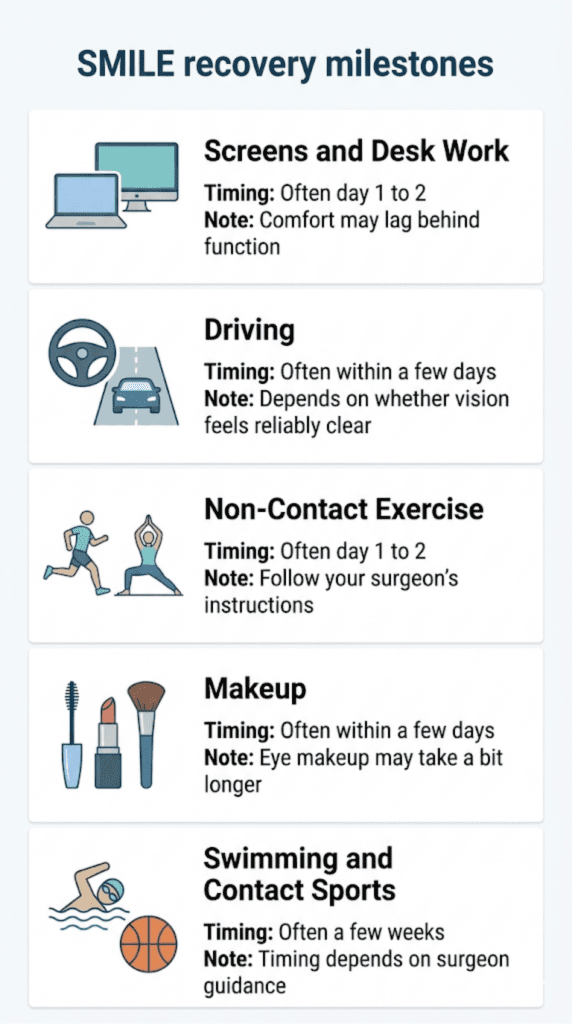
What I would not want readers to take from online summaries is the idea that early confidence in SMILE recovery means aftercare rules no longer apply. The safer and more useful principle is that many activities come back quickly, but your own surgeon’s instructions and follow-up guidance still win.
When to Call the Surgeon
One of the most useful things I can tell patients is that calling the surgeon or your eye doctor for reassurance is part of normal recovery care. It is not overreacting. Patients often hesitate because they think they are supposed to know what is normal. They are not. That is the whole point.
What should prompt a call?
- symptoms that are clearly worsening rather than fluctuating
- pain or redness that feels distinctly off-pattern
- vision that declines sharply rather than settling unevenly
- anything that feels meaningfully different from what you were told to expect
There is a reassuring principle here: if the surgeon told you before you left the clinic that everything looked routine, then first-week symptoms are overwhelmingly likely to be part of normal recovery rather than a late surprise. But that is still not a reason to sit on a concern that feels real to you. The patient does not know what the surgeon knows. That is why the check-in and any needed follow-up matter.
How SMILE Recovery Compares With LASIK and PRK
This comparison is only useful if it helps set expectations.
SMILE may take a little longer than LASIK to feel fully sharp because the visual sharpening curve can be slightly different. Where SMILE often feels easier is in the early structural recovery. There is no corneal flap to worry about. That changes the feel of the immediate post-op period.
Compared with PRK, SMILE is usually much easier in early comfort. PRK can involve a longer and more uncomfortable surface-healing period. That is why patients who compare recovery stories across laser vision correction procedures can get confused if they do not know which surgery those stories are actually about.
The useful takeaway is simple: if your vision is not instantly as sharp as LASIK patients sometimes describe, that can still be normal for SMILE. And if you are comparing your comfort to PRK accounts, SMILE recovery is usually much gentler.
What to Remember About SMILE Recovery
Most SMILE recovery anxiety comes from not knowing whether the current stage is still normal. The best way to think about recovery is not as a rigid countdown to perfect vision, but as a process of steady settling. Functional recovery and fully settled recovery are not the same milestone, and one-eye asymmetry, fluctuation, and dryness often feel more dramatic than they actually are.
Most patients reach good functional vision well before the settling process fully stops being noticeable. Recovery stories posted online are often not a representative sample of ordinary healing, so it helps to judge your recovery by the pattern your surgeon told you to expect, not by the most alarming story you found on a forum. If something genuinely worries you, calling your surgeon is part of normal recovery care.
SMILE Recovery FAQ
How long does SMILE recovery take?
Many patients are functional quickly, but fully settled visual quality can take longer. Early recovery often happens in the first few days, while the finer settling of sharpness, comfort, and consistency can continue over several weeks. For some patients, the process feels largely complete within days. For others, it continues through the first month.
How long after SMILE can I see 20/20?
Some patients can see 20/20 very early, sometimes within the first day, but that is not the right benchmark for judging recovery. A patient can be functioning quite well before vision feels fully settled, and another patient may need more time for clarity to stabilize. Early blur, fluctuation, or asymmetry do not automatically mean the result is off track.
How long after SMILE can you drive?
Driving depends less on a fixed calendar day and more on whether you personally see clearly enough to do it safely. Many patients who are recovering routinely are comfortable within a few days. Others need a little longer. The correct answer is always the one based on your own vision and your surgeon’s instructions.
What are the do’s and don’ts after SMILE surgery?
The main “do” is to follow your drop schedule and any dry eye regimen exactly as instructed. Use lubricating drops if recommended, and contact your surgeon if something feels clearly off-pattern. The main “don’t” is to assume that quick functional recovery means aftercare no longer matters. Many daily activities return quickly after SMILE, but timing for things like exercise, makeup, swimming, and contact sports should still follow surgeon-specific guidance.
How does SMILE recovery compare to LASIK?
SMILE may take a little longer than LASIK to feel fully sharp because the visual sharpening curve can be slightly different. Where SMILE often feels easier is in the early structural recovery, because there is no corneal flap to worry about. In practical terms, that means LASIK can sharpen faster for some patients, while SMILE often feels less fragile in the immediate post-op period.
About the Author