If you are researching SMILE laser eye surgery results, you are probably trying to answer two different questions: How long does SMILE last, and what will the vision actually feel like once it settles?
These questions belong together, but they are not the same. Longevity is about whether the distance correction holds over time. Visual quality is about how crisp, comfortable, and natural that correction feels once it has settled.
Drawing on my experience with Small Incision Lenticule Extraction (SMILE), an FDA-approved vision correction procedure performed with a femtosecond laser, I will explain that distinction first. I will then discuss what a settled result tends to feel like in daily life, including night driving, screen clarity, ghosting, and differences between the two eyes. If you first need a broader explanation of the procedure itself, SMILE Eye Surgery Basics covers that separately.
Table of Contents
Why SMILE Results Mean More Than 20/20
Measured visual acuity, or how well you read an eye chart, is part of the picture, but it is not the whole picture. I have had patients with identical chart outcomes describe their results in completely different ways. One will say it is the best decision they ever made. Another will say they expected more. Same procedure, same measurements, genuinely different experiences. Anatomic and visual success and patient reaction do not always coincide.
That gap is not a failure of the surgery. It reflects the fact that a clinical result and a lived result are two different things, and the lived result depends on what the patient was hoping for, how sensitive they are to subtle changes in their visual environment, and how their ocular surface behaves after surgery.
Understanding that distinction is useful before getting into the specifics of what results typically look like. This article discusses settled outcomes: how the correction holds up and what patients experience once healing has largely completed. The early weeks after surgery, including fluctuation, mild haze, and gradual sharpening, are covered in the SMILE Recovery Timeline.
How Long SMILE Results Last
SMILE results last because the corneal reshape is permanent. Most patients keep stable distance vision for many years, often into their 50s and 60s, when aging of the natural lens increasingly influences vision.
During the procedure, a precisely shaped disc of corneal tissue, called a lenticule, is removed through a small incision. That tissue does not grow back, and the cornea does not simply return to its original shape once healing is complete.
Permanent, however, does not mean that every part of your vision remains unchanged for life. SMILE corrects the cornea. It does not stop the natural lens inside the eye from aging, prevent the ocular surface from becoming dry, or guarantee that a prescription will never shift slightly. This is why I separate the permanence of the corneal reshape from the long-term behavior of the eye as a whole.
There is no single guaranteed number of years because the eye does not age according to a fixed schedule. The better way to think about longevity is that SMILE does not have a normal expiration date. The correction is intended to remain in place, while other parts of the visual system continue to change over time.
When patients say that SMILE has “worn off,” they may be describing several different things:
- A small residual prescription that became clear after healing settled
- Mild regression, which is more likely with higher levels of myopia
- Dry eye or tear-film instability making otherwise good vision feel blurred or inconsistent
- Presbyopia, the age-related loss of near focus that commonly becomes noticeable in the 40s
- A later lens change, including cataract, that affects vision independently of the corneal correction
Fluctuation during the first few weeks is different. Early blur, haze, dryness, or one eye settling faster than the other belongs to the healing period; it does not mean that the procedure has worn off. The SMILE Recovery Timeline explains what commonly happens during the first day, first week, and first month.
Several factors influence how stable and clear the result remains:
| Factor | How It Relates to Long-Term Results |
| Prescription and astigmatism | Higher myopia carries a somewhat greater chance of residual correction or later regression. |
| Prescription stability before surgery | A prescription that is still changing can continue to change after surgery; stability should be established first. |
| Corneal and ocular-surface health | Corneal suitability supports a predictable correction, while dry eye can reduce clarity even when the refraction remains good. |
| Age and natural-lens status | Presbyopia and cataract can alter vision later without reversing the corneal treatment. |
| Follow-up after surgery | Follow-up allows the surgeon to treat surface problems, confirm stability, and decide whether any refinement is appropriate. |
If a meaningful residual prescription remains, an enhancement may be discussed after the result has stabilized. That is a later, individualized conversation rather than something to rush during early healing. Depending on the eye, an enhancement may involve a surface treatment such as PRK.
Longevity is only one part of the result. A correction can remain stable while the patient still has questions about crispness, comfort, contrast, or how natural the vision feels from day to day. That is where the rest of this article begins.
What a Strong SMILE Result Usually Feels Like
The best description I have heard from patients is: “I forgot I had surgery.” Not in the sense that they cannot remember having it done, but in the sense that their vision stopped being something they thought about. They were at work, at the gym, behind the wheel, out with their children, and their vision simply was not an issue.
That is the working definition of a strong result: not a number on a chart, but vision that fades into the background of your daily life.
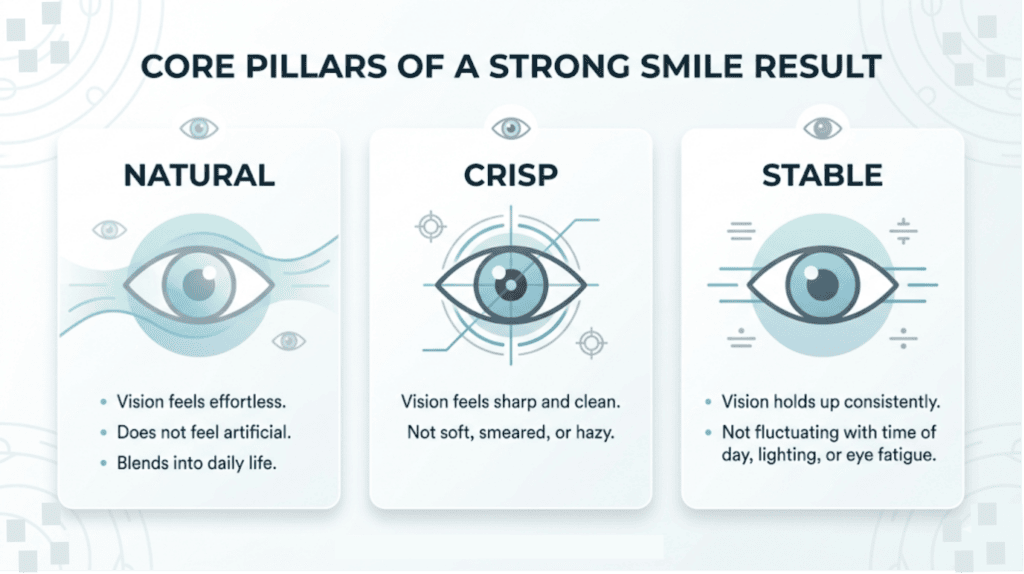
When I counsel patients before surgery, I describe the goal as natural, crisp, and stable. Natural means the vision does not feel effortful or artificial. Crisp means the optical quality is clean, not soft or hazy. Stable means it holds up consistently across conditions rather than fluctuating with the time of day, the lighting, or how tired the eye is.
If SMILE can give you the same quality of vision you had with your best soft contact lenses, but without wearing them, that is what I set as the benchmark. Not hard contacts, not the absolute sharpest moment during an eye exam, but the functional clarity of a good day in comfortable soft lenses. Not better, not worse. That expectation, when it is accurate, tends to produce satisfied patients.
In terms of measured outcomes, most patients achieve very good distance acuity. In my experience, around 92% of patients reach 20/20 and around 98% reach 20/25. Those percentages describe eye-chart acuity, but the experience of a strong result is broader than the number alone.
What Distance Vision Feels Like After SMILE Eye Surgery
Distance vision after SMILE is functional distance vision, which means it shows up across the full range of what people do with their eyes.
I make a point of asking patients before surgery what matters most to them: playing with their children, driving, sport, screen work, spending time outdoors. The answer is almost always everything. After surgery, the answer tends to be the same: everything, except now without the glasses or contacts.
One patient stands out. He came to me training for his first marathon. He was not a straightforward candidate. He had significant dry eye, which meant contacts were unreliable on long runs, and glasses were impractical for the mileage he was putting in. Because of the dry eye risk, LASIK surgery was not the right choice for him. We treated his ocular surface aggressively before proceeding with the SMILE procedure and managed it carefully afterward. He ran the New York City marathon. That is what distance vision results mean in practice.
The patients I see who are happiest are the ones who describe a version of the same experience: they are at work, at a game, behind the wheel on a highway at night, and they suddenly realize they are not thinking about their eyes at all. The vision is just there. That is the result.
Quality of Vision Matters as Much as the Eye Chart
A 20/20 result tells you how well a patient can read a standardized chart under clinical conditions. It does not tell you how their vision feels at dusk, on a screen, in a bright outdoor environment, or under artificial lighting late at night.
We are not treating the number. We are treating the patient’s experience. The two can diverge.
Post SMILE surgery, a patient can test at 20/20 and still feel that something is slightly off in their visual quality. A patient can test at 20/25 and feel completely satisfied with every visual task they undertake. The Snellen line is a useful marker, but it is not the whole measurement.
This is also what distinguishes SMILE eye surgery results from SMILE surgery success rate statistics. Our article on SMILE surgery success rate discusses what the clinical literature says about refractive accuracy and measured acuity. Here, the question is different: whether vision feels clear, natural, and reliable in the situations patients actually care about. Those are related questions, but they are not the same question.
Quality of vision is about contrast sensitivity, the ability to see fine detail and edges clearly, especially in lower light. It includes sharpness at distance in varying conditions. It also includes how well the visual system handles transitions between bright and dim environments. A strong SMILE result holds up well across all of these, but the factors that influence quality of vision are worth understanding.
White-on-Dark Ghosting, Night Driving, and Screen Clarity
White-on-dark ghosting, the slight doubling or trailing that some people notice when reading light text on a dark background is one of the concerns I hear most often from patients who have been doing their research.
This is typically traceable to one of two things: residual astigmatism that was not fully addressed, or an ocular surface issue that is affecting how light refracts through the tear film. If the ghosting fluctuates from one moment to the next, that is almost always an ocular surface problem rather than a refractive one. Fluctuating symptoms point to instability in the tear film, which can be treated.
Night driving and halos are addressed at the planning stage. I measure pupil size before surgery and perform pupil-centered treatment, which is specifically designed to minimize the optical edge effects that can cause glare and halo in low-light conditions. Not every complaint about night vision after laser surgery is unavoidable. Most can be anticipated and managed.
Screen-related visual quality is a concern I hear from professionals who spend most of their day in front of a monitor. When patients tell me they are worried about screen clarity after SMILE, I usually point out something they may not have considered: long-term contact lens wear is genuinely hard on the corneal surface and tends to cause dry eye over time, which itself creates screen fatigue and blurring. SMILE removes that variable. Whether screen vision is better or equal after surgery depends heavily on how well the ocular surface is maintained, but the baseline of contact-related dryness is typically lower.
A useful way to think about the ocular surface and visual quality: imagine a car that runs perfectly, but has a dirty windshield. The engine is fine. The problem is the view. Dry eye, incomplete tear film spread, and corneal surface irregularity work the same way. They sit between a clinically successful surgical result and what the patient actually sees.
This is why treating the ocular surface before surgery is important, but it is just as important to manage it carefully in the months after, often with lubricating eye drops or other treatment, because the tear film is a significant part of what visual quality feels like on a day-to-day basis.
When One Eye Feels Better Than the Other
After SMILE surgery, some patients notice that one eye seems sharper or more comfortable than the other, even after healing has largely settled. In early healing, it is normal for one eye to stabilize faster than the other. That is expected and temporary. But some patients, well past the healing phase, still perceive that their two eyes are not quite equal.
A few things are worth knowing. The first is that eyes are often asymmetric before surgery. A prescription difference, a slight difference in corneal shape, a variation in how each eye’s tear film behaves: these are common, and they do not disappear after surgery any more than they existed before it. Second, most people have a dominant eye, and the dominant eye is the one they naturally rely on more. If the non-dominant eye happens to be the sharper of the two post-operatively, it can create a subtle perceptual imbalance that patients notice, particularly when one eye is covered or when lighting changes.
The most useful habit when one eye seems to feel less sharp is to use both eyes together and stop isolating them. The visual system integrates input from both eyes in ways that individual monocular testing cannot replicate. Most patients who complain of one-eye asymmetry find that their binocular vision is better than either eye alone.
That said, a persistent meaningful difference in how the two eyes perform is not something to dismiss or wait out indefinitely. If something is genuinely off, it is worth investigating and usually correctable.
What Affects How Strong or Predictable Results Feel
Several pre-operative factors influence how clean and consistent the final result tends to be.
Prescription range matters. SMILE performs well across the myopic range it is designed for, but higher prescriptions can be somewhat less predictable at the tightest refractive endpoints. For patients at the higher end of the myopic range, I sometimes recommend EVO ICL instead, which addresses high prescriptions without removing corneal tissue and tends to give very clean optical quality for patients with significant myopia.
Astigmatism adds a nuance worth naming. SMILE addresses astigmatism in many patients, but for small amounts, specifically under about 0.75 diopters, the correction may actually be more precise with LASIK than with SMILE, because SMILE’s approach to very low astigmatism correction has a different threshold of predictability. If a patient has 0.5 or 0.3 diopters of astigmatism alongside their myopia, a conversation is warranted about whether LASIK may give a cleaner result for their specific numbers.
Corneal candidacy itself is essentially a binary decision: there is a threshold for shape, symmetry, and thickness, and either you clear it or you do not. Patients sometimes worry that being “on the lower end” of corneal thickness means their results will be marginal. That is not how it works. Once a patient is confirmed as a candidate, their corneal measurements within the acceptable range do not determine the quality of the result. If the cornea is irregular or at risk for ectasia, laser vision correction is no longer the appropriate option, and EVO ICL becomes the appropriate conversation.
Ocular surface quality is probably the single most modifiable factor when it comes to how results feel in daily life. A patient who enters surgery with healthy tear film and maintains that after surgery will tend to have cleaner, more consistent visual quality than one whose tear film is unstable. This is why managing dry eye before surgery is not optional for patients who have it, and why continued attention to ocular surface health in the months following surgery is part of getting the most out of the result and protecting overall eye health.
Finally, patient sensitivity and expectation shape how results are experienced. Two people with identical surgical outcomes can describe them very differently. This is not a criticism of the patient who is less satisfied; it reflects real differences in how people process subtle visual variation. I try to identify this in advance by understanding what each patient’s goals are and what they are specifically worried about, and by being honest that the outcome will likely match their best soft-contact vision rather than exceed it.
One technique I find useful before surgery: I ask patients to cover one eye and look at a light source, then the other. Everyone has some baseline glare. Establishing that before surgery means patients can accurately attribute what they notice afterward, rather than assuming anything new is a surgical side effect.
What Affects How Strong or Predictable SMILE Results Feel at a Glance
| Factor | Why It Matters |
| Prescription range | Higher prescriptions may carry a greater chance of residual correction. |
| Low astigmatism | Very low astigmatism may sometimes be corrected more precisely with LASIK than with SMILE. |
| Corneal candidacy | Irregular or at-risk corneas may shift the recommendation away from laser surgery altogether. |
| Ocular surface quality | Tear-film instability can make vision feel less crisp or less consistent, even after a good surgical result. |
| Patient sensitivity | The same measured outcome can feel very different depending on expectations and visual sensitivity. |
The Right Expectation to Leave With
A great SMILE result is not the same as the highest number on an eye chart. It is vision that feels natural, that holds up across conditions, and that stops being something you think about.
The healthiest expectation to carry into surgery is this: you will be able to do everything you currently do with glasses or contacts, and you will do it without them. You will drive, work, travel, exercise, and go through a day without reaching for correction. Your distance vision at its best is likely similar to what good soft contact lenses gave you.
The patients who are most satisfied are the ones who arrived with that expectation already accurate, and found that their vision, once healing settled, simply got out of the way of their lives.
Frequently asked questions
How long does SMILE last?
The corneal correction created by SMILE is permanent because the removed lenticule does not grow back. Distance vision is generally stable after healing and commonly remains useful for many years. Later changes in vision are more often related to mild regression, the ocular surface, presbyopia, or aging of the natural lens than to the SMILE correction reversing.
How long does it take before SMILE results are settled?
Most patients notice a significant improvement in distance vision within the first few days. Healing continues over several weeks, and in some patients fine-tuning of visual quality continues for two to three months. Fluctuation during this period relates to settling and healing; it is different from the question of how many years the correction lasts. If vision feels inconsistent well beyond that point, it is worth evaluating for ocular-surface issues.
Will my vision after SMILE be as good as it was in glasses?
The benchmark is soft contact lenses, not glasses. Rigid or gas-permeable lenses can correct optical aberrations that laser surgery is not designed to address, so glasses may test sharper than post-SMILE vision in specific clinical conditions. In practical daily life, most patients find that their visual function after SMILE is similar to or better than their experience with comfortable soft lenses.
Is 20/20 guaranteed after SMILE?
Around 92% of patients achieve 20/20 and around 98% achieve 20/25. For patients who have residual prescription after healing, there are options including enhancements such as a touch-up procedure or PRK. The starting point for any meaningful discussion of results is a comprehensive eye exam and refractive consultation that reviews your specific prescription range and corneal anatomy.
What if I see halos or glare at night after SMILE?
Night glare and halos after laser vision correction are related to how the treatment interacts with pupil size in low light. Pupil size is measured before surgery and the treatment zone is planned accordingly. Some patients notice subtle optical phenomena around lights at night, particularly in the early months. These typically diminish as healing continues. Persistent night-vision symptoms that develop after the recovery phase are worth discussing with your eye surgeon.
What causes ghosting on screens or text after SMILE?
Ghosting, including the slight doubling some patients notice when reading light text on a dark background, is most often linked to residual astigmatism or to an ocular surface issue. If the symptom fluctuates, especially if it is better after blinking, that is a strong indicator of a tear film component that can be treated. Fixed, non-fluctuating ghosting that persists after healing is worth evaluating directly.
Can SMILE results change over time?
Yes, vision can change even though the corneal reshape is permanent. A small amount of regression is possible, particularly with higher myopia, and dry eye can make vision fluctuate without changing the underlying correction. Presbyopia in the 40s and later cataract development arise from the natural lens; they are not caused by SMILE and do not mean that the lenticule has grown back.
What if one eye seems sharper than the other after SMILE?
Some asymmetry between the two eyes is common and often reflects a pre-existing difference that surgery did not create. Healing rates can also vary between eyes. The best way to assess this is binocularly, both eyes open, rather than comparing each eye individually. If a meaningful difference persists beyond the recovery period and affects daily function, there are typically options to address it.
What if SMILE is not the right procedure for my eyes?
Not every patient is a SMILE candidate, and that does not mean no option exists. LASIK surgery may be more appropriate for specific prescription profiles, particularly small amounts of astigmatism. EVO ICL and PRK may also be considered depending on the situation. A thorough evaluation identifies the right fit for your specific anatomy and overall eye health.
About the Author