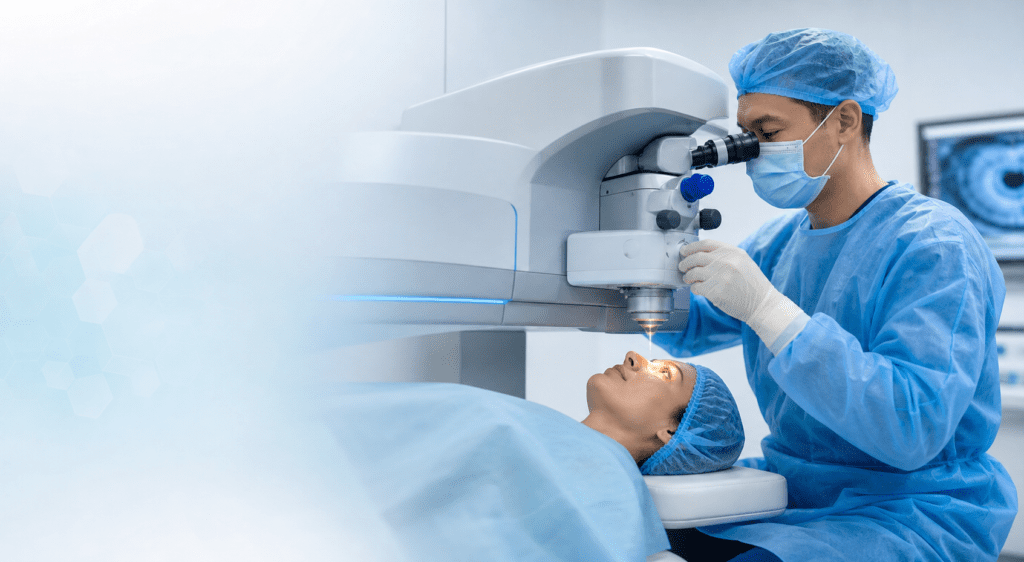
When patients ask me about SMILE technique, some want to know what they will see and feel during the procedure, while others want to know what is actually happening to the tissue in the eye. Both are reasonable questions. In fact, they are usually signs that the patient is trying to mentally rehearse the procedure before consenting. That is why this article offers a transparent walkthrough of what happens during Small Incision Lenticule Extraction (SMILE), what the laser does, what the surgeon does, and what a patient may notice while it is happening.
Table of Contents
What Makes SMILE Structurally Different
At the simplest level, SMILE works by creating a small disc-shaped piece of tissue, called a lenticule, inside the cornea. That lenticule is then removed through a small incision, usually about 2 to 4 mm wide. There is no LASIK-style flap.
That is the architectural difference in simple terms. If you want a broader orientation to what SMILE is and why it exists, SMILE Eye Surgery Basics covers that separately. This article stays focused on what happens in the room.
Before the Laser Starts: Preparation, Docking, and Fixation
Before the laser begins, the patient is positioned under the system, numbing drops are placed on the eye, and an eyelid holder is used to keep blinking from interfering with the procedure. That part can feel cold, metallic, or simply unfamiliar, but it should not be painful.
This is also where patients tend to imagine they have to perform perfectly, and that is usually the wrong instinct. I tell patients that their job is not to “help” the machine by working hard. Their job is to stay relaxed and let the positioning system do its work. Trying too hard to contribute often creates more tension than it solves.
During docking and fixation, the eye is brought into stable alignment with the laser interface. The cleanest way to describe this is as gentle pressure that helps hold the eye in a precise position. Patients may notice pressure, fluid, and a green fixation light. At some point that light may dim or disappear, and that does not mean anything has gone wrong.
What the Laser Actually Does
The femtosecond laser creates the lenticule and the tissue planes around it inside the cornea. It is doing this with high precision. It is not freehand cutting, and it is not the surgeon manually shaping tissue with an instrument.
At the same time, it is important not to oversimplify and say “the laser does the whole procedure.” It does not. The laser creates the anatomy the surgeon will then work with, but it does not complete the entire operation automatically.
From the patient’s perspective, this phase is usually brief. Patients may see a fixation light, some dimming, or temporary visual change. In real time, my language here is usually very simple: you are doing fine, keep looking where I tell you, you may feel some fluid, and temporary visual change is expected.
Temporary Visual Changes During the Laser
One of the hardest parts of this procedure for patients to imagine in advance is not pain. It is vision changing in a way they were not expecting.
During the laser phase, a temporary bubble layer can form inside the corneal tissue. Surgeons may refer to this as an opaque bubble layer, or OBL. Patients do not need to memorize the term, but they should know the concept: during the laser phase, what they see may briefly look different, dimmer, or stranger than they expected, and that does not mean the result is being harmed.
This is best understood as one of the procedure’s black-box moments. It is temporary. It does not mean the surgeon has lost control. It does not mean the laser is off target. It simply means there is something happening inside the cornea that can briefly change what the patient sees during that stage.
The Small Incision, Dissection, and Lenticule Removal
Once the laser phase is finished, the operation moves into the manual part.
This is where the small incision gives the surgeon access to the lenticule that has already been created. The surgeon first has to separate the lenticule cleanly from the surrounding tissue planes and then remove it through the incision.
That distinction matters because this is the most experience-dependent part of SMILE. In practical terms, dissection is the harder step. If the tissue planes are identified and separated well, extraction becomes smoother. If they are not, the rest of the step becomes more difficult. That is one reason surgeon experience matters more in SMILE than many patients assume from the phrase “laser vision correction.”
From the patient side, this phase may feel like touch, manipulation, or movement, but it should not feel sharp or painful. It can also feel psychologically longer than the laser phase, partly because the patient is no longer just staring at a light and waiting for a quick laser step to finish.
The Temporary White-Cloud or Whiteout Feeling During Extraction
Some patients describe a temporary white-cloud or whiteout-like visual change during the extraction phase. I would not present this as something every patient notices, but it is a useful thing to name because it can feel unexpected if it happens.
The important point is that a temporary visual change during this part of the procedure can feel strange without meaning something is wrong. The tissue is being manipulated, the optical situation is changing moment to moment, and what the patient sees during that brief stage is not the same thing as the final result.
How SMILE Differs From LASIK and PRK in the Operating Room
The easiest way to understand the difference is by comparing the sequence of what happens in the room.
In SMILE, the laser creates an internal lenticule, and the surgeon removes it through a small incision. In LASIK, a flap is created and the cornea is then reshaped with excimer ablation. In PRK, the surface layer is removed and the cornea is treated from the surface.
That is the procedural contrast that matters most here. If you want the broader comparison to how outcomes feel once healing settles, SMILE Eye Surgery Results and SMILE Surgery Success Rate cover those questions separately.
Why Surgeon Experience Matters in SMILE
Patients sometimes hear “laser eye surgery” and imagine the machine is doing almost everything. That is not how SMILE works.
The laser creates the lenticule and the planes. The surgeon then has to work within those planes, separate the tissue correctly, and remove it smoothly. That manual phase is where experience matters most.
This is why asking about a surgeon’s SMILE experience is reasonable. It is not a confrontational question. It is a practical question about technique. Case volume matters. SMILE-specific experience matters. Corneal surgical background can matter too, because the dissection part rewards tactile familiarity with corneal tissue.
What “Flapless” Really Means for the Cornea
“Flapless” is one of the most important words in how patients think about SMILE, and it is also one of the easiest to misunderstand.
Yes, flapless is real and meaningful. No, it does not mean nothing touches the eye. It does not mean there is no incision, and it does not mean the surgeon’s role disappears.
What it does mean is that SMILE does not create a large LASIK-style flap across the corneal surface. Architecturally, that is a real difference. It changes how the procedure is built. But it should be explained honestly, not treated like a slogan.
How Newer SMILE Platforms Changed the Workflow
One useful refinement in newer SMILE platforms, including the VisuMax 800, is speed during the laser phase. Faster lenticule creation means the eye has to remain in stable alignment for a shorter window of time. That matters because it can make the workflow smoother and reduce the chance of an interrupted docking sequence or the need to redock. That is a real procedural improvement.
What Patients Should Ask a Surgeon About Technique
If a patient wants to ask smart questions about technique without getting lost in jargon, these are useful ones:
- What will I likely feel during docking?
- What might I see during the laser?
- How much of the procedure is manual?
- What happens if docking is interrupted and you need to restart?
- How much SMILE experience do you have?
Those are not confrontational questions. They are reasonable questions from someone trying to understand the procedure clearly before consenting.
What to Remember About SMILE Eye Surgery Techniques
There is a meaningful difference between walking into a procedure not knowing what to expect and walking in with a clear picture of the sequence.
The moments that most often produce anxiety are not danger signals. The green light dimming, the brief visual strangeness during the laser, the sensation during extraction: these feel unexpected only when they have not been explained beforehand. Once they have a name and a place in the sequence, they stop reading as warnings and become recognized steps.
That is not the same as removing all uncertainty. A consultation will surface questions that no article can anticipate. But arriving at that conversation already having mentally walked through the procedure changes what kind of questions a patient can ask, and how clearly they can hear the answers.
Frequently Asked Questions About SMILE Eye Surgery Techniques
How long does the SMILE procedure take?
The laser phase itself is short, but the full procedure includes preparation, docking, the laser step, and the manual removal phase. From the patient’s perspective, it is best understood as a brief in-room procedure rather than a long operation.
Does SMILE use suction?
During docking, the eye is brought into stable alignment with gentle pressure. This is different from the higher-pressure suction many patients associate with older flap-based procedures. The contact is lighter and is mainly used to keep positioning accurate during the laser step.
What happens if SMILE docking is interrupted or the procedure needs to restart?
The surgeon can redock and continue safely if needed. Newer platforms help by shortening the time window during which the eye has to remain stably aligned, which reduces the chance of interruption.
What does flapless really mean in SMILE eye surgery?
It means SMILE does not create a large LASIK-style flap. It does not mean there is no incision, no manipulation, or no manual surgical step.
What might a patient see during the SMILE laser step?
Patients may see a fixation light, dimming, or temporary visual change. Brief changes in what the patient sees during the laser phase do not mean something is going wrong.
In SMILE, does the laser remove the tissue, or does the surgeon?
The laser creates the lenticule and the tissue planes around it. The surgeon then separates and removes the lenticule manually through the small incision.
How is SMILE different from LASIK in the operating room?
In SMILE, the laser creates an internal lenticule and the surgeon removes it through a small incision. In LASIK, a flap is created and the cornea is then reshaped with excimer ablation.
About the Author