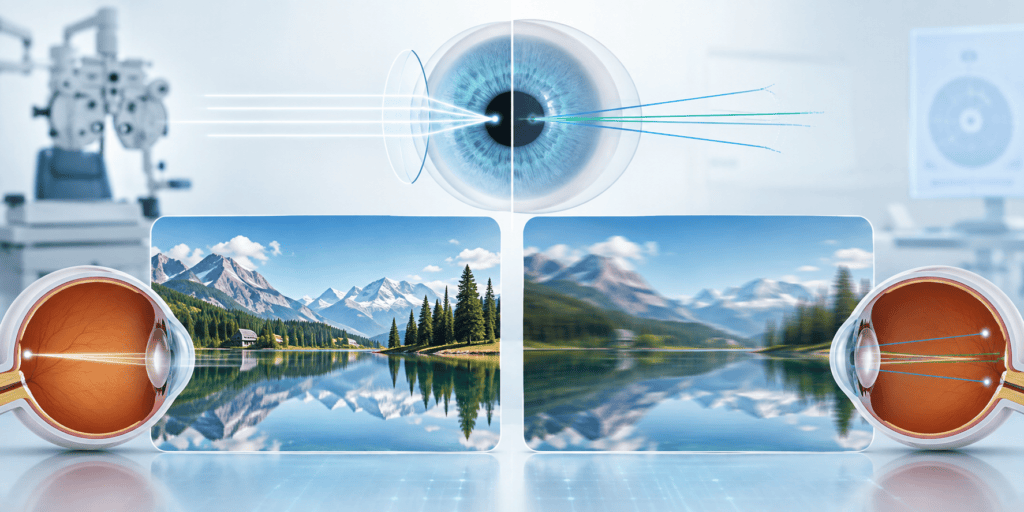
Astigmatic vision can be different in a way that is harder to describe. While normal vision feels crisp, stable, and clean, with astigmatic vision you may still be able to read the letters or recognize the road sign, but the edges can look shadowed, smeared, stretched, or slightly doubled.
That does not mean astigmatism is a disease. For most patients, astigmatism is a refractive error measured in the prescription. It describes how the eye focuses light. Many people see clearly once that focusing difference is properly corrected.
The harder part is that astigmatism symptoms can overlap with dry eye, cataracts, an outdated prescription, contact lens issues, and other eye conditions. This article explains how astigmatic focus differs from normal focus, why blurred or distorted vision can feel “almost clear” but not crisp, and when a comprehensive eye exam can help identify the cause.
Table of Contents
Normal Focus vs. Astigmatic Focus
The simplest difference between normal focus and astigmatic focus is this: normal focus is clean and even; astigmatic focus is uneven.
In normal vision, light comes to a clean focus on the retina, the light-sensitive layer at the back of the eye. The cornea and lens bend light in a balanced way, so the image lands sharply.
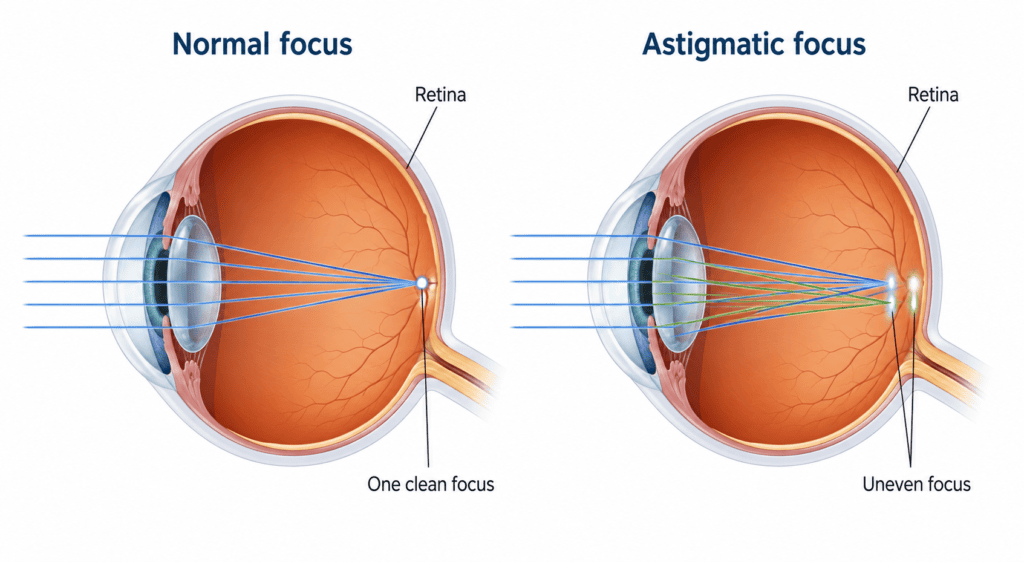
With astigmatism, one curve of the cornea or lens bends light differently than another curve. In many cases of corneal astigmatism, the front surface of the eye is curved more in one direction than another. Instead of landing in one clean focus, the image may overlap or smear. That is why astigmatism may feel like blur plus distortion, not just ordinary soft focus.
An astigmatic eyeball is often compared to a football rather than a basketball. That analogy helps, but it should not be taken literally. The whole eyeball is not shaped like a football. The point is that one focusing curve is steeper or flatter than the other.
Eyeball length also matters for vision. A longer eye tends to focus light in front of the retina, which causes nearsightedness. A shorter eye may focus light behind the retina, which contributes to farsightedness. Astigmatism is different because the focus is not equally sharp in every direction.
This is why astigmatism creates symptoms such as shadowing around letters, smeared points of light, stretched text, or faint double edges. The eye receives an image, but the edges do not line up cleanly.
If you are trying to understand which type of astigmatism you have, including regular astigmatism, irregular astigmatism, with-the-rule astigmatism, or against-the-rule astigmatism, see our guide to astigmatism types.
Why Astigmatism Can Affect Distance, Computer, and Reading Vision
If astigmatism is uncorrected or undercorrected, it can affect more than one distance, including distance vision, computer work, and reading.
This is because the focusing surface of the eye affects light as it enters the eye, whether you are looking across the street, at a computer, or at small print. Some patients notice it most during night driving. Others notice it during screen work or reading because clean edges and high contrast make the distortion easier to see.
The same idea can matter after cataract surgery or another vision-correction procedure. Even when distance, intermediate, and near focus targets have been addressed, residual astigmatism can keep vision from feeling fully crisp.
Why Vision May Be Readable but Still Not Crisp
Some people do not notice astigmatism as a separate symptom because another part of the prescription is doing most of the work. If the nearsightedness or farsightedness is strong, the patient may simply say, “My vision is blurry.”
Astigmatism often becomes more noticeable when the rest of the prescription is small, mostly corrected, or surgically improved. The vision may be better than before, but not clean. A patient may read letters on an eye chart during a visual acuity test, yet still feel that the edges are shadowed, doubled, or stretched. Lights may smear, and a sign may be readable without looking fully sharp.
This is one reason patients sometimes feel frustrated after a new prescription or a successful eye procedure. The vision is improved, but residual astigmatism can still leave an “almost right” quality. That does not mean something has failed. It simply means the remaining focusing difference needs to be measured and addressed.
For more detail on how eyeglasses and contacts handle this, see our guide to astigmatism corrective lenses.
Eye Strain, Headaches, Squinting, and Pressure Behind the Eyes
Uncorrected astigmatism can contribute to eye strain, brow fatigue, or headaches, especially during sustained visual tasks. But these symptoms are not specific to astigmatism.
An outdated prescription, uncorrected nearsightedness or farsightedness, dry eye, and ocular surface disease can cause similar complaints. Patients sometimes describe “pressure behind the eyes,” and in clinic that can often point toward ocular surface irritation rather than astigmatism itself or elevated eye pressure.
Squinting is another clue that vision may not be focusing clearly. Squinting can temporarily sharpen vision because it narrows the path of incoming light, similar to a pinhole. It does not fix astigmatism, and it does not make the prescription go away. Frequent squinting is a reason to have the prescription checked.
Children who consistently squint, sit close to screens, or hold reading material very close should be seen for a pediatric eye exam.
Why Astigmatism Symptoms Overlap With Other Eye Problems
Astigmatism is only one possible reason vision is not crisp. Several vision conditions can create similar complaints. During a comprehensive eye exam, your eye doctor is not trying to match one symptom to one diagnosis. The ophthalmologist or optometrist is checking the prescription, the ocular surface, the lens, the cornea, the retina, and the overall health of the eye.
Dry eye is a common overlap. It can cause fluctuating blur, ghosting, halos, and glare. Burning, grittiness, redness, tearing, or vision that briefly improves after blinking or lubricating drops can point toward a tear-film problem. Dry eye and astigmatism can also exist together, especially in contact lens wearers. For patients whose dryness needs more treatment support, see our guide to punctal plugs for dry eyes.
Cataracts can also overlap with astigmatism symptoms. They may cause glare, halos, cloudy vision, reduced contrast, or vision that no longer clears with the current glasses. Cataracts and age-related lens changes can also change the astigmatism prescription over time. Our guide to cataract symptoms and treatment explains that topic in more detail.
Presbyopia, nearsightedness, farsightedness, and outdated glasses can also blur the picture. Presbyopia usually affects near focus starting around the 40s. Nearsightedness, or myopia, usually affects distance more. Farsightedness, or hyperopia, may create near or intermediate strain. Astigmatism can blur or distort at multiple distances. These patterns give clues, but they do not replace a refraction test and eye exam.
Night Vision and Online Images: Useful Clues, Not Diagnosis
Astigmatism can make headlights look streaked, haloed, or smeared, especially at night. In dim light, the pupil gets larger, so more light enters through the cornea and lens. If that light is not focused evenly, glare and starbursts can become more noticeable.
However, night glare is not automatically astigmatism. Dry eye, cataracts, dirty glasses, a smudged windshield, and other optical issues can create similar symptoms.
A quick online search for “normal vision vs. astigmatism” reveals images that claim to test this, but they should be treated as illustrations, not diagnostic tests. They are often exaggerated or simplified. Matching one of those images does not prove astigmatism, and not matching one does not rule it out.
Corrected vs. Uncorrected Astigmatism
Uncorrected astigmatism can leave blurred vision, shadowing, ghosting, or distortion. With the right correction, many patients see normally or much more comfortably.
Eyeglasses and contact lenses, including toric lenses, do not physically remove the underlying shape of the cornea or lens. They compensate for the way light bends so the image focuses more cleanly. A person can have astigmatism but see clearly while wearing the right correction.
New astigmatism correction can also feel strange at first. If the eye has been living with uncorrected astigmatism for a long time, the first accurate correction may feel sharper but slightly distorted. In some patients, the doctor may introduce the correction gradually rather than giving the full amount immediately.
That adjustment period does not automatically mean the prescription is wrong. But persistent blur, imbalance, headaches, distortion, or discomfort should be rechecked. The issue may be adaptation, but it may also be dry eye, contact lens fit, cataract, frame alignment, or an inaccurate prescription.
When Double Vision May Be More Than Astigmatism
Patients sometimes use “double vision” to describe faint ghosting, shadowing, or double edges around letters. That kind of one-eye ghosting can happen with astigmatism, dry eye, cataract, or prescription error.
However, sudden true double vision is different. If two separate images are present with both eyes open and disappear when either eye is covered, the issue may involve eye alignment, a nerve, or a muscle. That should be evaluated promptly, especially if it comes on suddenly.
Patients should not try to diagnose the type of double vision at home. The practical point is to avoid assuming that sudden double vision is routine astigmatism. Persistent ghosting or doubling deserves an exam, even when it is less urgent.
When to Schedule an Eye Exam
Schedule an eye exam if you notice persistent blur, ghosting, shadowing, night-driving difficulty, eye strain, brow fatigue, pressure behind the eyes, or glasses and contacts that no longer seem to help.
You do not need to wait until symptoms are severe. An exam can usually separate prescription issues from dry eye, cataract, corneal changes, and other causes.
Some symptoms deserve prompt or urgent evaluation rather than a routine appointment:
- sudden vision loss
- a major sudden drop in vision
- sudden true double vision
- eye pain with redness
- nausea or vomiting with halos
- flashes of light
- a sudden shower of floaters
- a curtain or shadow over vision
- eye trauma
- rapidly worsening distortion
- visual changes with neurological symptoms
Most astigmatism symptoms are not emergencies. The point is to separate routine blur or distortion from symptoms that should not be watched at home.
Common Myths About Astigmatism vs. Normal Vision
“Astigmatism is a disease.”
False. Astigmatism is usually a prescription measurement. It describes how the eye focuses light.
“Halos or ghosting always mean astigmatism.”
False. Halos, ghosting, glare, and shadowing can also come from dry eye, cataracts, outdated correction, contact lens issues, or other eye conditions.
“Online images can tell me whether I have astigmatism.”
False. Online images are illustrations. They cannot confirm or rule out astigmatism.
“Screens, squinting, or reading in dim light caused my astigmatism.”
False. These habits do not create regular astigmatism. Screen use can worsen dry eye or fatigue, which may make blur more noticeable.
“Going without correction damages adult eyes.”
False. In adults, leaving astigmatism uncorrected usually does not damage the eye, but it can leave fixable blur, strain, or night-driving difficulty.
“If new glasses feel strange, the prescription must be wrong.”
False. Some patients need time to adapt to astigmatism correction, especially if the change is large. Persistent symptoms should still be rechecked.
“My brain will simply get used to uncorrected astigmatism.”
Not always. Some people tolerate mild astigmatism well, but many continue to have blur, ghosting, eye strain, or night-driving trouble until the focusing difference is corrected.
The Bottom Line on Astigmatism vs. Normal Vision
Normal vision focuses light cleanly. Astigmatic vision leads to uneven focus, which can cause blurry vision and distortion: shadowed letters, smeared edges, halos, glare, or ghosting.
Astigmatism is usually a measurement, not a disease. It is also not the only possible cause of these symptoms. Dry eye, cataracts, outdated glasses, contact lens fit, and other eye conditions can create similar complaints.
If your vision is not as crisp, stable, or comfortable as it should be, an eye exam can show whether astigmatism, dry eye, cataract, an outdated prescription, or another issue is responsible.
To schedule your eye exam, book an appointment with Manhattan Eye.
FAQs on Astigmatism vs. Normal Vision
How is astigmatic vision different from normal vision?
In normal vision, the cornea and lens bend light evenly so it comes to one clean focus on the retina. With astigmatism, one curve of the eye bends light differently than another, so the image may overlap or smear rather than land sharply. The result is often blur plus distortion, shadowed letters, smeared edges, or faint double outlines.
Can astigmatism affect both near and distance vision?
Yes. Because the focusing difference comes from the shape of the cornea or lens, it affects light entering the eye at every distance.
Why does my vision still feel slightly off after new glasses or eye surgery?
When the main part of a prescription is corrected but some astigmatism remains, vision may improve significantly while still feeling shadowed, doubled, or not fully sharp. Residual astigmatism tends to stand out more once the larger prescription issue has been addressed. That does not mean the procedure or prescription failed. It means the remaining focusing difference needs to be measured and corrected.
How do I know whether my symptoms are from astigmatism or dry eye?
Dry eye symptoms often fluctuate and may improve briefly after blinking or using lubricating drops. Burning, grittiness, redness, or tearing also point more toward a tear-film problem. Both conditions can cause blur, ghosting, halos, and glare, which makes them difficult to separate by symptoms alone.
Does leaving astigmatism uncorrected damage your eyes?
In adults, leaving astigmatism uncorrected generally does not damage the eye. However, it can leave fixable blur, distortion, eye strain, headaches, and difficulty driving at night. Many people continue to notice these symptoms until the focusing difference is corrected.
About the Author