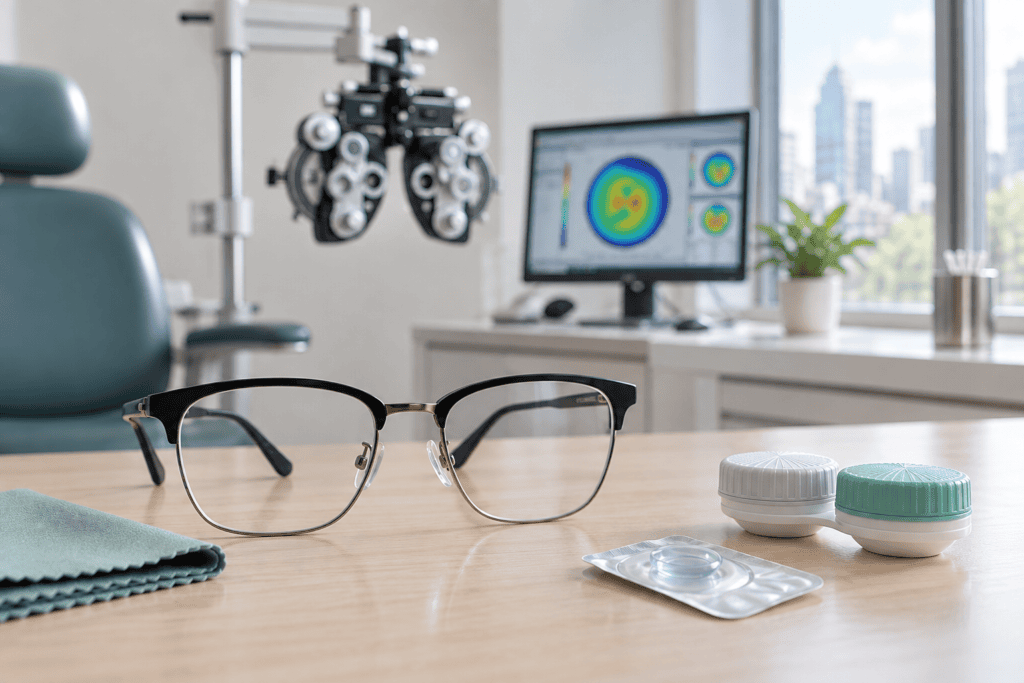
When patients look for the best way to correct astigmatism, they are often trying to solve a broader problem: blurred vision. Astigmatism is one part of the prescription, along with nearsightedness or farsightedness, and it can often be corrected with glasses, contact lenses, or surgery.
There is no single best option for everyone. Some patients may get clear, comfortable vision from glasses, while others may prefer toric contacts for sports or daily convenience. Irregular astigmatism may require a specialty lens, while patients who want to reduce their dependence on glasses may be candidates for laser or lens-based surgery.
The right astigmatism correction depends on the full prescription, whether the astigmatism is regular or irregular, corneal health, dry eye, age, reading-vision needs, lifestyle, and goals. This article compares the main options and explains why an eye doctor may recommend one approach over another.
Table of Contents
What Determines the Right Astigmatism Correction?
The right option for correcting astigmatism is not chosen based on the amount of astigmatism alone. A comprehensive eye exam assesses how the entire eye focuses and whether the measurements are stable enough to guide treatment.
Important factors include:
- whether the astigmatism is regular or irregular
- the full prescription, including nearsightedness or farsightedness (hyperopia)
- the cylinder and axis measurements
- whether the prescription is stable
- corneal shape and thickness
- dry eye and tear-film stability
- how clearly each eye sees with the best correction
- cataracts or changes in the natural lens
- age and presbyopia
- daily needs, maintenance preferences, budget, and comfort with surgery
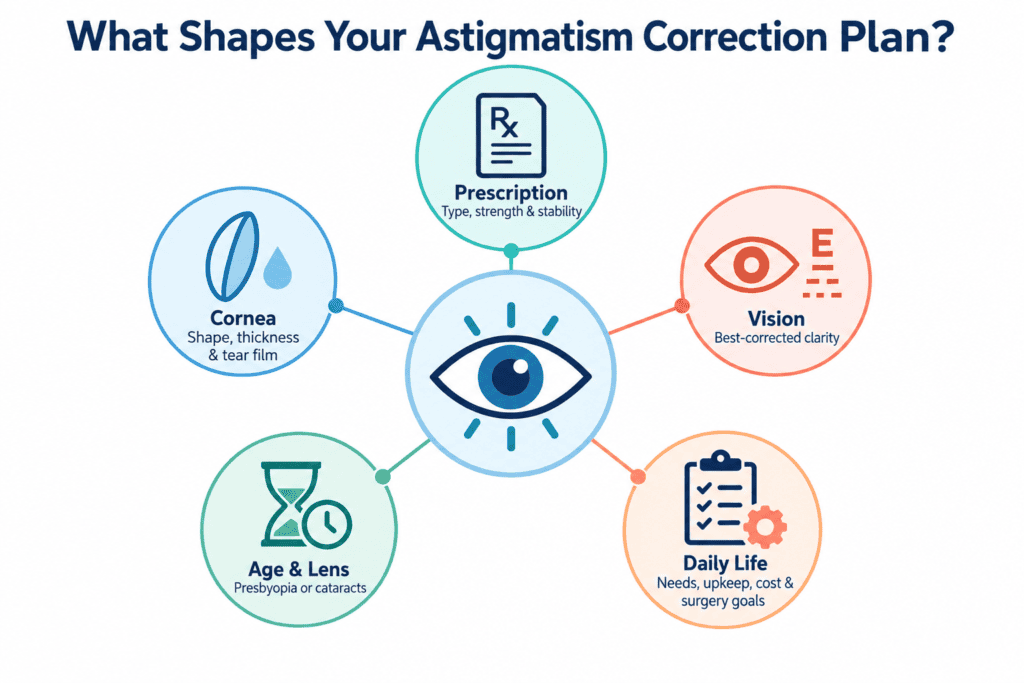
Dry eye deserves particular attention because an unstable tear film can make the cylinder or axis appear to change. If dryness or inflammation is affecting the measurements, the ocular surface may need treatment before a final glasses, contact lens, or surgical plan is chosen.
The distinction between regular and irregular astigmatism also changes the available options. Regular astigmatism is usually more predictable to correct. Irregular astigmatism may require corneal topography, specialty lenses, or a different surgical plan.
Astigmatism Correction Options at a Glance
| Option | Who it may suit | Main advantage | Main limitation or tradeoff |
| Glasses | Patients who want stable, reversible, low-maintenance correction | Reliable correction without touching the eye | Frames may be inconvenient for sports or some daily activities |
| Soft toric contacts | Patients with regular astigmatism who want frame-free vision | Wider field of view and convenience for active lifestyles | Require fitting, care, and a healthy enough ocular surface |
| RGP or scleral lenses | Patients with irregular astigmatism or vision that does not sharpen enough with standard lenses | Can create a smoother optical surface over an irregular cornea | More specialized fitting, handling, and cost |
| LASIK, PRK, or SMILE | Selected patients with stable regular astigmatism and healthy corneas | Can reduce dependence on glasses or contacts | Requires surgical screening, recovery, and acceptance of risk |
| EVO Toric ICL | Selected patients with higher myopia and astigmatism or corneal constraints | Corrects vision without removing corneal tissue | Intraocular surgery with specialized screening and follow-up |
| Toric IOL | Patients having cataract surgery or selected patients considering refractive lens exchange | Can address corneal astigmatism when the natural lens is replaced | Intraocular surgery; lens choice and reading-vision goals require careful planning |
These options are not steps that every patient is expected to move through. Many patients use glasses or contacts successfully for life. Surgery is generally elective unless a condition such as a cataract changes the clinical situation.
Glasses Are a Foundational Astigmatism Correction
Eyeglasses can correct a wide range of astigmatism and are often the most stable, reversible, and low-maintenance choice. They can work well for patients with low or high cylinder, dry eye, contact lens intolerance, or no interest in elective surgery.
Even some irregular astigmatism may improve with glasses, although the correction may be incomplete if the corneal surface is too uneven. The important point is that glasses are not a lesser option. If they provide clear, comfortable vision and fit the patient’s daily life, they may be all that is needed.
Glasses are also important for patients who prefer contacts. Contact lens wearers should have an up-to-date pair of glasses so they are not forced to over-wear their lenses when the eyes feel dry, irritated, or simply need a break.
Frames can be less practical during contact sports, boating, or activities where they fog, slip, or limit peripheral vision. Those are lifestyle reasons to consider contacts, rather than evidence that glasses are medically inadequate.
For a closer look at cylinder, axis, lens adaptation, and the ways prescription lenses correct astigmatism, see our guide to astigmatism corrective lenses.
Toric Contact Lenses for Regular Astigmatism
Soft toric contact lenses can provide frame-free correction for many patients with regular astigmatism. They may be useful for sports, active work, social situations, or anyone who prefers an unobstructed field of view.
The fitting process may take some refinement. The first toric lens tried is not always the final lens. The eye doctor may compare different lenses or adjust the prescription based on clarity, comfort, movement, and how steadily the lens holds its orientation on the eye.
Patients who have never worn their full astigmatism correction may also need time to adjust. In some cases, the correction is introduced gradually rather than all at once.
Dry eye can make toric contacts less comfortable and may cause vision to fluctuate. Appropriate hygiene and wearing habits are important for maintaining ocular-surface health.
Our article on astigmatism corrective lenses explains toric lens rotation, blur after blinking, fitting adjustments, and daily versus reusable options in more detail.
Specialty Contact Lenses for Irregular Astigmatism
When glasses or standard soft contacts do not provide sufficiently clear or stable vision, rigid gas permeable or scleral lenses may offer a more customized solution.
A rigid lens creates a smooth optical surface in front of the cornea. With a scleral lens, a fluid layer fills the space between the lens and the cornea. Together, the lens and fluid can help neutralize an irregular corneal surface and focus light more cleanly.
Specialty lenses may be considered for:
- irregular astigmatism
- keratoconus
- corneal scarring
- vision that remains unstable in soft toric lenses
- selected cases of severe dry eye or ocular surface disease
These are custom medical lenses. Needing one does not mean the eye cannot be helped. It means the cornea may need a more individualized optical surface than glasses or a soft lens can provide.
The tradeoffs include a more specialized fitting, additional visits, a learning curve for insertion and removal, and a higher upfront cost. For more about RGP, hybrid, and scleral lens fitting and handling, see our guide to astigmatism corrective lenses.
LASIK, PRK, and SMILE for Astigmatism
Corneal refractive procedures can treat astigmatism in appropriately selected patients. LASIK eye surgery uses a corneal flap, PRK treats the corneal surface without creating a flap, and SMILE removes a small piece of corneal tissue through a small incision.
Patients do not need to decide which procedure they want before the consultation. The surgeon evaluates the full prescription, corneal shape, corneal thickness, dry eye, measurement stability, and other eye-health findings before making a recommendation.
Higher astigmatism deserves particularly careful screening. A higher cylinder can sometimes occur with an irregular corneal pattern or keratoconus risk. Treatment ranges also differ by procedure and device, so one number should not be treated as a universal cutoff.
The goal of surgery is usually to reduce dependence on glasses or contacts. It does not guarantee that corrective lenses will never be needed again, and it does not prevent future presbyopia or cataracts.
For more detail on how both parts of the prescription are evaluated together, see our guide to LASIK for astigmatism and nearsightedness.
EVO Toric ICL for Higher Prescriptions or Corneal Constraints
EVO Toric ICL is an implantable lens placed inside the eye while the natural lens remains in place. Unlike corneal laser procedures, it does not permanently remove corneal tissue.
It may enter the discussion when a patient has higher myopia along with astigmatism, a thinner cornea, or a combined prescription that would require more corneal tissue removal than the surgeon considers appropriate. It can also be useful when preserving the cornea is an important part of the plan.
Its suitability still depends on the patient’s anatomy, prescription, and goals. EVO Toric ICL is intraocular surgery and requires careful measurements, anatomical screening, and follow-up. The lens is removable, but removing it requires another procedure. It also does not prevent the natural lens from developing presbyopia or cataracts later in life.
Toric IOLs During Cataract Surgery or Refractive Lens Exchange
A toric intraocular lens, or toric IOL, can reduce corneal astigmatism when the natural lens is removed. This may happen during cataract surgery or, in selected patients, during refractive lens exchange.
The two procedures address different circumstances. Cataract surgery removes a natural lens that has become cloudy. Refractive lens exchange removes a clear natural lens electively to change the eye’s focusing power. Although the surgical steps are similar, the reason for surgery and the risk-benefit discussion are different.
Toric IOL planning can surprise patients whose glasses prescription shows little astigmatism. The prescription reflects the combined effect of the cornea and the natural lens. Sometimes those two sources of astigmatism add together. In other eyes, they point in different directions and partly offset each other.
When cataract surgery or refractive lens exchange removes the natural lens, its contribution is removed as well. That can reveal, or “unmask,” corneal astigmatism that was previously less obvious in the glasses prescription. For this reason, the old prescription alone does not determine whether a toric IOL is appropriate. The surgeon also uses direct corneal measurements and lens calculations.
Refractive lens exchange may be considered for selected patients with presbyopia who want a broader distance, intermediate, and near-vision plan. It is still intraocular surgery and should be considered with the same seriousness as other lens procedures.
Astigmatism Correction After 40 Must Include a Reading-Vision Plan
Correcting astigmatism for distance does not restore the natural lens’s ability to focus up close. That ability gradually decreases with presbyopia, an age-related change that commonly becomes noticeable in the 40s.
A patient may therefore have excellent astigmatism correction and still need help with reading. Depending on the eyes and goals, the plan may involve progressive glasses, reading glasses over distance contacts, monovision in a carefully selected patient, or a lens-based option when cataracts or refractive lens exchange are already being considered.
The same principle applies to younger patients considering surgery. Correcting the current prescription does not stop later presbyopia or cataracts. Those changes are part of normal aging rather than evidence that the astigmatism treatment has failed.
What to Expect When Astigmatism Is Newly or Fully Corrected
Patients who have lived with uncorrected or partially corrected astigmatism may find that full correction looks unfamiliar at first. Vision may be sharper, yet depth, orientation, or spatial perception can feel different while the visual system adapts.
With glasses or contacts, an eye doctor may sometimes introduce a large change gradually. Persistent distortion, imbalance, discomfort, or blur should still be rechecked. An adjustment period should not be used to dismiss a prescription problem, dry eye, or another reason the correction is not working well.
Patients considering surgery should also discuss their history of adapting to astigmatism correction. Refractive procedures aim to reduce dependence on glasses or contacts, but a small amount of astigmatism can remain. Recovery and quality of vision matter alongside the visual-acuity number measured in the office.
Glare and halos are also important to discuss before refractive or lens surgery. They may be more noticeable during early healing and can persist in some patients. The likelihood and significance depend on the procedure, the eye, and the patient’s baseline vision and expectations.
Cost, Insurance, Maintenance, and Recovery
The practical burden of each correction can be as important as the optics.
| Option | Cost pattern | Maintenance and follow-up |
| Glasses | Upfront purchase with periodic updates | Low day-to-day maintenance |
| Soft contacts | Recurring lens and supply costs | Regular replacement, hygiene, and fitting checks |
| Specialty lenses | Higher upfront lens and fitting costs | Longer fitting process, specialized care, and more follow-up |
| Surgery | Larger upfront expense | Recovery and postoperative care |
Medical insurance, vision benefits, and elective-procedure coverage are not the same. Routine glasses and contacts are often paid through a vision plan or out of pocket. Refractive procedures such as LASIK, PRK, SMILE, EVO ICL, and refractive lens exchange are commonly elective and paid out of pocket. Specialty lens coverage may depend on medical necessity and the individual plan.
Cataract surgery may qualify for medical insurance coverage, while premium toric or presbyopia-correcting lens upgrades may involve additional out-of-pocket costs. Patients should confirm coverage, fitting fees, follow-up costs, and financing details with the practice and insurer before choosing an option.
Some patients compare the recurring cost of contacts with the upfront or financed cost of surgery. That calculation can be useful for personal budgeting, but cost alone should not determine which correction is safest or most appropriate for the eye.
When More Evaluation Is Needed Before Choosing an Option
Astigmatism is often correctable, but some findings require a closer look before the treatment plan is finalized.
The eye doctor may recommend additional evaluation when there is:
- irregular astigmatism or possible keratoconus
- corneal scarring
- cylinder or axis measurements that change between visits
- untreated dry eye or inflammation
- reduced vision even with the best glasses prescription
- cataracts or other changes in the natural lens
- amblyopia or a history of a large prescription difference between the eyes
- another corneal, retinal, or optic-nerve concern found during the exam
An axis that appears to shift may come from an unstable ocular surface rather than a settled prescription that should be treated surgically. Reduced best-corrected vision may also mean that ordinary astigmatism is not the only factor limiting clarity.
Needing more testing does not mean vision cannot be improved. It helps the doctor understand what is limiting the vision and which correction is most likely to be safe and useful.
Questions to Ask Before Choosing Astigmatism Correction
A few focused questions can make an eye exam or surgical consultation more useful:
- Is my astigmatism regular or irregular?
- Are my cylinder and axis measurements stable?
- Is dry eye or another condition affecting my prescription?
- Which options are realistic for my full prescription and eye health?
- Why do you recommend this option over the alternatives?
- What adaptation, maintenance, recovery, or night-vision changes should I expect?
- How likely am I to need glasses, contacts, or reading glasses afterward?
- What is covered by insurance or vision benefits, and what is elective or out of pocket?
The Bottom Line on Astigmatism Correction Options
There is no single best correction for every patient, and astigmatism by itself does not rule out glasses, contact lenses, or refractive surgery.
Glasses provide stable, low-maintenance correction. Toric contacts offer frame-free vision for many regular prescriptions. Specialty lenses can create a smoother optical surface over an irregular cornea. Refractive and lens-based procedures may reduce dependence on corrective lenses in appropriately screened patients.
The most useful next step is a comprehensive eye exam or refractive surgery consultation. The measurements can show which options fit the prescription, corneal health, age, reading-vision needs, lifestyle, and goals.
FAQs About Astigmatism Correction
What symptoms can astigmatism cause?
Common symptoms of astigmatism include blurred vision, distorted vision, squinting, eye strain, and headaches. These symptoms can occur when light does not focus evenly on the retina. Because dry eye, cataracts, and other problems can cause similar symptoms, an eye exam is needed to identify the cause.
What tests help determine the right astigmatism correction?
An optometrist or ophthalmologist may use an autorefractor and a refraction test to measure the prescription. Keratometry measures corneal curvature, while corneal topography provides a more detailed map of the corneal shape. The tests used depend on whether the patient is considering glasses, contacts, or surgery.
Can laser eye surgery correct astigmatism?
Laser eye surgery can correct regular astigmatism in appropriately selected patients. Laser vision correction includes LASIK surgery (laser-assisted in situ keratomileusis), PRK (photorefractive keratectomy), and SMILE. These treatment options require stable measurements, healthy corneas, and consideration of dry eye and the full prescription.
Is astigmatism a refractive error, and can it be fully corrected?
Astigmatism is a refractive error and can occur with myopia or hyperopia. Many patients achieve clear vision with eyeglasses, contact lenses, or surgery, although the most appropriate vision correction depends on whether the astigmatism is regular, stable, and otherwise compatible with the chosen option.
Can other eye conditions or eye injuries change the correction options?
Yes. Eye injuries, corneal scarring, dry eye, cataracts, keratoconus, and other findings can affect which correction is safe or likely to work well. Additional testing may be needed before the treatment plan is finalized.
About the Author