
Patients considering LASIK often ask whether the eye-drop routine afterward will be long, complicated, or difficult to fit into everyday life. While the usual antibiotic and steroid course lasts about one week after the procedure, artificial tears or prescription dry-eye treatment can continue longer, depending on the eye’s surface and how it is healing.
Eye drops serve different purposes after LASIK: reducing infection risk, controlling inflammation, and supporting comfort and the tear film. Understanding these roles makes the routine easier to follow.
This guide explains what LASIK eye drops do, how to handle them safely, and which symptoms need a call to the surgeon. It provides general information, not a personal medication schedule. Always follow your written instructions. If pain increases or vision worsens, contact your surgeon promptly rather than waiting for the next scheduled visit.
Table of Contents
Which Eye Drops Are Used Before And After LASIK?
LASIK eye drops generally fall into four categories. Not every patient needs every category, and prescription dry-eye treatment is separate from the short postoperative antibiotic and steroid course.
| Drop category | What it does | Typical Choices And Examples (at Manhattan Eye) |
| Antibiotic drops | Used around the procedure to reduce infection risk. | Usually ofloxacin. |
| Steroid drops | Control inflammation after the procedure. | Usually prednisolone. |
| Preservative-free artificial tears | Lubricate the eye and support the tear film. | A preservative-free lubricant, with no single preferred brand. |
| Prescription dry-eye drops | Treat dry-eye disease as part of an individualized surface-care plan. | Examples include cyclosporine (such as Restasis), lifitegrast, and acoltremon (Tryptyr). These are alternatives with different properties, not a routine combination. |
These drops serve different purposes and are not interchangeable. Prescription dry-eye treatment does not replace an antibiotic or steroid prescribed for postoperative care, and artificial tears provide lubrication rather than infection protection or steroid-based inflammation control.
Why Eye Drops May Start Before LASIK Measurements
Eye-drop care can begin before LASIK to address surface problems identified during the eye examination and support reliable measurements. The tear film coats the cornea, the clear front surface of the eye. When that film is unstable or the surface is irregular, light does not interact with it consistently, which can affect measurement quality.
Before final calculations, I focus on getting the ocular surface into good condition. Some patients need preservative-free tears or prescription dry-eye treatment, followed by reassessment, before we proceed. This is preparation for accurate planning. For the broader preparation and treatment process, see our Bladeless LASIK Surgery Guide.
Antibiotic drops may also be prescribed before LASIK to reduce infection risk around the procedure. Their role is separate from preparing the eye’s surface with lubrication or dry-eye treatment.
How Long Do LASIK Eye Drops Need To Be Used?
In my usual LASIK routine, the antibiotic and steroid are used for about one week after treatment. Your written instructions specify when to start, how often to use them, and when to stop.
Artificial tears and prescription dry-eye treatment may continue beyond that week. I sometimes see patients stop the dry-eye regimen they began before LASIK, even though their eye’s surface still needs support afterward. Completing the antibiotic and steroid course does not mean the dry-eye treatment should end too.
Steroids also require directed use and follow-up. They can raise pressure inside the eye in susceptible patients, a risk described in prednisolone acetate labeling. Do not extend, taper, or restart a steroid independently because the eye feels irritated or vision seems hazy. Those symptoms may need examination rather than more medication.
Preservative-Free Artificial Tears After LASIK
Artificial tears help lubricate the surface during recovery. Dryness can feel gritty or irritating, but it can also show up as vision that fluctuates rather than a strong sensation of dryness. Lubrication may therefore matter even when the eyes do not feel particularly dry.
Preservative-free tears are often useful when frequent lubrication is needed, because preservatives in some formulations can irritate sensitive eyes. That does not mean preserved drops inevitably harm LASIK results, or that preservative-free products should be used without regard to the care plan.
Packaging alone does not tell you whether a product contains preservatives. Preservative-free tears come in individual vials and specially designed multidose bottles. Check the label rather than assuming every bottle contains preservatives.
I do not have one preferred artificial-tear brand for all patients. The priorities are an appropriate product, consistent use as advised, and safe handling. New or worsening blur should not simply be attributed to dryness and treated with additional tears without contacting the surgeon.
How To Use And Store LASIK Eye Drops Safely
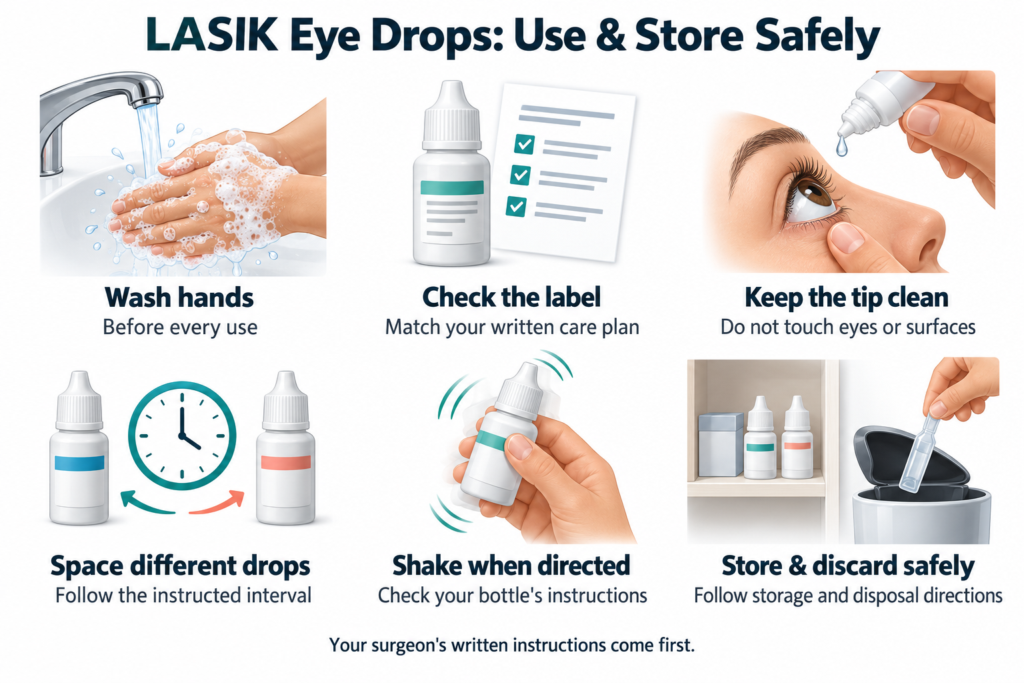
Safe handling helps prevent contamination. Wash your hands before using eye drops, and keep the dropper tip from touching your eye, hands, clothing, or other surfaces.
- Check the label before use. Match the medicine and directions to your written sheet. Cap colors can be a reminder, but should not be the only way you identify a bottle.
- Keep the tip clean. Avoid contact with the eyelids, lashes, or surrounding skin, and recap a multidose bottle after use. If contamination is suspected, ask the practice or pharmacist about replacement rather than trying to disinfect the tip yourself.
- Leave the instructed interval between products. Putting different drops in immediately one after another can wash out the first. Follow the interval on the product label and your care plan; ask the practice to resolve any conflicting instructions. If an ointment is prescribed, drops generally go first and ointment last.
- Shake only when directed. Some eye-drop formulations require shaking before use. Follow the instructions on your bottle.
- Follow storage and disposal instructions. Use the specified storage conditions, observe expiration and after-opening limits, and do not share drops.
A single-use vial should not be reused simply because some liquid remains. Follow the product’s disposal instructions and discard any remaining contents after use when directed. Keeping an opened vial in a bag or refrigerator does not make it safe to reuse against those instructions.
Redness-Relief Drops And Pharmacy Substitutions After LASIK
Patients sometimes turn to redness-relief drops hoping to ease dry-eye symptoms. However, reducing visible redness is not the same as treating the dryness or inflammation behind it. These products should not replace prescribed lubrication or postoperative medicines.
Check with the surgeon before adding a redness-relief product or another eye drop that is not in your plan. Over-the-counter availability does not establish whether it is appropriate for your recovering eye. Ingredients differ, so redness-relief products should not all be assumed to have the same effects or risks.
Pharmacy substitutions also deserve attention. A different package does not necessarily mean the medicine is wrong, but the prescribed ingredient, formulation, and directions still need to match the intended treatment. If the pharmacy supplies something different from your written plan, ask the pharmacist and practice to confirm it before substituting it yourself. The issue is matching the prescription, not assuming generic medicines are inferior.
What To Do If You Miss Drops, Run Out, Or Cannot Identify A Bottle
If you miss a dose, do not double the next dose to compensate. Follow that medicine’s missed-dose instructions, and contact the practice if you are unsure how to continue. Several missed medicated doses or an interrupted course warrant guidance rather than guessing at a restart schedule.
If you are running out, contact the practice about the prescription instead of replacing it with artificial tears or a different product. Refill questions and symptoms need different responses: worsening pain or vision should not wait while a routine prescription issue is being resolved.
If you cannot identify a bottle, compare its label with the handout. If you are still unsure, contact your surgeon’s team before using it. For urgent concerns, follow the postoperative contact instructions provided.
Which Symptoms After LASIK Need A Call To The Surgeon?
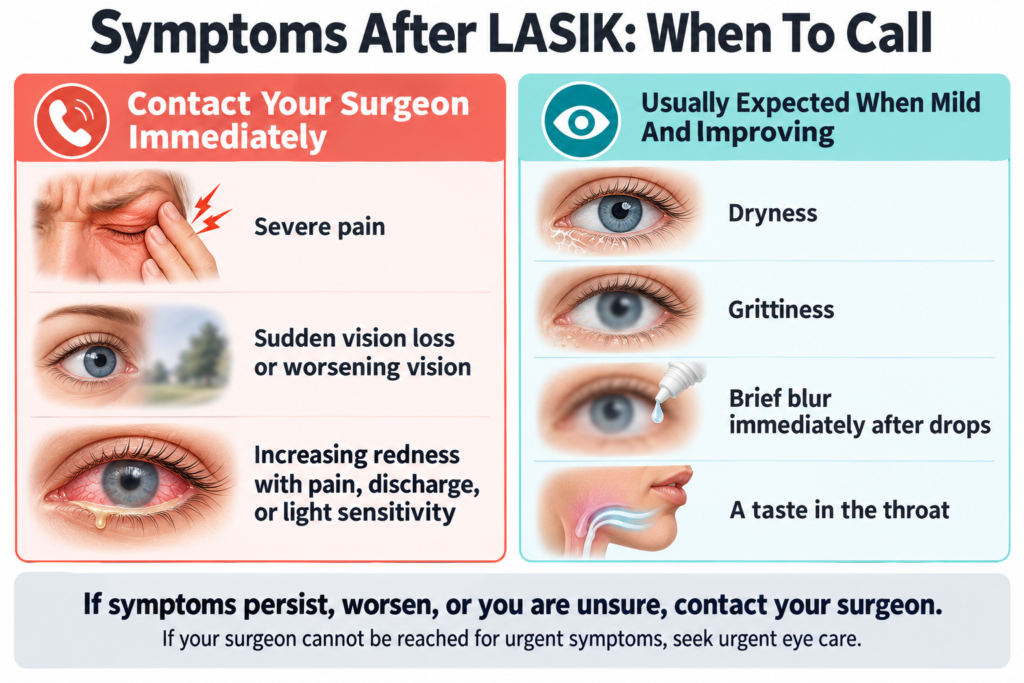
Dryness, grittiness, brief blur after a drop, or a taste in the throat can occur. A short-lived sensation that resolves is different from significant pain, a sudden drop in vision, or symptoms that are getting worse.
A small red patch on the white of the eye can occur after LASIK and fade over time, as described in MedlinePlus’s LASIK patient information. Increasing redness, especially with pain, discharge, light sensitivity, or a change in vision, needs a prompt call.
Hazy vision and light sensitivity can have more than one cause. An examination may be needed to distinguish a surface problem from an issue requiring different treatment. Do not change steroid drops or try to diagnose a complication at home.
Contact the surgeon immediately for severe pain, sudden vision loss, or worsening vision or other symptoms. Do not wait for a scheduled follow-up. If the surgeon cannot be reached, seek urgent ophthalmic care rather than waiting for a routine message response.
LASIK Eye Drops Support Preparation And Recovery
Eye drops are part of LASIK care. Before treatment, they help prepare a stable eye surface for accurate measurements. Afterward, they help reduce infection risk, control inflammation, and support comfort as the eye heals. Their role extends beyond the procedure itself, even when the postoperative medication course is short.
For patients, the priorities are straightforward: know what each drop is for, follow its prescribed schedule, and handle it cleanly. These habits support healing and eye health. Check with your surgeon’s team before changing products or stopping treatment, and seek prompt advice if pain or vision worsens.
Frequently Asked Questions About LASIK Eye Drops
Can artificial tears replace my antibiotic or steroid drops?
No. After LASIK eye surgery, artificial tears work as lubricating eye drops, antibiotics help prevent infection, and steroids act as anti-inflammatory drops. Each has a different job, so none can substitute for another. Use all three according to your written plan.
Should treatment for dry eye after LASIK stop when the antibiotic and steroid course ends?
Not automatically. Artificial tears and prescription eye drops for dry eye often continue longer during LASIK recovery, and follow-up appointments help your surgeon decide when that care can stop. Confirm the stop date for each medicine rather than ending all drops together.
Do preservative-free eye drops only come in individual vials?
No, preservative-free artificial tears also come in specially designed multidose bottles. Check the product label for preservative status, handling, and after-opening instructions.
Can I reuse an opened single-use eye-drop vial?
Follow the specific product’s disposal instructions. If the instructions are to discard after use, discard the remaining liquid. A bag or refrigerator does not make reuse acceptable against the label’s directions.
What should I do if I miss a LASIK eye-drop dose?
Do not double dose to make up for it. Follow the medicine’s missed-dose instructions or contact your eye surgeon’s team if the next step is unclear or several medicated doses have been missed.
Can I use redness-relief drops after LASIK?
Check with the surgeon before adding them. They do not replace lubrication or prescribed postoperative treatment. Worsening redness, particularly with pain, light sensitivity, discharge, or vision changes, needs prompt assessment rather than cosmetic treatment.
Can LASIK eye drops cause side effects such as blurry vision?
Brief blurry vision right after a drop, or a taste in the throat, can occur and usually resolves quickly. Treat these as expected side effects only while they stay mild and improving. Contact your surgeon if blur persists, worsens, or comes with pain or sudden vision loss.
Can I rub my eyes after using LASIK drops?
No. Do not rub your eyes after any laser eye surgery, including LASIK. Mild grittiness can occur during recovery and does not necessarily mean something is wrong. Instead of rubbing, use the recommended lubricating drops to help ease discomfort. If the irritation persists or worsens, contact your surgeon’s team for guidance.
About the Author