Modern LASIK is different from the LASIK many patients remember from older stories. Today, the procedure is supported by better imaging, laser flap creation, customized treatment planning, eye tracking, and more careful screening.
These tools matter, but LASIK is not defined by technology alone. It is also defined by the decision-making around the procedure: who should have LASIK, who may need treatment first, and who may be better served by another vision correction option.
This guide explains what has changed in modern LASIK, which older concerns are less relevant today, which risks still need to be reviewed carefully, and how surgeons decide whether LASIK or another refractive option is the better fit.
Table of Contents
Is LASIK Different Today Than It Used To Be?
Yes, LASIK has changed in meaningful ways.
Older LASIK stories often centered on mechanical blade flap creation, less detailed corneal screening, less customized treatment planning, and more limited ways to identify patients who should not have corneal laser surgery. Those older experiences still shape how many patients think about LASIK today.
Modern LASIK is different because several parts of care have changed:
- corneal imaging is more detailed
- dry-eye screening is taken more seriously
- flap creation is performed with a femtosecond laser rather than an older mechanical device
- excimer treatment planning can be more customized
- eye-tracking and alignment systems help with treatment positioning
- surgeons have more refractive options to choose from when LASIK is not the best fit
But “different” does not mean without risk. LASIK still changes corneal tissue. LASIK still creates a flap. Dry eye, glare, halos, healing variability, enhancement possibility, and rare complications still need to be reviewed before treatment.
A modern recommendation should account for the patient’s cornea, tear film, prescription, age, visual goals, and risk tolerance.
LASIK Is Sometimes A Catch-All Term
Many patients use the word LASIK the way people use a brand name for an entire category. They often use the term “LASIK” when they really mean laser eye surgery, laser vision correction, vision correction surgery, or refractive surgery in general.
However, LASIK, or laser-assisted in situ keratomileusis, is only one refractive surgery option. SMILE, PRK or photorefractive keratectomy, EVO ICL, and Refractive Lens Exchange (RLE) may be better fits for certain eyes, prescriptions, or age-related goals.
A modern consultation should not begin and end with one question: “Can we do LASIK?” It should ask a better question: “Which option fits this eye best?”
Modern LASIK Is Not Just “Bladeless”
“Bladeless LASIK” usually means that the corneal flap is created with a femtosecond laser rather than an older mechanical microkeratome. In modern LASIK, laser-created flap creation is usually the baseline.
Laser-created flaps can reduce some flap-interface risks seen with older blade-based methods, such as epithelial ingrowth. However, “bladeless” is not the same as “flapless.”
LASIK still involves creating a flap in the cornea. That flap is part of why LASIK recovery time can be fast, but it also means LASIK has flap-specific considerations. The cornea is not exactly the same structurally after a flap is created, and the flap creation process can affect corneal nerves.
Patients should avoid rubbing the eye, and people who play contact sports or have a higher risk of eye trauma may need a different recommendation. If a patient wants to avoid a flap entirely, PRK, SMILE, or EVO ICL might be a better fit.
That is why “bladeless” by itself is an incomplete way to judge whether care is modern. A more useful question is whether the surgeon is evaluating whether a LASIK flap makes sense for your eye at all.
For a detailed explanation of what the LASIK procedure feels like and how flap creation works on surgery day, see our Bladeless LASIK Surgery Guide.
Modern Refractive Care Starts With Screening
The most important part of modern LASIK often happens before the laser is used.
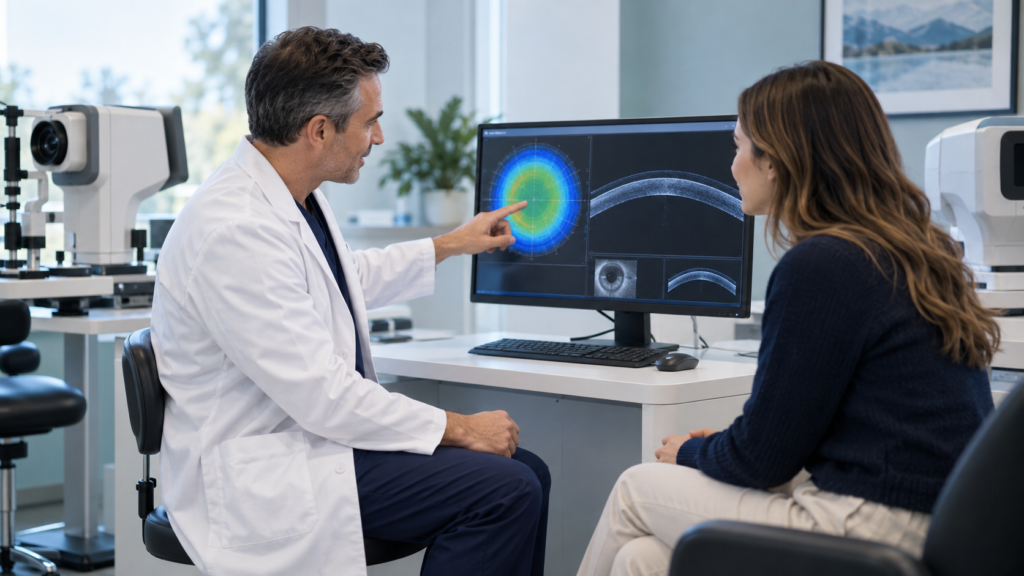
Screening is where a surgeon carefully evaluates whether the eye is appropriate for LASIK. That decision is based on the cornea, tear film, prescription stability, age, medical history, medications, and visual goals.
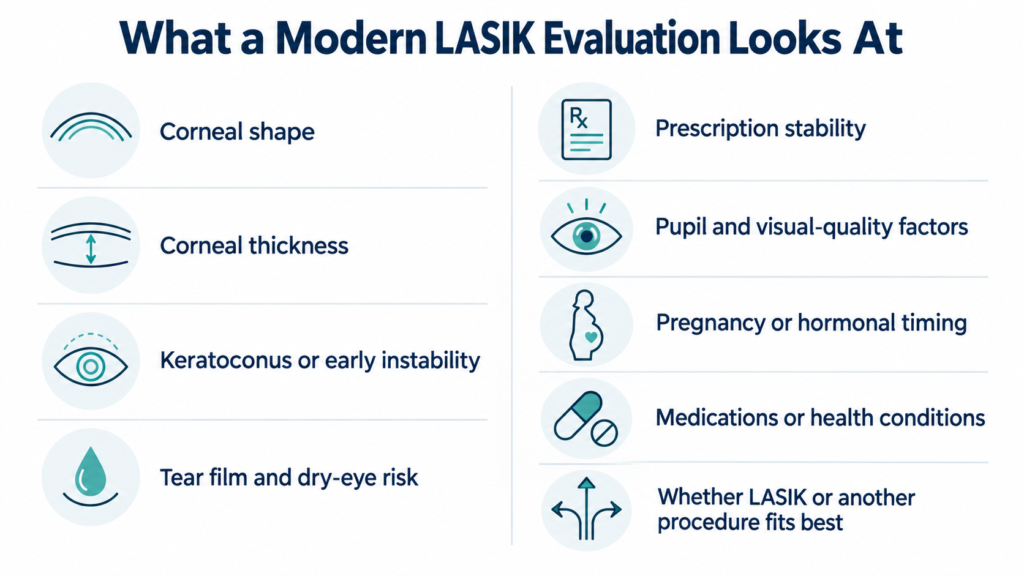
A modern evaluation may look at:
- corneal shape
- corneal thickness
- signs of keratoconus or early corneal instability
- tear-film quality and dry-eye risk
- prescription stability
- pupil and visual-quality factors
- pregnancy or hormonal timing
- medications or systemic conditions that may affect healing
- whether the patient’s goals fit LASIK or another procedure better
LASIK candidacy does not depend on a single number. It is more nuanced than that. Corneal thickness matters, but it is not the only variable. Topography matters, but it has to be interpreted in context. Dry eye matters because it can affect measurements, healing, comfort, and whether LASIK is the right recommendation at all.
This is why being told “not LASIK” can sometimes be a good sign. It may mean the surgeon is not forcing one procedure onto every patient.
Dry Eye Can Change The Recommendation
Dry eye is one of the most important reasons modern LASIK care has to be individualized.
LASIK can worsen dryness because the procedure affects the cornea and can disrupt tear-film stability during healing. For many patients, dryness is most noticeable in the first few months. For others, it can last longer, and dry eye may be the reason LASIK is not the best recommendation.
If the ocular surface is not healthy, measurements may be less reliable. A patient can have a technically well-performed procedure but still be unhappy if the preoperative measurements were affected by an unstable surface. That is why dry eye, meibomian gland dysfunction, and tear-film instability may need to be addressed before final measurements are trusted. Significant contact-lens-related inflammation or keratitis can also move the recommendation toward SMILE or EVO ICL instead of LASIK.
The key point is not that one procedure is always better. The point is that the surface of the eye helps determine which procedure is safest and most predictable for that patient. SMILE may be preferred in some dry-eye-risk patients because it avoids a LASIK flap and can disturb fewer corneal nerves. EVO ICL may be considered because it does not reshape the cornea.
Customized Planning Can Improve Visual Quality
Modern LASIK planning can be more customized than older treatment approaches.
Older planning focused heavily on correcting refractive errors such as nearsightedness, farsightedness (hyperopia), and astigmatism. Modern custom LASIK planning can also consider more subtle optical features of the eye including wavefront-guided, wavefront-optimized, or topography-guided treatments.
Patients do not need to understand the technical details behind those terms. The practical idea is this: customized planning can help the excimer laser treatment better match the optical shape of the eye, not just the prescription written in a glasses lens.
This matters for glare, halos, astigmatism alignment, night-vision concerns, and the difference between seeing 20/20 vision on a chart and feeling that vision is crisp in real life.
Still, custom planning is not a guarantee. It does not promise perfect vision, permanent glasses independence, freedom from glare or halos, or a result that every patient experiences the same way. It is a tool. The tool still depends on accurate measurements, a healthy ocular surface, appropriate candidacy, and good surgical judgment.
LASIK may also remain a strong option in specific situations. For example, some alternatives only correct astigmatism above a certain amount, so LASIK can be the better choice for small amounts. The exact threshold should be confirmed during a consultation.
How Modern LASIK Handles Blinking, Movement, and Eye Tracking
Many patients worry that they might move, blink, look away, or somehow ruin the treatment.
Modern systems are designed to account for normal blinking and small eye movements. The eyelids are controlled during the procedure, the patient is guided where to look, and tracking or alignment systems help keep the treatment centered.
The patient does not need to perform under the laser. A useful way to think about it is: show up, stay as relaxed as possible, and let the surgical team and technology do their jobs. You only need to be awake enough to look where the team asks.
Some patients also worry about suction or their vision going dark during flap creation. The exact experience depends on the platform used. At Manhattan Eye, flap creation is performed with the Zeiss VisuMax femtosecond platform, which is designed for a suctionless, just-touch experience.
Which Older LASIK Fears Are Smaller Now?
Some older LASIK fears are smaller today because screening, planning, and procedure selection have improved.
A few examples:
- Fear of a mechanical blade: modern LASIK uses femtosecond laser flap creation rather than older blade-based flap creation.
- Fear of the laser missing because the eye moves: tracking and alignment tools help manage small movements.
- Fear of a thin-cornea complication: modern imaging and screening help identify patients who should not have LASIK.
- Fear of night-vision symptoms: customized planning and better optical-zone decisions may reduce some risks, though they do not eliminate them.
- Fear of dry eye: careful practices identify and treat ocular surface problems before surgery and may recommend SMILE or ICL instead when appropriate.
- Fear of being pushed through too quickly: patients should look for a consultation where the surgeon has room to pause, treat first, recommend another procedure, or say no.
These improvements can make certain older fears less relevant, but biology, healing, tear film, corneal shape, and patient expectations still matter.
What Risks Should Patients Review Before Modern LASIK?
Modern LASIK still requires clear informed consent. Patients should talk with their surgeon about:
- dry eye
- glare, halos, and night-driving symptoms
- flap-related precautions
- residual prescription or enhancement possibility
- healing variability
- corneal stability
- rare but serious complications
- whether another procedure would be safer or more predictable
Some patients already have glare or halos before surgery. Noticing that baseline can make the risk review more concrete. If a patient has night-driving symptoms before LASIK, those symptoms should be documented before treatment.
Dry eye also needs realistic screening. Most patients have some dryness after LASIK, especially during the early healing period. The ocular surface should be evaluated and managed before and after treatment.
Serious complications are rare, but they still belong in the consent process. Ectasia, for example, is one of the complications modern screening is designed to prevent by identifying patients whose corneas should not be treated with LASIK.
FDA-approved LASIK lasers are reviewed for specific treatment ranges and uses, but approval does not decide whether LASIK is right for a particular patient. That still depends on the exam, candidacy screening, and surgeon judgment. Modern care can reduce avoidable risk, but it cannot remove the biological risk from a surgical procedure.
Why SMILE, EVO ICL, or PRK May Be Recommended Instead of LASIK
Modern refractive care is not about forcing every patient into LASIK. The better recommendation depends on what the exam shows and what the patient needs.
| Patient factor | Option that may be considered | Why it may fit better |
| Meaningful dry eye | SMILE or EVO ICL | These options can lower LASIK-related dry-eye risk in selected patients. |
| Thin cornea or high prescription | EVO ICL | A lens-based option may preserve corneal tissue and may be preferable when high prescriptions raise night-vision concerns. |
| Strong desire to avoid a LASIK flap | SMILE, PRK, or EVO ICL | These procedures do not create a LASIK flap. |
| Unstable prescription | Waiting | The safest recommendation may be to delay treatment until the prescription is stable. |
| Small amounts of astigmatism | LASIK | LASIK planning may sometimes address small astigmatism more directly than alternatives that require a higher threshold before astigmatism correction is built into the plan. |
Age and near-vision goals can also change the recommendation. A patient entering presbyopia may need a different plan than a younger patient with straightforward myopia. In some cases, lens-based surgery may be part of the longer-term plan.
Psychology matters too. Some patients are more comfortable with a removable EVO ICL because they are anxious about changing the cornea. A careful surgeon does not ignore those concerns. The goal is to choose a procedure that is both technically appropriate and comfortable for the patient to accept.
How To Judge A Modern LASIK Consultation
A modern LASIK consultation should feel measured, not rushed. Refractive ophthalmologists should be able to explain why a recommendation fits the eye in front of them.
Useful signs include:
- the surgeon explains why LASIK fits your eye, not just that you qualify
- dry eye and tear-film quality are evaluated seriously
- corneal shape and thickness are discussed in patient-friendly terms
- alternative procedures are considered when appropriate
- the practice can explain why LASIK, SMILE, PRK, EVO ICL, treatment first, or waiting makes sense
- technology is described clearly without promises
- the surgeon is willing to say no
At Manhattan Eye, the value of a modern evaluation is that LASIK, SMILE, PRK, EVO ICL, and lens-based procedures can all be considered. Because the recommendation is not limited to one procedure, the plan can follow the patient’s eye rather than a preset menu.
The strongest sign of a modern refractive practice is not that every patient is told yes. It is that the recommendation changes when the eye, surface, prescription, or goals call for a different plan.
The Bottom Line On Modern LASIK
Modern LASIK has changed in meaningful ways. Femtosecond flap creation, customized planning, eye tracking, better imaging, and better ocular-surface care can all improve how patients are evaluated and treated.
But the biggest change is the decision process.
A modern LASIK consultation should ask whether LASIK is truly the right answer for that eye. Sometimes it is. Sometimes SMILE, PRK, EVO ICL, refractive lens exchange, dry-eye treatment first, waiting, or no surgery is the better answer.
That is what patients should look for: not the loudest promise, but the clearest reasoning.
Frequently Asked Questions
Is LASIK different today than it was 20 years ago?
Yes. Modern LASIK uses more detailed screening, laser-created flaps, customized planning, and tracking/alignment tools. But it is still a medical procedure and still requires individual candidacy evaluation.
Is modern LASIK the same as bladeless LASIK?
No. Bladeless LASIK usually refers to laser flap creation instead of an older mechanical blade. Modern LASIK is broader. It includes screening, planning, ocular-surface evaluation, eye tracking, and procedure selection.
Does modern LASIK still create a flap?
Yes. LASIK still creates a corneal flap. If a patient wants to avoid a flap, SMILE, PRK, or EVO ICL may be considered instead.
Can modern LASIK still cause dry eye?
Yes. Dry eye can still occur after LASIK. Modern care reduces avoidable risk by screening for dry eye, treating the ocular surface, and recommending another procedure when LASIK is not the best fit.
Can modern LASIK still cause halos or glare?
Yes. Modern planning may reduce some night-vision risk, but halos, glare, starbursts, and fluctuating vision can still occur, especially during healing.
What if I move during LASIK?
Modern LASIK systems use patient guidance, stabilization, and tracking or alignment features. Patients are guided through the process and do not need to feel that one tiny movement will ruin the procedure.
Does FDA approval mean LASIK is safe for me?
Not by itself. FDA approval applies to specific devices and indications. Your own candidacy depends on your measurements, corneal health, tear film, prescription stability, medical history, and surgical judgment.
Why would a surgeon recommend something other than LASIK?
A surgeon may recommend another option because of dry eye, corneal shape, corneal thickness, high prescription, age-related goals, flap concerns, or personal risk tolerance.
Is LASIK different today than it was 20 years ago?
Yes. Modern LASIK uses more detailed screening, laser-created flaps, customized planning, and tracking/alignment tools. But it is still a medical procedure and still requires individual candidacy evaluation.
Is modern LASIK the same as bladeless LASIK?
No. Bladeless LASIK usually refers to laser flap creation instead of an older mechanical blade. Modern LASIK is broader. It includes screening, planning, ocular-surface evaluation, eye tracking, and procedure selection.
Does modern LASIK still create a flap?
Yes. LASIK still creates a corneal flap. If a patient wants to avoid a flap, SMILE, PRK, or EVO ICL may be considered instead.
Can modern LASIK still cause dry eye?
Yes. Dry eye can still occur after LASIK. Modern care reduces avoidable risk by screening for dry eye, treating the ocular surface, and recommending another procedure when LASIK is not the best fit.
Can modern LASIK still cause halos or glare?
Yes. Modern planning may reduce some night-vision risk, but halos, glare, starbursts, and fluctuating vision can still occur, especially during healing.
What if I move during LASIK?
Modern LASIK systems use patient guidance, stabilization, and tracking or alignment features. Patients are guided through the process and do not need to feel that one tiny movement will ruin the procedure.
Does FDA approval mean LASIK is safe for me?
Not by itself. FDA approval applies to specific devices and indications. Your own candidacy depends on your measurements, corneal health, tear film, prescription stability, medical history, and surgical judgment.
Why would a surgeon recommend something other than LASIK?
A surgeon may recommend another option because of dry eye, corneal shape, corneal thickness, high prescription, age-related goals, flap concerns, or personal risk tolerance.
About the Author