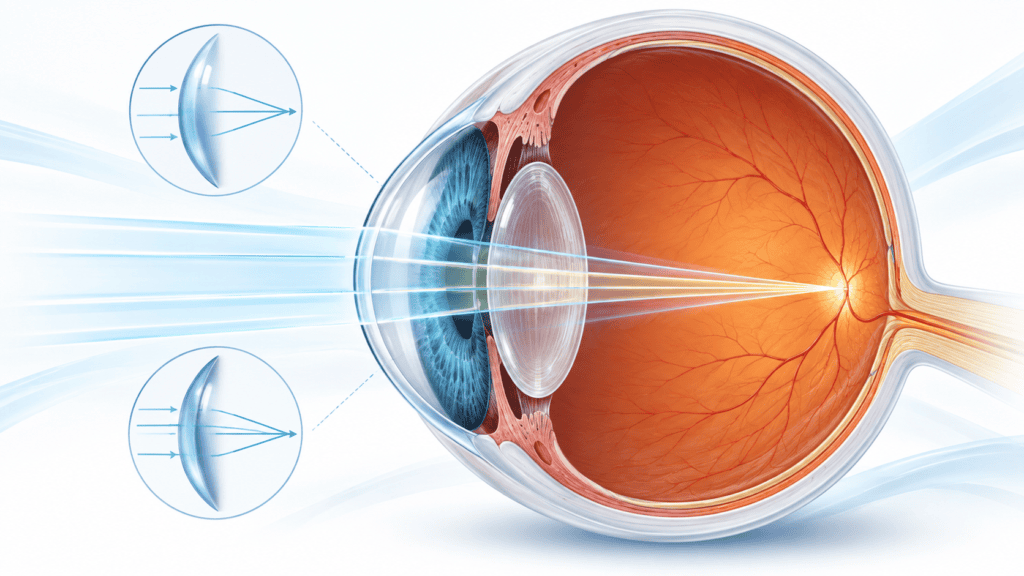
When patients hear the word astigmatism, they often worry that the eye is deformed, damaged, or too complicated for normal correction. The term can sound more concerning than nearsightedness or farsightedness. In most cases, that is not what astigmatism means.
Astigmatism usually describes a common focusing difference caused by the shape of the cornea, the natural lens inside the eye, or both. The eye is not usually diseased. Although astigmatism is often explained with a football analogy, that does not mean the whole eyeball is literally shaped like a football. More often, one focusing surface is curved a little differently in one direction than another, and that difference can be measured during an eye exam.
This article explains what “eye shape” means in astigmatism, why the football analogy is useful but limited, how the cornea and lens can both contribute, and when a shape change deserves a closer look.
Table of Contents
The Short Answer on Astigmatism Eye Shape
Astigmatism is usually a refractive measurement, not a disease.
The word “shape” can make it sound as if the whole eye is abnormal. For most patients, the issue is more specific: the front focusing surface of the eye, the internal lens, or both may bend light unevenly. That uneven focusing can make vision blurred, shadowed, stretched, or smeared.
Astigmatism is also common. A global systematic review and meta-analysis estimated astigmatism in about 40% of adults and about 15% of children, though estimates vary by definition and region. Some people have a small amount that causes little or no noticeable blur. Others need glasses, contact lenses, or another correction to make vision clear. In most cases, astigmatism is usually measurable and correctable.
What “Eye Shape” Really Means
When eye doctors explain astigmatism and eye shape, they are usually talking about the eye’s focusing surfaces.
The cornea is the clear front surface of the eye. It does a large part of the eye’s focusing work. The natural lens, which sits inside the eye, also helps focus light. Astigmatism can come from the cornea, the lens, or both together.
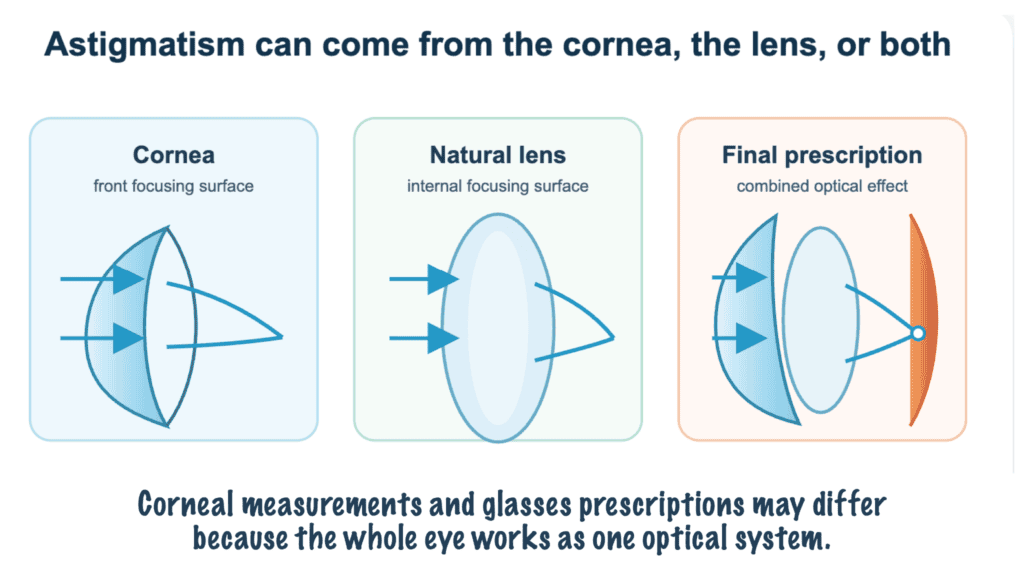
In a perfectly even optical surface, light bends in a balanced way. With astigmatism, one curve may be steeper while the curve across it is flatter. That does not mean the entire eyeball is stretched or misshapen. It means one focusing curve bends light differently than another.
As a result, light may not focus as cleanly. The focus can feel stretched or smeared, which is why astigmatism can contribute to blur, shadowing, or distortion.
The Football Analogy for Astigmatism: Helpful, but Limited
Astigmatism is often explained with a basketball-versus-football analogy.
A basketball is evenly round. A football has one curve that is different from the curve across it. That comparison can help explain regular astigmatism: one direction of the cornea or lens is steeper, while another direction is flatter.
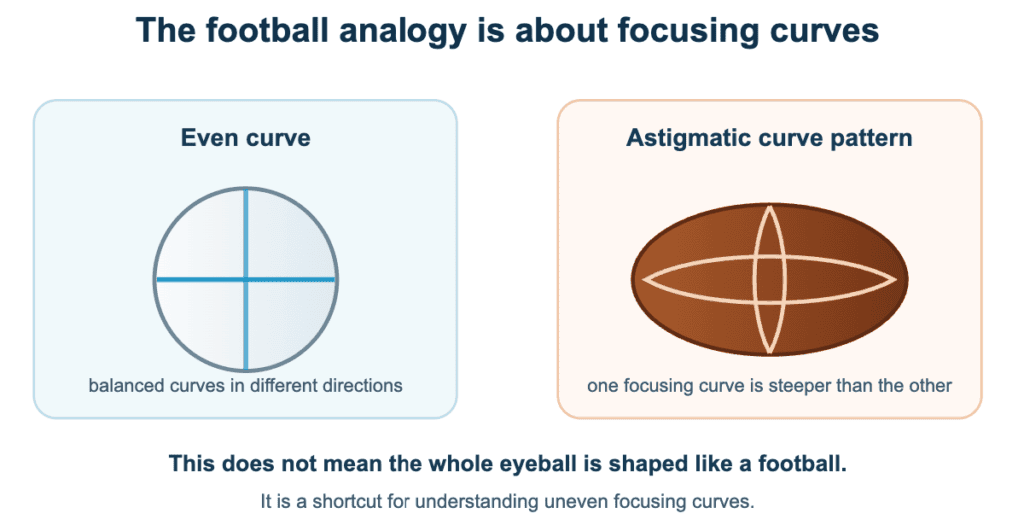
However, the analogy should not be taken literally. The whole eyeball is not shaped like a football. The comparison is only a shortcut for understanding uneven focusing curves.
It also does not explain irregular astigmatism well. Regular astigmatism has a more predictable pattern. Irregular astigmatism is less smooth or less predictable, so the eye doctor may need more detailed corneal mapping to understand what is happening.
The football can also be oriented in different directions. In some people, the steeper curve is closer to vertical. In others, it may shift toward a diagonal or horizontal orientation over time. Those details matter more to the prescription and measurement than to the basic reassurance: the analogy is about focusing curves, not a visibly football-shaped eye.
How the Cornea and Lens Work Together
Astigmatism does not always come from one structure.
The cornea may contribute some of the astigmatism. The natural lens inside the eye may contribute some as well. Sometimes those contributions point in the same direction and add together. Sometimes they point in different directions and partly balance each other out.
This is why corneal measurements do not always match the final glasses prescription exactly. The eye works as a full optical system, not as one isolated surface.
Practically, the astigmatism that matters most day to day is usually the combined number in the prescription. That number reflects how the cornea and lens are working together to focus light.
What Causes an Astigmatic Eye Shape?
For most patients, astigmatism comes from genetics and natural eye development. It may be present from childhood, become more noticeable as the eye grows, or change gradually over time.
Age can also play a role. The shape and focusing behavior of the eye can shift slowly with time. The natural lens can change with age, and cataract-related lens changes can sometimes affect the astigmatism measured in the prescription.
Less common causes include corneal scars, prior infection, eye trauma, prior surgery, or surface growths such as pterygium that pull on the cornea. Irregular astigmatism may also raise concern for keratoconus or corneal ectasia, especially when the corneal shape is changing or vision does not correct well.
Patients sometimes ask whether habits such as eye rubbing can cause astigmatism. While eye rubbing is generally not the main cause of ordinary astigmatism, in patients with keratoconus or irregular corneal patterns, rubbing may contribute to worsening corneal shape over time.
Dry eye is another important nuance. Dry eye does not usually mean the cornea has permanently changed shape, but an unstable tear film can make vision fluctuate and can affect the way astigmatism is measured. That is one reason dry eye may need to be treated before the final prescription or surgical measurements are used for planning.
Can Astigmatism Change Over Time?
Astigmatism can change, but that does not mean it always gets worse.
Some changes happen slowly with age. The direction of astigmatism can shift over time, and lens changes can contribute as people get older. A prescription may therefore look different at 60 than it did at 25.
Slow change is often part of normal eye development and aging. Faster change, one eye changing much more than the other, or vision that no longer clears well with updated correction deserves more careful evaluation.
What Does Not Cause Astigmatism?
Screens do not cause astigmatism. Reading in dim light does not cause astigmatism. Wearing glasses, not wearing glasses, or wearing an old prescription does not reshape the eye into astigmatism.
This kind of shape difference can be thought of a little like shoe size. It is often a characteristic of how the eye developed, not something the patient did wrong.
That does not mean screens and reading habits are irrelevant to comfort. Screen use can reduce blinking, worsen dryness, and make blur feel more noticeable. Reading for long periods can also bring out eye strain when the prescription or ocular surface is not ideal. Those symptoms can be real without being the cause of the astigmatism itself.
Regular vs. Irregular Astigmatism Shape and When to Look Closer
Regular astigmatism usually means the focusing difference follows a smooth, predictable pattern. It is often straightforward to measure and can often be corrected with glasses, contact lenses, or other options.
Irregular astigmatism is different. The corneal surface may be less smooth or less predictable. In that situation, a standard glasses prescription may not fully explain or correct the vision, and the eye doctor may want corneal mapping.
Irregular astigmatism does not mean vision cannot be improved. It means the eye may need more careful evaluation. The doctor may want to rule out keratoconus, corneal ectasia, scarring, or another corneal issue.
Shape changes deserve a closer look when astigmatism changes quickly, one eye changes much more than the other, vision does not clear well with updated correction, or a corneal map looks irregular. New distortion or sudden visual change should also be evaluated rather than assumed to be routine astigmatism.
For more background on regular and irregular patterns, see our guide to astigmatism types.
How Eye Doctors Measure Astigmatism Shape
Astigmatism is measured in more than one way because the eye doctor is checking both focusing and shape.
Refraction measures how the eye focuses and helps determine the glasses or contact lens prescription. This may include an automated starting measurement and the familiar “which is better, one or two?” part of the exam.
Corneal topography maps the front surface of the cornea. It helps show whether the astigmatism pattern is smooth and regular or whether it needs closer evaluation. In some practices, corneal mapping is routine, especially when the doctor is evaluating corneal shape, contact lens fit, cataract surgery planning, or refractive surgery planning.
Having a corneal map does not automatically mean something is wrong. It is often simply a way to understand the shape of the eye more precisely.
How Eye Shape Affects Correction Choices
The shape of the cornea and lens matters because correction is trying to make light focus more cleanly.
For regular astigmatism, glasses and soft toric contact lenses can often compensate for the focusing difference. They do not remove the underlying shape, but they help light focus in a cleaner way.
Irregular corneal surfaces may need a different approach. Soft lenses can drape over the cornea, so they may not fully smooth an irregular surface. Specialty or rigid lenses can sometimes create a smoother optical surface over the cornea, which may improve vision when glasses or soft lenses are not enough.
For more detail on glasses, toric contact lenses, and specialty contacts, see our guide to astigmatism corrective lenses. If surgery is being considered, the shape and stability of the cornea become even more important and should be evaluated separately.
Questions to Ask Your Eye Doctor
Patients do not need to arrive with a technical checklist. A good eye exam should cover the important measurements. Still, a few practical questions can help clarify the shape issue:
- Is my astigmatism regular or irregular?
- Is it mainly from my cornea, my lens, or both?
- Has it changed compared with earlier exams?
- Would corneal mapping help explain the shape?
- What correction options fit this eye shape best?
The goal is not to memorize terminology but to understand whether the astigmatism is a routine focusing difference or whether the shape needs closer evaluation.
The Bottom Line on Astigmatism Eye Shape
Astigmatism eye shape usually means the eye’s focusing surfaces curve differently in different directions. It does not usually mean the eye is damaged, diseased, or literally football-shaped.
The cornea and natural lens can both contribute. Sometimes they add together; sometimes they partly offset each other. The final prescription reflects the combined focusing effect.
The football analogy can help explain regular astigmatism, but it has limits. It does not explain irregular astigmatism well, and it should not make patients think the entire eyeball is deformed.
Screens and reading habits do not cause astigmatism. Corneal mapping and refraction can help identify the pattern and guide the best correction. When astigmatism changes quickly, looks irregular, or does not correct well, the next step is usually a more detailed eye exam.
Frequently Asked Questions
Can astigmatism cause blurry vision, distorted vision, squinting, or headaches?
Yes. Astigmatism can cause blurry vision, blurred vision, shadowing, distorted vision, or squinting because light is not focusing as cleanly as it should. Some patients also notice eye strain, headaches, or worse night vision, especially when the prescription or ocular surface is not optimized.
What is the difference between corneal astigmatism and lenticular astigmatism?
Corneal astigmatism comes from the front surface of the eye. Lenticular astigmatism comes from the natural lens inside the eye. Either one can affect how light is focused toward the retina, and both can contribute to the prescription needed for clearer, more normal vision.
What is a keratometer, and how can it help measure astigmatism?
A keratometer measures the curvature of the cornea and can help an ophthalmologist or optometrist understand part of the eye’s focusing shape. A refraction test then measures the overall refractive error and helps determine the eyeglasses or contact lens prescription. These measurements may not always match exactly because the cornea and natural lens both affect focus.
Can an eye injury, eye disease, or other eye conditions change astigmatism?
Yes. Most astigmatism is related to natural eye development, but an eye injury, corneal scar, eye disease, prior surgery, or certain eye conditions can change the corneal shape. A faster change, irregular pattern, or vision that does not clear well with updated correction should be checked with a more detailed exam.
Can LASIK, PRK, or laser eye surgery correct astigmatism?
LASIK, PRK, and other forms of laser eye surgery can sometimes correct astigmatism by reshaping the cornea. Candidacy depends on the corneal shape, corneal thickness, prescription stability, dry eye status, and whether the astigmatism pattern is regular enough for treatment planning.
About the Author