
You may still be able to read the menu, drive home, or work on your laptop, but something about the image does not look clean. Letters may have a faint shadow. Headlights may smear into streaks. Text may be readable, yet never quite crisp.
That is often how patients describe astigmatism before they know the word for it. The vision is not always completely blurry. It can feel doubled, dragged, shadowed, or just slightly wrong.
While these examples can describe what you are seeing, they cannot diagnose the cause. Dry eye, an outdated prescription, cataracts, contact lens fit, corneal irregularity, presbyopia, and other eye conditions can also create similar symptoms. Only an eye exam can measure whether astigmatism is present and whether something else is contributing.
In this article, we will walk through common astigmatism examples, explain why they can overlap with other vision problems, and help you understand when it is worth getting your vision checked.
Table of Contents
Is This What Astigmatism Looks Like?
People often search for astigmatism examples because the symptom is real, but hard to put into words.
It may look like:
- letters have a shadow
- words are readable but slightly smeared
- headlights stretch into glare or streaks
- road signs look unclear until you are closer
- phone text looks sharp for a moment, then not quite sharp
- one eye seems to create a faint duplicate image
- vision feels “off” even though it is not completely blurry
While these experiences can be consistent with astigmatism, they are also common enough in other vision problems that they should not be treated as a diagnosis.
Astigmatism is measured during an eye exam. Your doctor can check how well you see, whether your prescription needs to be updated, how the cornea is shaped, and whether the eye surface, lens, or retina may be playing a role.
Common Ways Patients Describe Astigmatism-Like Vision
Patients do not usually come in saying, “I think my cylinder power is wrong.” They usually describe what they notice in everyday language.
That language can be more specific than “blurry.” A person may describe ghosting when there is a faint duplicate image near the main one, shadowing when letters look like they have a light drop shadow, or smearing when text or lights seem dragged in one direction. Others may describe streaking around lights, double edges around letters, or distortion when shapes look warped, tilted, stretched, or uneven.
Phrases like these are useful during an eye exam because they help your doctor understand what you are experiencing. They are clues, not a diagnosis.
Everyday Astigmatism Examples
Astigmatism-like vision often becomes noticeable during tasks that require clean edges and fine detail.
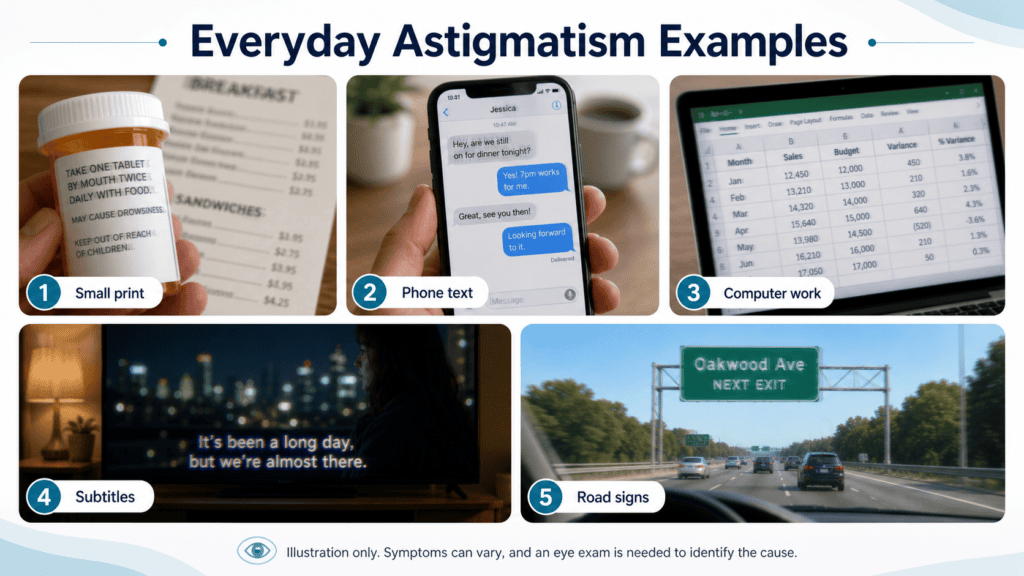
Small print is a common example. Menus, medication labels, forms, and receipts may look fuzzy or shadowed. You may be able to read the words, but it takes more effort than expected.
Phone text is another common example. The letters may be readable but not crisp. High-contrast text, such as black letters on a white background or white text in dark mode, may look slightly doubled, glowing, or smeared.
Computer text can bring out the same issue. Some people squint at spreadsheets, emails, or long pages of text because the letters do not feel clean at the edges. This does not mean screens caused the astigmatism. Screen use can make blur more noticeable because of dry eye, reduced blinking, fatigue, or an outdated prescription.
Subtitles can be especially noticeable, particularly white subtitles on a dark background. The words may look like they have a shadow or a faint second copy.
Driving signs are another common example. Road signs, street names, or store signs may look smeared until you are closer. Fine details in faces or objects may look slightly soft, especially at a distance.
These are common examples patients bring up in clinic. They are meant to help you recognize and describe the pattern, not to work like a checklist.
Night Driving, Headlights, Halos, and Starbursts
Night driving is one of the most common situations where patients notice astigmatism-like symptoms.
Headlights may look stretched, streaked, smeared, or surrounded by glare. Streetlights may have halos. Taillights may look like starbursts. Reflective signs may be harder to read, and bright lights may feel more distracting than they used to.
These symptoms can feel worse in low light. At night, the pupils are larger, and glare can become more noticeable. Untreated astigmatism can contribute to that experience. Dry eye can also contribute, especially if the surface of the eye is unstable.
It is important not to assume that all night glare is astigmatism. Cataracts, dry eye, dirty glasses, a smudged windshield, corneal irregularity, and other eye conditions can also create halos, glare, or streaking around lights.
If night driving has become uncomfortable, unsafe, or noticeably different, that is a good reason to schedule an eye exam rather than trying to decide from symptoms alone.
Why Astigmatism Symptoms Can Change From Day to Day
Astigmatism symptoms do not always stay exactly the same.
For many patients, the biggest day-to-day factors are dry eye, fatigue, and whether the current correction is accurate and aligned. An unstable tear film can make vision fluctuate even when the prescription is close. Long screen sessions can make this worse because people often blink less fully when concentrating. Fatigue can also make blur, ghosting, or eye strain more noticeable.
Correction issues can matter too. Glasses that are outdated, bent, or sitting differently on the face may not place the correction as intended. Contact lenses, especially toric lenses for astigmatism, can blur if the fit, rotation, dryness, or lens movement is affecting the way the correction sits on the eye.
Lighting also changes the experience. Some people notice symptoms mainly at night or in high-contrast situations because glare and edge distortion become easier to see.
Fluctuation does not prove astigmatism, and it does not rule it out. It simply means the eye exam should look at the prescription, the ocular surface, and the way the correction is working.
For a deeper discussion of glasses, toric contacts, and specialty lenses, see our guide to astigmatism corrective lenses.
Astigmatism vs. Other Vision Problems
Astigmatism can overlap with several common vision problems. The pattern gives your doctor useful clues, but testing identifies the cause.
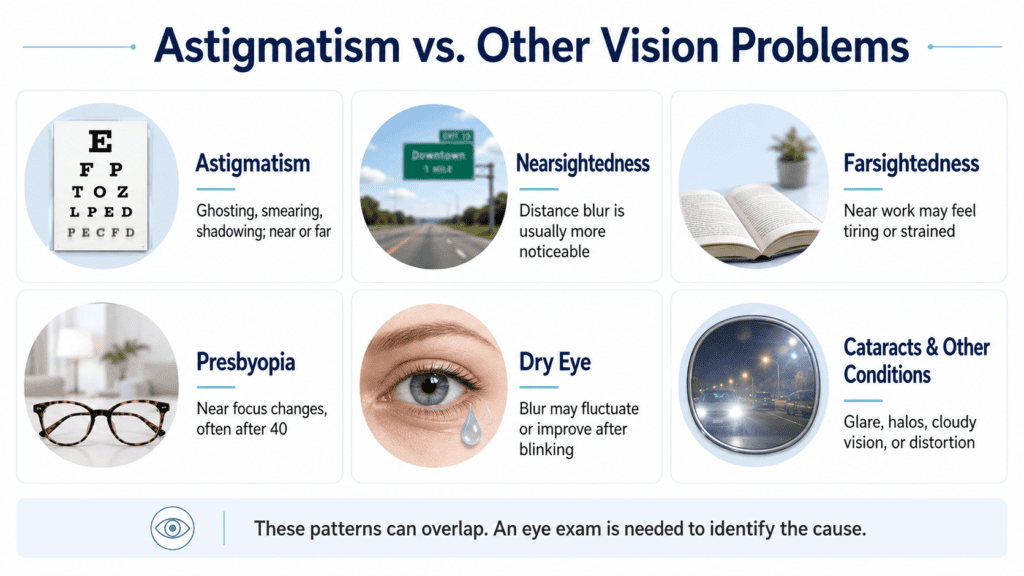
Astigmatism often causes blur or distortion at both near and far distances. The blur may feel directional, shadowed, ghosted, or smeared.
Nearsightedness usually makes distance vision blurrier than near vision. A person may see the phone clearly but struggle with signs across the street.
Farsightedness may make near work more tiring, especially with reading or screens. Some people can compensate for a while, but they may develop eye strain or headaches.
Presbyopia is the age-related near-focus change that usually starts around the 40s. It often shows up as difficulty focusing up close or needing to hold reading material farther away. Astigmatism can affect near and far vision and may create ghosting or shadowing; presbyopia is more about near focusing. The two can also exist together.
Dry eye often causes fluctuating blur. Vision may briefly improve after blinking or lubricating drops, then blur again. Burning, gritty, watery, or irritated eyes can point toward the ocular surface.
Cataracts can cause glare, halos, reduced contrast, or cloudy vision, especially as they become more significant.
Corneal irregularity can cause blur or distortion that does not sharpen fully with standard glasses. Macular problems can cause distortion or central-vision changes that need a retinal evaluation.
The overlap is why examples are only a starting point. Many patients have more than one issue at the same time.
Why Online Astigmatism Images Can Mislead You
Online images comparing “normal vision” with “astigmatism vision” are common. They can sometimes help people find words for what they are seeing, but they are not diagnostic tests.
Images of lights are easy to distort. Camera lens flare, photo exposure, dirty windshields, smudged glasses, screen brightness, and glare can all create dramatic streaks that may not represent human vision accurately. Real symptoms vary from person to person. Prescription strength, axis, pupil size, dry eye, contact lens fit, cataracts, and corneal shape can all affect how lights or text appear.
Matching an online image does not confirm astigmatism, and not matching one does not rule it out.
Patients do not need to guess from pictures. Astigmatism can be measured during an eye exam, and tools such as refraction and corneal topography can help separate astigmatism from dry eye, cataracts, corneal irregularity, or other causes. For more on regular and irregular patterns, see our article on astigmatism types.
Why Astigmatism Symptoms May Persist With Glasses or Contacts
If glasses or contacts do not fully fix the ghosting, smearing, or blur you notice, it does not automatically mean your astigmatism is uncorrectable. Your doctor may first check whether the prescription is accurate. They may also look at the full eye exam, the ocular surface, dry eye, cataracts or lens changes, and retinal or macular causes when relevant.
Sometimes the tear film needs treatment before the prescription can be refined accurately. Sometimes the issue is contact lens movement or toric lens rotation. Sometimes the prescription has changed, or the glasses are not sitting correctly.
The answer is not always a stronger prescription. Often it is a more careful look at why vision is still not crisp.
Symptoms That Should Not Be Assumed to Be Astigmatism
Most routine astigmatism symptoms are not emergencies. But some symptoms should not be casually blamed on astigmatism.
Seek prompt evaluation for:
- sudden vision loss or an abrupt vision change
- sudden new halos with eye pain, nausea, or redness
- flashes of light
- a sudden shower of floaters
- a curtain or shadow in the vision
- significant eye pain
- marked redness
- discharge
- light sensitivity
- sudden true double vision
- rapidly worsening distortion
- vision changes after trauma or surgery
Faint ghosting can happen with astigmatism, dry eye, cataract, or corneal irregularity. Sudden true double vision is different and should be evaluated promptly.
The Bottom Line on Astigmatism Examples
Astigmatism examples can help you recognize and describe what you are seeing. Ghosting, smearing, shadowed letters, halos, glare, and streaks can all be consistent with astigmatism. They can also have other causes.
The most useful next step is to have your vision measured and evaluated. Astigmatism is treatable, and an exam can usually clarify whether the issue is astigmatism, dry eye, a prescription change, cataract, corneal irregularity, or another eye condition.
Frequently Asked Questions
What does astigmatism vision look like?
Astigmatism may make letters look shadowed, smeared, doubled at the edges, or not quite crisp. Lights may also look streaked, haloed, or more distracting at night.
Can I tell if I have astigmatism from an online image?
No. Online images can help you describe what you are seeing, but they cannot diagnose astigmatism. An eye exam is needed to measure the prescription and check for other causes.
Why do headlights look streaky with astigmatism?
Astigmatism can make glare, halos, streaks, and starbursts more noticeable, especially at night. Dry eye, cataracts, dirty glasses, or other eye conditions can cause similar symptoms.
Can astigmatism make vision blurry up close and far away?
Yes. Astigmatism can affect both near and distance vision. That is one reason it can be confused with other problems, such as nearsightedness, presbyopia, or dry eye.
Why do I still see ghosting with glasses or contacts?
Persistent ghosting can happen if the prescription needs adjustment, the tear film is unstable, a contact lens is rotating, or another eye condition is contributing.
About the Author