Is Laser Eye Surgery Permanent? How LASIK Holds Up Over Time

LASIK eye surgery is a permanent surgical procedure that reshapes the cornea to correct refractive error. But that does not mean your vision can never change again. This is what confuses most patients when they read about vision changes after LASIK surgery. They assume it means the procedure “wore off” or “stopped working.”
The corneal reshaping created by LASIK is permanent. What is not permanent is the rest of the eye. The natural lens continues to age. Near vision can change. Cataracts and other age-related changes can still develop later in life. A small number of patients can also experience some refractive drift after surgery.
LASIK is also an elective procedure, which is why this question feels so loaded for patients. No one wants to make a permanent change to the cornea if the benefit is only temporary. The confusion usually comes from blending together three different things:
- LASIK correction, which is the permanent reshaping of the cornea
- Regression, which is a mild refractive drift in some patients
- Aging, which includes lens changes such as presbyopia and cataracts
This article explains the difference between those changes so you can understand what LASIK permanently fixes, what it does not prevent, and what realistic long-term expectations should look like.
Table of Contents
Does LASIK Wear Off?
LASIK, like other forms of laser vision correction, does not “wear off” in the way patients often imagine. The procedure uses a laser to reshape the cornea so light focuses more accurately on the retina. Once the cornea heals into that new shape, the reshaping itself does not reverse over time. This is why surgeons describe LASIK as a permanent procedure.
However, permanent corneal change does not mean permanent freedom from future vision changes that may occur later for reasons that have nothing to do with LASIK. The table below highlights several common causes of later vision change that patients sometimes mistake for LASIK wearing off.
| Factor | How It Can Affect Vision Later | Why It Does Not Mean LASIK Wore Off |
| Presbyopia | Near vision becomes harder in the 40s and 50s. | This is an age-related lens change, not a reversal of the corneal treatment. |
| Cataracts | Vision may become blurry, dimmer, or more glare-sensitive over time. | Cataracts develop in the natural lens, not in the part of the eye LASIK reshaped. |
| Dry eye or tear-film instability | Vision may fluctuate, especially with screen use, fatigue, or environmental stress. | This affects the eye surface and visual quality, not the permanence of the LASIK correction. |
| Retinal disease | Vision may become distorted, reduced, or less reliable. | LASIK does not prevent retinal conditions, and these are separate from the corneal reshaping. |
| Glaucoma or other optic nerve disease | Vision can decline gradually, sometimes without obvious early symptoms. | These conditions affect the optic nerve, not the laser treatment itself. |
When patients become concerned that their LASIK “stopped working,” in most cases they are describing one of the changes above rather than a reversal of the original treatment.
What LASIK Actually Changes in the Eye
LASIK, or laser-assisted in situ keratomileusis, changes the shape of the cornea, which is the clear front surface of the eye and one of the main structures responsible for focusing light. In nearsightedness (myopia), farsightedness (hyperopia), and astigmatism, the way light bends through the front of the eye is not properly matched to the eye’s optical system. LASIK corrects that mismatch by reshaping the corneal curvature with an excimer laser.
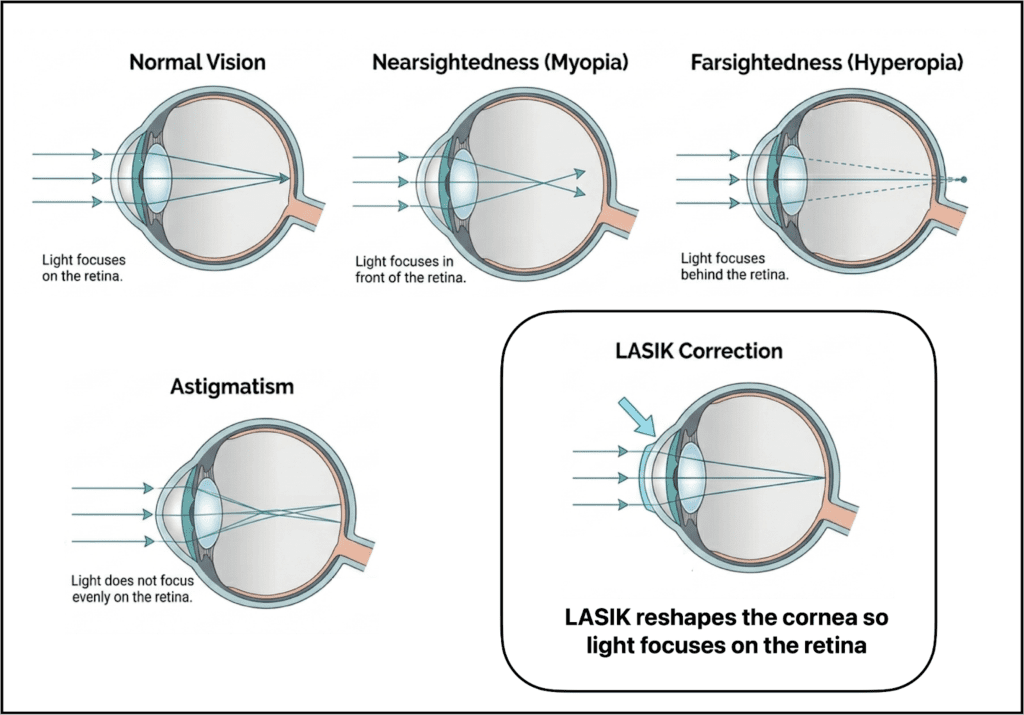
That reshaping changes how incoming light is focused onto the retina. Once the eye heals, the new corneal contour becomes the basis of the corrected prescription. This is why LASIK is described as a permanent refractive procedure: it creates a lasting structural change in the cornea itself.
A more detailed explanation of how the LASIK procedure is performed is covered separately in the article Bladeless LASIK Surgery Guide. For this article, the important takeaway is that LASIK permanently changes the corneal optics that were causing the original refractive error.
Because LASIK permanently changes the cornea, later vision changes are usually being driven by something else, such as regression, normal aging, dry eye, or unrelated eye disease.
Regression After LASIK: What It Is and What It Is Not
Regression after LASIK is a mild loss of some of the refractive correction achieved by the original procedure. It does not mean that the original laser correction has disappeared. In clinical terms, this loss in vision is usually small, often in the range of about 0.25 to 0.75 diopters, and in some patients mild enough that they barely notice it.
Patients sometimes confuse regression with normal age-related vision change, but the two are not the same. If regression is going to happen, it usually shows up in the first couple of years rather than suddenly appearing decades later. It is seen more often in patients who started with higher myopia or hyperopia, in younger patients, and in eyes with more healing-related corneal remodeling after surgery. That remodeling can involve stromal healing that slightly alters corneal shape, or epithelial thickening that restores a small amount of the original curvature.
Among the long-term vision changes discussed here, regression is the one most directly tied to the original LASIK correction. Other later changes, such as presbyopia, cataracts, dry eye fluctuation, or unrelated eye disease, are usually being driven by separate processes rather than by the LASIK treatment.
Patients also need one more distinction here. Small day-to-day changes are not the same as true progression. A quarter-diopter swing related to contact lens wear, dry eye, fatigue, or heavy screen use is fluctuation. True myopia progression means the prescription is genuinely continuing to worsen over time. That distinction matters because true progression is a reason to delay LASIK, while minor fluctuation is not.
Presbyopia: The Vision Change Everyone Eventually Gets
Presbyopia is the normal age-related loss of near focusing ability. It happens because the natural lens becomes less flexible with age. LASIK does not cause that process, and LASIK does not stop it.
This is one of the biggest reasons patients later worry that LASIK “stopped working.” Someone may still have clear vision in the distance after LASIK, then begin needing reading glasses in the mid-to-late 40s and assume the surgery has failed. In most cases, that is not what happened. The LASIK result can still be stable while the lens has simply aged in the normal way.
Distance vision and near vision are not the same problem. LASIK is often excellent for reducing dependence on glasses or other corrective lenses for distance, while presbyopia is about near focus. Once presbyopia begins, options may include:
- over-the-counter reading glasses
- progressive glasses
- contact lenses
- monovision strategies, which usually means trying one eye for distance and the other for near, often first with contact lenses to see if the patient tolerates it
- later lens-based procedures such as refractive lens exchange or cataract surgery when appropriate
That is why a patient can have a successful LASIK outcome and still need help with near vision later.
Who Is Most Likely to Need Future Vision Correction
Not every LASIK patient has the same long-term profile, and not every patient has the same chance of needing glasses, reading help, or additional correction later.
Patients who are more likely to need some kind of future correction include:
- patients with higher myopia or higher hyperopia at baseline
- patients whose prescription was not truly stable before surgery
- patients who have LASIK close to the onset of presbyopia
- patients with ocular surface problems that affect visual quality
These patients may still do well with LASIK, but they are also more likely to wear glasses, need readers, or require other vision correction later.
LASIK Longevity for Patients With High Myopia
High-myopia patients are often the most anxious about permanence, and for good reason. They have often spent years watching their prescription change and may worry that surgery cannot possibly “hold.”
LASIK can correct the prescription you have now. It does not stop true myopia progression if the eye is still changing. If the myopia is genuinely progressing, LASIK should not be done yet.
For stable high myopia, LASIK can still be effective, but higher corrections generally mean more tissue removal and a somewhat greater chance of mild regression or later enhancement.
That is why the clinical conversation matters more than a single number. In high myopia, surgeons think carefully about corneal thickness, topography, optical quality, stability, and whether a cornea-based procedure is truly the best fit. In some patients, EVO ICL may be the better option because it preserves corneal tissue and is removable.
What Happens to Your Vision Decades After LASIK
If you have LASIK in your 20s or 30s, the most important long-term changes usually happen later in the lens, not the cornea.
In your 40s and 50s, the primary issue is usually presbyopia. In your 60s and beyond, cataracts become increasingly relevant. Neither of these is a problem with LASIK or the cornea itself. They reflect changes in the aging lens, which is not the part of the eye LASIK treats.
There is one practical consequence many patients do not hear enough about: prior LASIK matters when cataract surgery is planned later.
After LASIK, the corneal curvature is different, which changes the measurements surgeons rely on when choosing intraocular lens power. Modern formulas have improved this substantially, but prior refractive surgery still makes cataract planning more specialized. It can also affect premium lens selection. In some post-LASIK eyes, especially those with more irregular topography or greater prior tissue removal, trifocal lens planning becomes more complicated and sometimes less attractive than it would be in an untouched cornea.
This does not mean LASIK prevents good cataract surgery. It means you should always tell your future cataract surgeon that you had LASIK so your lens calculations and options can be planned appropriately.
Long-Term Visual Quality Changes After LASIK
Some patients notice changes in visual quality after LASIK even when the prescription itself is stable. This is because the sharpness of the prescription and the quality of the visual image are not always the same thing. Patients may describe glare, halos, reduced contrast, or a sense that vision feels different even when the refractive correction itself is still good.
The cause of these symptoms often depends on timing. If they are directly related to LASIK, they are more often immediate or early post-surgical concerns tied to corneal optics, pupil size, healing, or higher-order aberrations. They are not the kind of issue that usually appears for the first time many years later because the LASIK correction is somehow fading.
When visual quality symptoms show up or worsen much later, the cause is often more likely to be something else, such as dry eye, lens aging, or cataract change. That is why later night-vision problems or contrast complaints do not automatically mean the LASIK treatment itself has deteriorated.
When Enhancement Procedures May Be Needed
Enhancements are usually considered for three main reasons:
- residual refractive error after the original surgery
- mild regression that meaningfully affects function
- a mismatch between current vision and the patient’s actual visual goals
If an enhancement is going to be needed, it is more commonly discussed in the earlier years after LASIK than decades later. Early on, a flap relift may still be possible. Later, if enhancement is appropriate at all, surgeons may consider a different surface-based approach such as PRK rather than simply relifting the old flap.
Not every small change should be treated surgically. A contact lens trial is often a simple way to judge that. If the lens does not make vision clearly better, an enhancement is unlikely to help much either. In that situation, the better answer may be a small prescription, reading glasses, dry eye treatment, or simply watching the change over time.
Setting Realistic Long-Term Expectations for LASIK
The most satisfied LASIK patients usually start with realistic expectations.
LASIK permanently reshapes the cornea. It does not stop the lens from aging. It does not guarantee that you will never need reading glasses, a future enhancement, or cataract surgery. It does not lock your vision at one perfect point for life.
But that does not make LASIK temporary. It means LASIK solves one problem very well while leaving the rest of the normal aging process untouched.
It also helps to understand that long-term LASIK care should not be treated like a one-time transaction. Good refractive practices continue to follow patients over time, often with yearly eye exams and follow-up appointments, because visual needs change and long-term eye care still matters after a successful procedure.
Expect the corneal correction to last, but expect the rest of the eye to keep aging. Later vision changes are usually explainable, and most have practical next steps. Presbyopia may call for readers or a monovision adjustment. Regression, if it happens, may or may not justify enhancement. Cataracts are addressed with lens surgery when the time comes.
Making an Informed Decision About Long-Term Vision Correction
If you are thinking seriously about LASIK, permanence should be part of the conversation.
A good consultation with an eye doctor should cover what LASIK changes, whether your prescription is truly stable, how close you are to presbyopia, and whether your cornea is the right long-term target in the first place. Whether you are a good LASIK candidate still depends on more than today’s prescription alone.
Some useful questions to ask are:
- Is my prescription truly stable, or just fluctuating?
- If I have high myopia, is LASIK still the best option for my cornea?
- How should I think about presbyopia if I am already in my 40s?
- If my vision changes later, what would the likely cause be?
- What kinds of follow-up care do you recommend after LASIK?
For patients who remain uncomfortable with the permanence of corneal surgery itself, that concern should be taken seriously. In some cases, a removable option such as EVO ICL may fit better emotionally and optically.
LASIK can be durable and still exist alongside normal aging. If vision changes later, the next step depends on the cause. Presbyopia may call for reading help. Dry eye may need treatment. Mild regression may or may not justify enhancement. Cataracts can be addressed with lens surgery.
Frequently Asked Questions
Is LASIK permanent?
Yes. LASIK permanently reshapes the cornea. What can still change later is the rest of the eye, which is why later vision changes do not automatically mean LASIK wore off.
Can vision change years after LASIK?
Yes. Vision can change later because of presbyopia, cataracts, dry eye, mild regression, or unrelated eye disease. The cause matters more than the timing alone.
Does needing reading glasses mean LASIK failed?
Usually not. Most often it reflects presbyopia, which is the normal age-related loss of near focusing ability in the natural lens.
When does regression usually happen after LASIK?
If regression happens, it usually appears within the first couple of years after surgery rather than first showing up decades later.
Can you still have cataract surgery after LASIK?
Yes. Cataract surgery is still possible after LASIK, but prior LASIK changes the corneal measurements, so lens planning usually requires more specialized calculations.
About the Author