Best Stye Medications and Treatment: What Works, What Doesn’t, and When to Escalate Care

The root cause of styes is often misunderstood. Although they are commonly treated as infections, most styes develop from inflammation and blockage of the eyelid’s oil glands. This is why treatment can vary and why antibiotics may offer limited benefit. In clinical practice, decisions about stye medications are based on inflammation severity, gland behavior, recurrence risk, and response to prior care. This guide explains how medications are targeted to specific inflammatory cycles, why “antibiotic-only” approaches often fail, and when it is time to move from at-home care to a clinical procedure.
Do Styes Need Medication?
Patients are often told that styes are “self-limiting” and will resolve on their own with time and warm compresses. While true in some cases, it oversimplifies what is happening inside the eyelid and why some styes linger, recur, or progress despite conservative care.
A stye is an inflammatory process involving a blocked oil gland in the eyelid. Bacteria may be present on the surface of the skin, but the primary problem is not an active infection in the way patients typically imagine. Instead, swelling, congestion, and inflammatory debris prevent the gland from draining normally. When that inflammation persists, it can lead to scarring of the gland, chronic blockage, and long-term disruption of normal oil flow across the eye surface.
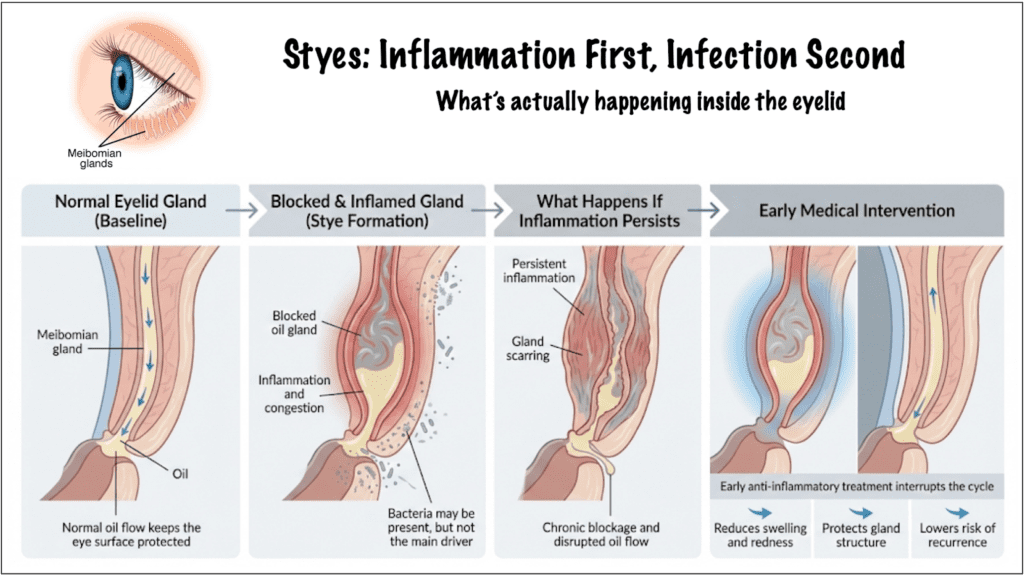
This is why specialists often consider medication earlier rather than later. The goal is not to “kill bacteria” or to make the eye dependent on treatment but to interrupt the inflammatory cycle before the gland becomes permanently damaged. Early treatment can reduce redness, lid thickening, and structural changes that make future styes more likely.
That said, not every stye automatically leads to a prescription. In practice, observation without medication is sometimes appropriate, particularly in very mild cases where symptoms are minimal and basic conservative care has not yet been tried.
However, once a stye is clearly established with indications of clogged glands or underlying lid inflammation, ophthalmologists view targeted medical therapy as an effective way to protect gland function.
Medication decisions are also shaped by history. Patients who have had recurrent styes, chronic eyelid inflammation, or prior procedures such as injections or surgical removal are often treated more proactively. In these cases, early medical management helps prevent a pattern of repeated obstruction and scarring.
This also explains why patients sometimes receive prescriptions even after being told that styes are “not infections.” Medication in these cases is aimed at controlling inflammation and supporting gland function, not treating an active infection.
In short, medication for styes is decided based on timing, risk, and long-term eyelid health. The question is not simply whether a stye can go away on its own, but whether allowing inflammation to persist is the best choice for that individual eye.
Topical Treatments: Drops, Ointments, and When They Help
When medication is used for a stye, it is most often topical. Patients often encounter confusion when they are prescribed drops in one setting, ointment in another, or told that antibiotics are unnecessary despite visible swelling and redness.
The key point to understand is that topical treatment for styes is not primarily to eliminate bacteria. It is aimed at calming eyelid inflammation, improving gland drainage, and protecting the structure of the oil glands while the stye resolves.
The table below summarizes how commonly used topical treatments differ in what they target and when they are helpful.
| Treatment Type | What It Targets | When It’s Helpful | What It Does Not Do |
| Steroid Drops / Ointments | Eyelid inflammation | Redness, swelling, thickened lid tissue, recurrent inflammation | Does not instantly drain the stye or prevent all recurrence |
| Steroid–Antibiotic Combination | Inflammation + surface bacteria | Inflamed styes with drainage risk or compromised lid margin | Does not treat the blocked gland itself |
| Topical Antibiotics Alone | Surface bacteria | Limited situations; prevention of secondary infection | Does not resolve the stye or unblock the gland |
| Ointments (General) | Lid margin and surrounding tissue | Styes involving the eyelid margin; prolonged contact needed | Does not act faster than drops |
| Drops (General) | Eye surface and nearby inflammation | When ointments are poorly tolerated or eye surface is involved | Shorter contact time with the lid |
In ophthalmology practice, steroid-containing drops or ointments are commonly used when inflammation is prominent. The eyelid tissue around a stye often becomes thickened, irritated, and chronically inflamed. Left unchecked, this inflammation can contribute to scarring of the oil glands and long-term dysfunction. Reducing inflammation early helps relieve symptoms and lowers the risk of persistent gland damage.
Ointments are often preferred over drops when the stye involves the lid margin or surrounding eyelid tissue. Because ointments remain in contact with the eyelid longer than drops, they can provide a more sustained anti-inflammatory effect where it is needed most. Drops may still be used in some cases, particularly when patients have difficulty tolerating ointments or when the inflammatory component extends to the eye surface itself.
Topical antibiotics, by contrast, play a limited role in stye treatment. While they are frequently prescribed in primary care settings, they do not address the underlying blockage or inflammation that causes a stye to form. When antibiotics are included in ophthalmic prescriptions, they are typically combined with a steroid and used to reduce the risk of secondary infection rather than to treat the stye itself.
With topical medication, patients should expect reduced redness, tenderness, and lid inflammation, not an instant “cure” or stye drain. Improvement is usually gradual, and medication works best as part of a broader approach that supports gland function rather than as a stand-alone solution.
How long topical medication is used depends on the severity of inflammation and how the eyelid responds to treatment. Continuing medication beyond the point of improvement offers little benefit and can increase the risk of irritation. This is why topical treatment decisions are individualized and reassessed, rather than applied as a fixed or one-size-fits-all approach.
Oral Medications: When Pills Are Necessary
Patients often see oral medication as a more serious or more effective step than topical treatment. In stye care, that assumption is often incorrect. Most uncomplicated styes do not require oral medication, and prescribing pills does not improve outcomes.
When oral medication is used, it is typically not to treat the stye itself, but to address inflammation that extends beyond a single blocked gland or reflects underlying eyelid disease contributing to repeated flare-ups.
The most commonly used oral medication is doxycycline. Importantly, it is prescribed not for its antibiotic effect, but for its anti-inflammatory properties. At the doses used for eyelid disease, doxycycline helps reduce chronic inflammation associated with conditions such as blepharitis, which can lower the likelihood of recurrent styes over time.
Oral antibiotics are not generally prescribed for isolated styes because the problem is localized. Pills do not unblock the affected gland or make a stye drain faster. Using oral antibiotics simply to “speed things up” offers little benefit and exposes patients to unnecessary side effects and antibiotic resistance.
There are, however, situations where oral medication may be appropriate. These include cases with widespread eyelid inflammation, recurrent styes linked to chronic lid disease, or signs that inflammation is no longer confined to a single gland. In these scenarios, oral therapy is used as part of a broader strategy to calm inflammation rather than as a stand-alone treatment.
Medication vs Warm Compresses: How They Work Together
Warm compresses are commonly recommended as an initial step in stye care because heat can soften thickened oil and encourage drainage from a blocked gland. In mild cases, this may be sufficient to relieve symptoms and allow the stye to resolve.
While compresses address mechanical blockage, medication may still be needed to reduce eyelid inflammation that can interfere with drainage or contribute to prolonged symptoms, particularly when inflammation is prominent, symptoms persist, or styes recur despite conservative care.
Warm compresses and medication are not competing treatments. Compresses may be continued alongside topical therapy, especially when gland blockage remains part of the problem. However, compresses alone are not expected to resolve every stye, especially when inflammatory changes within the eyelid are significant.
When improvement plateaus despite consistent conservative care, reassessment is appropriate. At that point, treatment decisions are guided by the degree of inflammation, recurrence patterns, and underlying eyelid conditions rather than by duration of compress use alone.
What Medication Can’t Fix and When to Escalate Care
Medication is effective at controlling inflammation around a stye, but it cannot resolve every case. In some situations, the problem is driven by a physically blocked or structurally altered oil gland rather than surface inflammation. As a stye progresses, the affected gland may become increasingly localized, firm, or more abscess-like in nature.
In these cases, medication can reduce redness, swelling, and discomfort, but it cannot eliminate the core obstruction. This is particularly common once scarring has begun or when the contents of the gland have consolidated rather than draining.
There is no fixed timeline that determines when medication has “failed.” Some styes are easier to address earlier, when they are more fluctuant and localized, while others remain treatable later, even after becoming more chronic. What matters is how the stye behaves and whether it responds meaningfully to treatment.
Signs that medication alone may be insufficient include persistence despite appropriate care, increasing firmness, visible distortion of the eyelid, or repeated recurrence in the same location. Escalation is not a sign that earlier care was inappropriate, but a recognition that some styes require a different approach once structural blockage or scarring is present.
When escalation is required, it is typically to address the obstruction directly and may involve in-office stye drainage or removal. This is not major surgery, but a brief, in-office procedure performed under local anesthesia to release the blocked material and support proper gland healing. Medication is usually continued as supportive care before and after the procedure.
Safe Use, Common Mistakes, and Antibiotic Stewardship
Medication is most effective when it is used for the problem it is intended to address. In stye care, that means treating inflammation and supporting gland recovery rather than assuming that more medication will lead to faster resolution.
One common mistake is relying on antibiotics alone. Because most styes are primarily inflammatory, antibiotic-only drops or ointments often provide limited benefit and may delay more appropriate treatment. Reusing old prescriptions or extending medication without reassessment can also mask progression without resolving the underlying blockage.
Oral antibiotics are another area where restraint matters. Using systemic antibiotics when they are unlikely to help exposes patients to side effects and contributes to antibiotic resistance without improving outcomes. For this reason, oral medication is typically reserved for specific situations rather than used routinely.
Patients are also advised to avoid manipulating or attempting to drain a stye at home, which can worsen inflammation or introduce infection. If symptoms persist, worsen, or recur despite appropriate care, the safest next step is reassessment rather than escalation on one’s own.
Using medication thoughtfully and knowing when to seek further evaluation helps prevent unnecessary treatment while ensuring that styes are managed effectively when additional care is needed.
In Summary
Good stye treatment is about using the right approach at the right time. Most styes are driven by inflammation and gland blockage rather than infection, which is why treatment decisions vary from observation to targeted medication and, in some cases, procedural care. Understanding how and why these choices are made helps set realistic expectations and supports timely, appropriate treatment when symptoms persist or recur.
About the Author