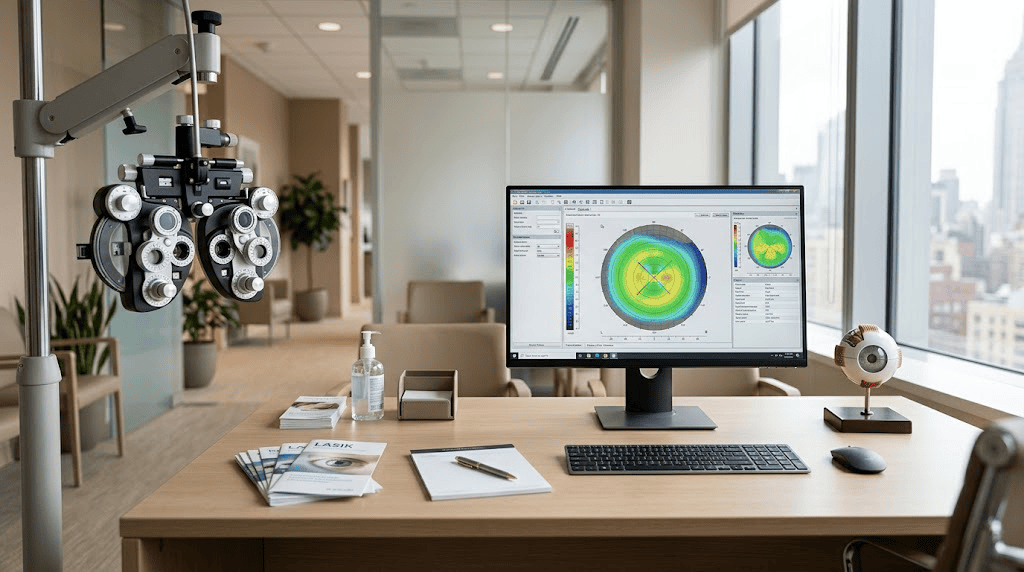
LASIK eye surgery, short for laser-assisted in situ keratomileusis, can often correct astigmatism and nearsightedness during the same procedure. From a medical perspective, having both conditions is not usually the main concern. The surgeon’s focus is whether the cornea is regular, stable, and healthy enough for laser treatment.
That makes the consultation more specific than a yes-or-no LASIK question. It also helps determine whether LASIK is truly the safest and most predictable procedure for that individual eye.
This article explains how LASIK can treat nearsightedness and astigmatism together, why the type of astigmatism matters, and what an eye surgeon checks before recommending the right procedure.
Table of Contents
Can LASIK Correct Astigmatism and Nearsightedness Together?
Yes, LASIK can often correct nearsightedness and regular astigmatism together.
Nearsightedness, also called myopia, is a refractive error that can cause blurry vision at a distance because light focuses in front of the retina. Astigmatism means the eye focuses light unevenly in different directions, which can cause blurred or distorted vision. In a LASIK treatment plan, the laser can address both the overall focusing error and the directional focusing error.
For many patients, astigmatism is simply another measurement in the surgical plan. It does not automatically make LASIK impossible.
What matters is whether the astigmatism is regular, whether the cornea has a safe shape, whether there is enough corneal thickness for the full correction, and whether the measurements are stable. Those answers come from a refractive surgery evaluation, including corneal mapping, thickness measurements, tear-film assessment, contact lens history, and repeat measurements when needed.
Why a LASIK Consultation May Include SMILE, PRK, or EVO ICL
When patients come in asking for LASIK, they may not be asking for one exact surgical procedure. Many people use “LASIK” to mean refractive surgery in general: a way to reduce dependence on glasses or contact lenses.
That is why the consultation should not stop at whether LASIK can technically correct the prescription. The eye surgeon should also consider whether LASIK is the best fit compared with other refractive procedures.
For some eyes, LASIK is a strong option. For others, SMILE, PRK, EVO ICL, or another option may be safer or more predictable. This is especially relevant for patients with higher myopia, a higher combined prescription, dry eye concerns, thinner corneas, or irregular corneal findings.
The goal is to choose the procedure that best matches the measurements of the eye.
How LASIK Treats Myopia and Astigmatism in One Plan
LASIK reshapes the cornea so light focuses more accurately on the retina. During LASIK, an excimer laser changes the corneal shape according to the treatment plan. When someone has both myopia and astigmatism, that plan includes both parts of the prescription.
The myopia component changes the overall focusing power. The astigmatism component treats the uneven focus in a specific direction. In practical terms, the laser is not only treating the amount of blur; it also has to treat the direction of the uneven focus.
This is why the cylinder and axis in the prescription matter. The cylinder describes the amount of astigmatism correction. The axis describes the direction of that correction. The surgeon uses repeated measurements to confirm that those values are stable enough to treat.
The patient does not need to understand the technical planning details. But it is helpful to know that astigmatism correction is not an afterthought. It is built into the customized treatment plan.
Why Astigmatism Alone Does Not Decide LASIK Candidacy
One common concern is, “I have astigmatism, so I was told I am not a LASIK candidate.”
Sometimes that is true. Often, it is incomplete.
Astigmatism alone does not decide whether LASIK is safe. The important distinction is whether the astigmatism is regular or irregular, whether the cornea is healthy, and whether the full prescription can be treated while leaving enough healthy tissue behind.
A routine prescription check with an eye doctor can identify astigmatism, but a LASIK consultation asks additional surgical questions. It looks at corneal shape, corneal thickness, tear film quality, contact lens effects, prescription stability, and overall eye health. These are not the same questions a standard glasses or contact lens visit is designed to answer.
For more background on how astigmatism is classified, refer to our guide to astigmatism types.
Regular vs. Irregular Astigmatism Before LASIK
Regular astigmatism has a more predictable pattern. In many cases, it can be managed well with corrective lenses such as glasses or contact lenses, or with refractive surgery if the rest of the eye exam is reassuring.
Irregular astigmatism is different. It may mean the cornea has an uneven or abnormal shape that makes laser vision correction less predictable. Irregular astigmatism can be associated with keratoconus, corneal scarring, prior surgery, or other corneal conditions.
This is one reason corneal mapping is so important before LASIK. On a corneal topography image, regular astigmatism may show a more symmetrical pattern. Irregular astigmatism may look asymmetric, distorted, or suspicious.
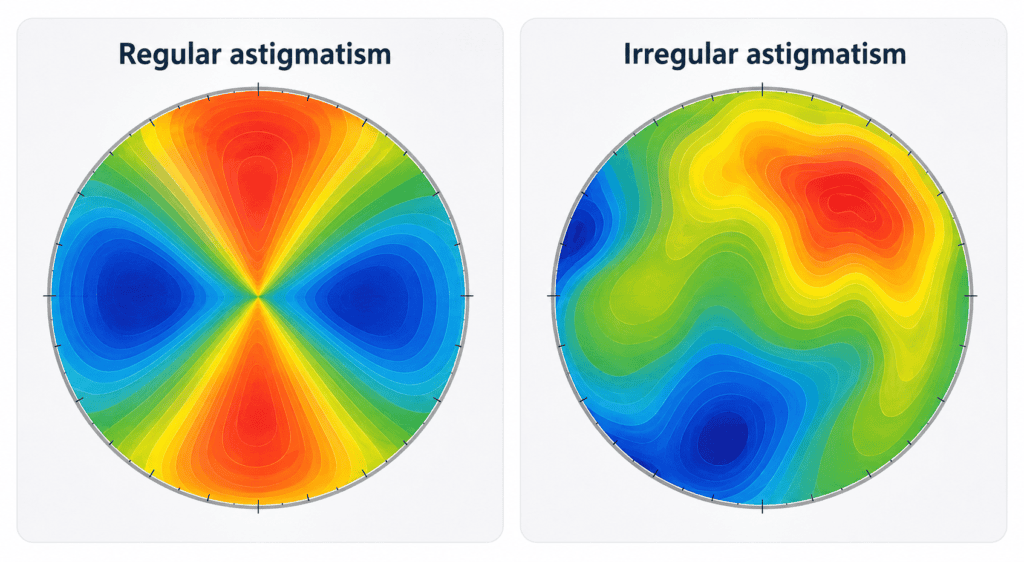
Finding irregular astigmatism does not mean clearer vision is impossible. It may simply mean LASIK is not the safest way to improve it. In some cases, the better plan may involve specialty contact lenses, EVO ICL, treating the underlying corneal issue, or avoiding elective refractive surgery.
Corneal Mapping, Thickness, and Tissue Planning
A vision prescription tells the ophthalmologist what correction the eye needs. Corneal mapping helps show whether the cornea has the kind of regular, healthy shape that makes laser treatment predictable.
Before LASIK, the surgeon may use corneal topography or tomography to evaluate the shape and structure of the cornea. These tests help screen for irregular astigmatism, early keratoconus-type changes, and other patterns that may make LASIK unsafe or less predictable.
Corneal thickness also matters. LASIK works by reshaping corneal tissue. Treating both nearsightedness and astigmatism uses more corneal tissue than treating either alone. The surgeon has to confirm that the full correction can be done while leaving enough healthy cornea afterward.
This is why two patients with similar nearsightedness may receive different recommendations. If one also has meaningful astigmatism, thinner corneas, or a suspicious corneal shape, the safest procedure may be different.
Why Cylinder, Axis, Dry Eye, and Contact Lens Wear Affect LASIK Measurements
Astigmatism correction is direction-specific, so stable measurements matter.
The cylinder is the amount of astigmatism correction. The axis is the direction of that correction. If the cylinder or axis changes between measurements, the surgeon may need to understand why before recommending surgery.
Dry eye can affect both symptoms and measurements before LASIK. If the tear film is unstable, vision may fluctuate, and the measured cylinder or axis may vary. A patient may feel that the prescription keeps changing when the surface of the eye is actually the problem.
This is why dry eye should be addressed before final surgical planning. A careful surgeon may treat the ocular surface first, then repeat measurements once the tear film is more stable.
Contact lenses can also temporarily shape the cornea. Soft spherical lenses may require several days out of lenses before measurements. Toric soft lenses may require a longer break because they are designed to correct astigmatism. RGP lenses can shape the cornea over years of wear and may require weeks to months out of lenses, depending on wear history and how quickly the cornea returns to a stable shape.
These timelines are practice-specific, but the reason is consistent: the treatment plan should be based on the eye’s natural, stable measurements after lens-related shape changes, dryness, and normal testing variation have been addressed.
When SMILE, PRK, or EVO ICL May Be Better Than LASIK
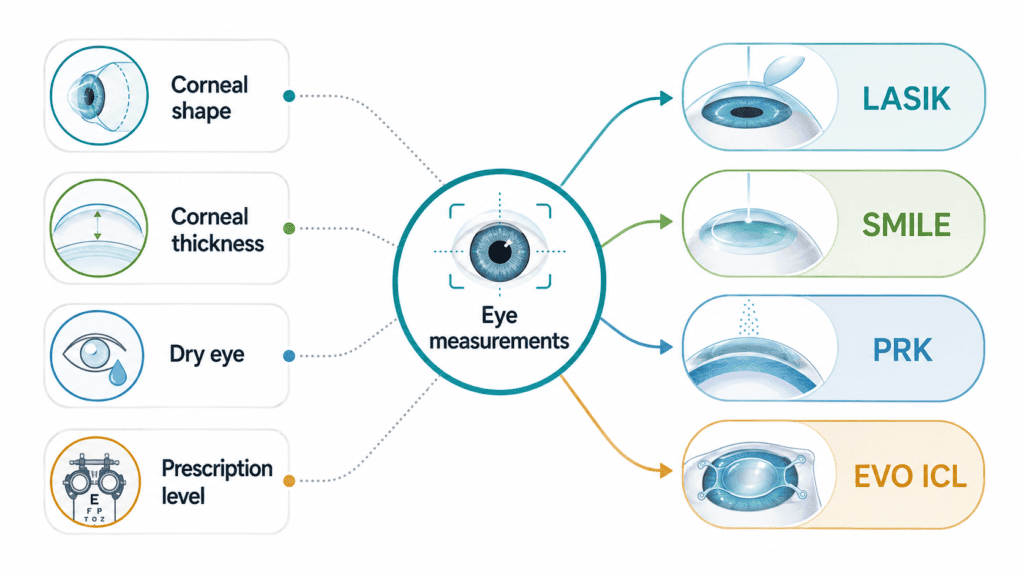
For some myopic patients, the surgeon may discuss SMILE eye surgery instead of LASIK. SMILE is flapless and may be appealing in selected patients where preserving corneal nerves or reducing dry-eye impact is part of the discussion. It is still a refractive surgery procedure, but it is not the same operation as LASIK.
PRK may be considered in selected cases, including some surface-treatment situations or enhancements. It is not automatically safer for everyone, and it has its own recovery considerations.
EVO ICL may be preferred when the prescription is high, the cornea is thin, the combined correction would require too much corneal tissue removal, or the surgeon wants a corneal-sparing approach. A toric EVO ICL can also address astigmatism in appropriate candidates.
The best procedure is not always the one the patient first asks about. The right recommendation depends on the full exam.
Residual Astigmatism and Enhancement Possibilities
Even with careful planning, a small amount of astigmatism or nearsightedness can remain after refractive surgery.
Residual astigmatism does not automatically mean the surgery failed. Healing response, measurement variability, dry eye, contact lens effects before measurement, and individual corneal response can all affect the final result.
Some patients are not bothered by a small remaining amount. Others notice that vision is much better than before, but still not as crisp as they expected. This can be frustrating because even a small residual cylinder may create shadowing, streaking, or a slightly smeared quality for some people.
An enhancement may be possible, but it is not automatic. The surgeon has to consider the patient’s symptoms, the repeat measurements, corneal thickness, healing pattern, dryness, and whether correcting the remaining error is likely to improve functional vision. For broader context on long-term results and regression, see our article on whether laser eye surgery is permanent.
20/20 Vision, Night Vision, and Quality of Vision
Seeing 20/20 on an eye chart is important, but it is not the whole story.
Patients also care about how vision feels in daily life: night driving, contrast, screen use, reading signs, glare, halos, starbursts, dryness, and visual fluctuation. A patient may measure well in the exam room but still notice symptoms in low light or high-contrast settings.
This matters for patients with myopia and astigmatism because astigmatism can create streaking or distortion before surgery. Higher prescription correction and higher astigmatism may make night-vision planning more important. The surgeon may consider baseline glare, pupil size, treatment zone, and how symptoms compare between the two eyes.
Because glare and halos can affect how vision feels after surgery, quality of vision should be part of the consultation alongside the eye-chart number.
LASIK After 40 With Astigmatism and Nearsightedness
For patients around 40 and beyond, reading vision becomes more important in LASIK planning.
LASIK can correct distance nearsightedness and astigmatism, but it does not restore the eye’s natural near-focusing ability. Presbyopia, the age-related loss of near focusing, happens whether or not someone has LASIK.
For some patients, the plan may be distance correction plus reading glasses. Others may discuss presbyopia-correcting drops, monovision, mini-monovision, or lens-based options. If monovision is being considered, a trial is important before surgery because not every patient likes having one eye set differently from the other.
Monovision is a vision-planning strategy, not a separate laser procedure. LASIK or SMILE may be used to create that target when the patient is a good candidate. For more detail on age-related planning, see our guide to LASIK age and suitability.
When LASIK May Not Be the Right Choice
LASIK may not be the right choice if the cornea is irregular, suspicious on topography or tomography, too thin for the combined prescription, or not stable enough for predictable treatment.
It may also be delayed or avoided if dry eye is significant, contact lens effects are still changing the corneal shape, the cylinder or axis measurements are not repeatable, best-corrected vision is limited, or the patient’s expectations do not match what surgery can realistically provide.
Not being a LASIK candidate does not mean there are no options. It may mean SMILE, EVO ICL, PRK, specialty lenses, waiting, or treating another eye condition first is a better fit.
In other words, the reason LASIK may not fit is usually found in the cornea, prescription, ocular surface, measurement stability, or expectations. Once that reason is clear, the surgeon can discuss which non-LASIK options are worth considering.
Why the Surgeon Should Offer More Than One Option
For patients with both myopia and astigmatism, it is especially useful to see a surgeon who can evaluate more than one refractive procedure.
If a surgeon only performs LASIK, the recommendation may be limited by what that practice can offer. A surgeon who performs LASIK, SMILE, PRK, and EVO ICL can compare the options against the patient’s actual measurements.
That matters because the best choice may change based on corneal thickness, dry eye, prescription level, corneal mapping, age, and visual goals. The goal is not to force the eye into LASIK. The goal is to choose the procedure that gives the safest and most predictable correction for that eye.
Questions to Ask Before Surgery
If you are considering LASIK for astigmatism and nearsightedness, useful consultation questions include:
- Is my astigmatism regular or irregular?
- Are my cylinder and axis measurements stable?
- What does my corneal topography show?
- Do I have enough corneal thickness for the full myopia-plus-astigmatism correction?
- Is dry eye or contact lens wear affecting my measurements?
- How long should I stay out of contact lenses before final measurements?
- Why do you recommend LASIK rather than SMILE, PRK, or EVO ICL?
- If residual astigmatism remains, what would determine whether an enhancement is safe?
- How are night vision, pupil size, and treatment zone being considered?
- If I am over 40, how will reading vision be handled?
- Do you offer multiple refractive procedures, or would I need a referral if LASIK is not the best fit?
These questions help move the conversation beyond “Can LASIK treat my prescription?” and toward the more useful question: “Which option fits my eye best?”
The Bottom Line on LASIK for Astigmatism and Nearsightedness
LASIK can often correct regular astigmatism and nearsightedness together. Astigmatism alone does not rule someone out.
But LASIK is not always the best procedure for every patient who has myopia and astigmatism. The right recommendation depends on corneal shape, corneal thickness, prescription stability, dry eye, contact lens history, night-vision planning, age, and visual goals.
A strong consultation should compare LASIK with other appropriate options when needed. For some patients, LASIK fits well. For others, SMILE, PRK, EVO ICL, or a non-surgical approach may be safer or more predictable.
The best outcome starts with choosing the right procedure for the eye, not simply choosing the most familiar name.
Frequently Asked Questions
Can you get LASIK with astigmatism and nearsightedness?
Yes, many patients with nearsightedness and regular astigmatism can be considered for LASIK. The decision depends on corneal shape, corneal thickness, prescription stability, dry eye status, contact lens history, and whether LASIK is the safest option compared with SMILE, PRK, or EVO ICL.
How effective is LASIK for correcting astigmatism and nearsightedness?
LASIK can be effective when the astigmatism is regular, the measurements are stable, and the cornea is healthy enough for the full correction. The goal is clearer unaided vision, but the final result can depend on healing, dry eye, residual astigmatism, and the quality of the pre-surgery measurements.
Is LASIK worth it if you have astigmatism?
LASIK may be worth considering if the astigmatism is regular and the patient is otherwise a good surgical candidate. The better question is whether LASIK is the best refractive procedure for that eye. In some cases, SMILE, PRK, EVO ICL, or non-surgical correction may fit better.
What disqualifies you for LASIK?
Possible reasons include irregular astigmatism, suspicious corneal mapping, corneas that are too thin for the combined prescription, unstable measurements, significant untreated dry eye, contact lens-related corneal shape changes, limited best-corrected vision, or expectations that surgery cannot realistically meet.
Is LASIK worth it over 40?
LASIK can still be worth discussing after 40, but reading vision needs separate planning. LASIK can correct distance nearsightedness and astigmatism, but it does not restore natural near focusing. Patients may need reading glasses, presbyopia drops, monovision planning, or another approach depending on their goals.
About the Author