
Regular astigmatism is described with names that sound more complicated than the condition usually is: simple myopic, compound myopic, simple hyperopic, compound hyperopic, and mixed astigmatism.
These names do not describe five separate eye diseases. They describe how the eye focuses light in relation to the retina, the light-sensitive layer in the back of the eye. In everyday terms, they explain whether the astigmatism is paired with nearsightedness, farsightedness, or a little of both.
Knowing the types of astigmatism can be helpful if you are reading an exam note or trying to understand your prescription. However, what matters practically is whether the astigmatism is regular, measurable, and correctable, and whether your vision feels clear with the correction you are using.
This article explains what the five regular astigmatism subtypes mean, how they relate to nearsightedness and farsightedness, and why the subtype label is usually less important than how well your vision can be corrected.
Table of Contents
What Regular Astigmatism Means
Regular astigmatism is a refractive error in which the focusing pattern is organized and predictable. Most regular astigmatism is corneal astigmatism, meaning the cornea is the primary source of the uneven focus. The cornea is often described as being shaped more like a football than a basketball: one curve is steeper than the other, so light does not focus evenly in all directions.
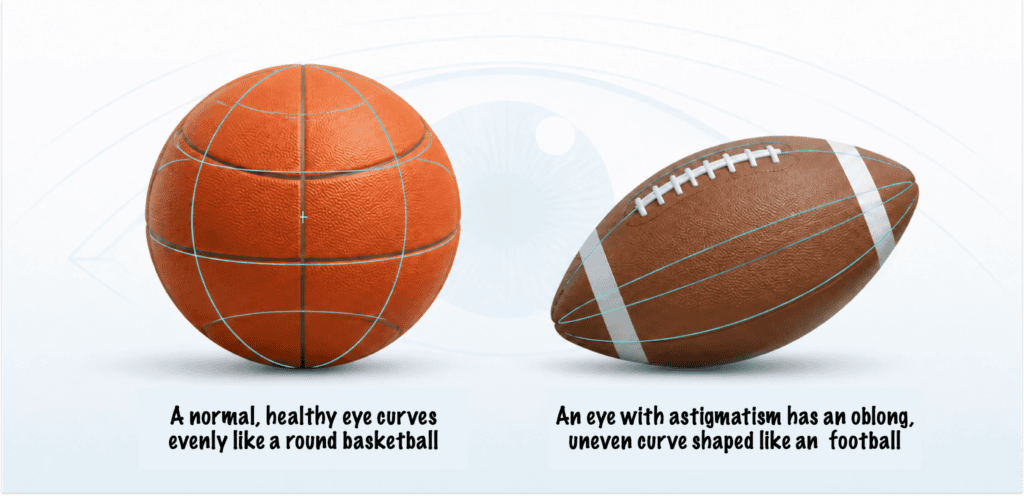
Another useful way to think about astigmatism is as a structural measurement. Just as the length and width of your foot describe its shape, astigmatism describes how the eye focuses light in different directions. Screen time, reading in dim light, or one long workday does not create a subtype of regular astigmatism.
Unlike irregular astigmatism, regular astigmatism pattern is symmetrical or organized enough that it can usually be measured and corrected predictably. In contrast, irregular astigmatism is less symmetrical and requires a closer look at the cornea. For the broader distinction, including direction patterns such as with-the-rule astigmatism and against-the-rule astigmatism, see our guide to astigmatism types.
Why Regular Astigmatism Has Subtypes
Regular astigmatism subtypes describe how the eye’s two principal meridians, the vertical and horizontal meridians, relate to normal focus.
The words are easier to understand if you separate them:
- Myopic (from myopia) means nearsighted.
- Hyperopic (from hyperopia) means farsighted.
- Simple means one focusing direction is on target and the other is off.
- Compound means both focusing directions are off in the same general direction.
- Mixed means one focusing direction is nearsighted and the other is farsighted.
These are prescription descriptions, not separate diseases. They are not severity grades. A “compound” subtype is not automatically worse than a “simple” subtype, and “mixed” does not mean the eye is unstable or dangerous.
The Five Regular Astigmatism Subtypes Explained
The table below gives the practical version of the five regular astigmatism subtypes. It is simplified on purpose. Your exact prescription pattern is measured during a comprehensive eye exam, which includes a refraction test.
| Subtype | Plain-English meaning | Patient takeaway |
| Simple myopic astigmatism | One focusing direction is on target; the other is nearsighted. | This is still a regular, measurable prescription pattern. |
| Compound myopic astigmatism | Both focusing directions are nearsighted, but not by the same amount. | Compound does not mean severe; it describes how the focusing lines sit. |
| Simple hyperopic astigmatism | One focusing direction is on target; the other is farsighted. | Hyperopic describes focusing direction, not danger. |
| Compound hyperopic astigmatism | Both focusing directions are farsighted, but not equally. | It may contribute to blur or focusing effort, but it is still a regular pattern. |
| Mixed astigmatism | One focusing direction is nearsighted and the other is farsighted. | Mixed sounds complicated, but regular mixed astigmatism is still measurable and often correctable. |
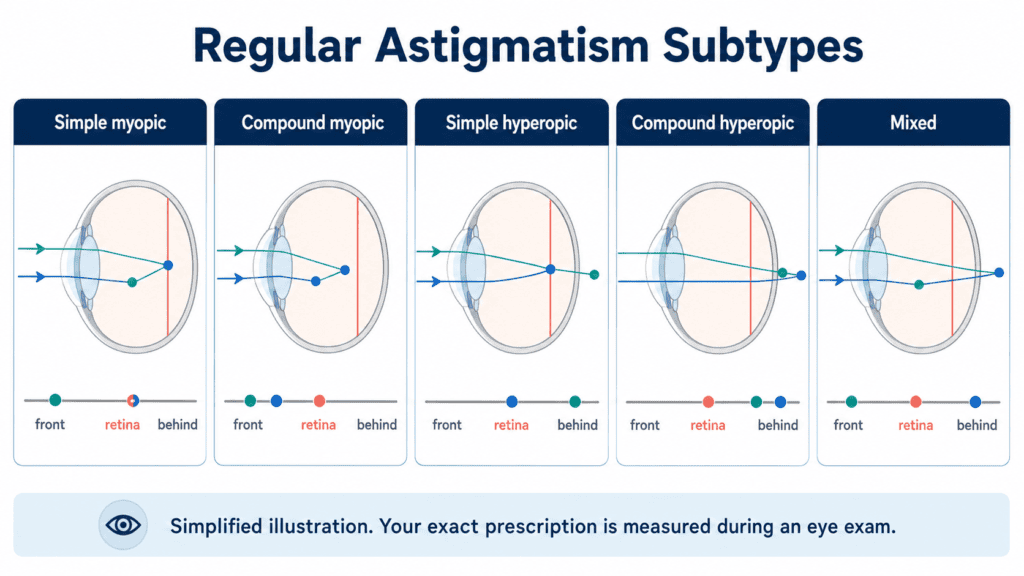
While the table is useful for orientation, it should not be used for self-diagnosis. Symptoms overlap across these subtypes, and the exact label comes from the prescription and exam measurements.
Myopic forms of regular astigmatism are commonly seen in routine prescription care. Hyperopic forms are generally less common in younger patients. What matters for patients is whether the prescription is measured accurately and whether the correction is working well.
Do Regular Astigmatism Subtypes Feel Different?
Patients generally do not experience the five regular subtypes as five clearly different symptom patterns. From the patient’s side, the experience tends to be similar regardless of subtype.
It may cause:
- blurred vision
- distorted vision
- ghosting
- shadowing around letters
- slight doubling
- streaking around lights
- squinting
- headaches
- vision that feels not fully crisp
- night vision difficulty
Some patients also experience frequent headaches, particularly when astigmatism is uncorrected or undercorrected.
The subtype label usually does not explain why one patient is more bothered than another. Prescription strength, correction accuracy, visual demands, dry eye, age, and eye health often matter more.
An eye chart number usually does not tell the whole story either. A patient may test around 20/25 and still feel unhappy with the vision if astigmatism is not corrected well. The person may be able to read the chart, but the image still feels slightly blurry, doubled, shadowed, or off.
Myopic forms may often be noticed more as distance blur. Hyperopic forms may involve more focusing effort or eye strain. But those are broad tendencies, not a way to identify your subtype from symptoms.
Do Regular Astigmatism Subtypes Change Treatment?
Usually, the subtype label does not change treatment by itself. Ophthalmologists care more about the full prescription, the amount of astigmatism, whether the astigmatism is regular or irregular, how well the vision corrects, and whether the eye is healthy. The patient’s work, driving needs, screen use, contact lens tolerance, and goals also matter.
All five regular subtypes are generally correctable. Eyeglasses, toric contact lenses, scleral lenses, custom contacts, and refractive surgery may all be options in appropriate patients. The right path depends on the full exam and refraction findings, not only on whether the label says simple, compound, myopic, hyperopic, or mixed.
Higher amounts of astigmatism may require more precise correction or a more customized contact lens option. That is about the prescription strength, lens availability, and fit, not because one subtype is inherently uncorrectable.
For more on glasses, toric contacts, and specialty lenses, see our article on astigmatism corrective lenses.
When Astigmatism Needs a Closer Look
The subtype alone does not usually trigger extra testing.
A closer look may be needed when high astigmatism is present or increasing, when it is not correcting as expected, or when it is associated with reduced best-corrected vision. The doctor may also look more closely if the corneal shape seems suspicious or if a patient is being evaluated for eye surgery.
Corneal topography and keratometry are tools that can help. It maps the shape of the cornea and helps distinguish regular, predictable patterns from irregular ones. This becomes more important when the amount of astigmatism is high, when the prescription is changing, or when glasses do not sharpen vision as expected.
The key distinction is regular vs. irregular astigmatism — whether the pattern is correctable, or whether the cornea needs a more detailed evaluation.
Does Screen Time Cause a Regular Astigmatism Subtype?
No. Screen time is not among the causes of astigmatism. It does not create simple, compound, myopic, hyperopic, or mixed astigmatism.
Screens can still affect how your vision feels. Long screen sessions and reduced blinking can worsen dry eye, and dry eye can make blur fluctuate. That may make existing astigmatism or an outdated prescription feel more noticeable.
But screen use does not create the subtype. Regular astigmatism is a structural focusing pattern, not something caused by one night of reading, dim lighting, or computer work.
Common Myths About Regular Astigmatism Types
“Astigmatism cannot be corrected.”
False. Regular astigmatism is usually measurable and correctable. At moderate or high levels of astigmatism, more precise glasses, toric contacts, custom contacts, or a surgical evaluation may be needed, but astigmatism is not automatically uncorrectable.
“Simple means mild.”
False. Simple describes where the focusing lines fall. It is not a severity label.
“Compound means severe.”
False. Compound means both focusing directions are off in the same general direction. It does not mean the eye is in worse condition.
“Mixed astigmatism is dangerous or unstable.”
False. Mixed astigmatism can sound complicated, but regular mixed astigmatism is still a prescription pattern. It is not automatically dangerous or untreatable.
“The subtype tells me what treatment I need.”
False. Treatment depends more on prescription strength, regularity, corneal health, dry eye, lifestyle, and visual goals.
“LASIK eligibility depends on simple vs. compound vs. mixed astigmatism.”
False. For LASIK, PRK, or other refractive procedures, surgeons care much more about corneal shape, corneal thickness, prescription stability, total prescription, and overall eye health than the simple, compound, or mixed subtype label.
Questions That Matter More Than the Subtype Label
You can ask your eye doctor which subtype you have if you are curious. But for most patients, these questions are more useful:
- Is my astigmatism regular and correctable?
- Has the amount of astigmatism changed since my last exam?
- Does my vision correct well with glasses or contacts?
- Is my astigmatism high enough to affect contact lens choices?
- Does my corneal topography look healthy?
- Is there any sign of irregular astigmatism or keratoconus?
- If I am interested in LASIK, do my corneal shape, thickness, and prescription stability make me a candidate?
Those questions focus on the things that affect care. The subtype label may explain the prescription, but it rarely tells the whole story.
The Bottom Line on Regular Astigmatism Types
Regular astigmatism subtype names can sound more important than they usually are. Simple myopic, compound myopic, simple hyperopic, compound hyperopic, and mixed astigmatism describe how the prescription focuses light. They are not separate diseases, and they are not a ranking from mild to severe.
Most patients do not need to memorize these labels. The more useful point is that regular astigmatism is usually measurable and correctable.
If you are experiencing blurry vision, ghosting, doubling, shadowing, or streaking, the next step is not to worry about the subtype name. It is to have the vision measured and the eye examined so the prescription and eye health can be understood clearly.
About the Author