
During an eye exam for astigmatism, you may be told you have “regular,” “irregular,” “with-the-rule,” “against-the-rule,” or “oblique” astigmatism. While these terms can sound serious, they are descriptive and help your eye doctor understand the pattern, source, or direction of the astigmatism. They do not automatically mean that you have several different eye problems or that something dangerous is happening.
For most patients, the most useful starting point is the difference between regular and irregular astigmatism. Regular astigmatism is usually a measurable prescription number and a type of refractive error. Irregular astigmatism means the corneal shape needs a closer look, often with corneal topography.
This article explains the main types of astigmatism in plain language: what the terms mean, which ones patients should care about, when testing matters, and when keratoconus should be considered without turning every astigmatism diagnosis into a reason to panic.
Table of Contents
What Astigmatism Types Actually Mean
Astigmatism type is meant to answer practical questions about the prescription and the shape of the eye. The label can help explain whether the astigmatism is straightforward to correct, whether the cornea needs closer evaluation, or whether the direction of the correction needs extra precision during refraction.
Regular versus irregular astigmatism tells your doctor how predictable the pattern is. Regular astigmatism usually behaves like a standard prescription number. Irregular astigmatism means the surface is less even, so glasses may not sharpen the vision as cleanly and corneal topography becomes more important.
Corneal versus lenticular astigmatism tells your doctor where the focusing change is coming from. Some astigmatism comes from the cornea, the clear front surface of the eye. Some comes from the natural lens inside the eye. Patients do not usually feel a difference between the two, but the distinction can matter for measurements, visual acuity, and surgical planning.
With-the-rule, against-the-rule, and oblique astigmatism tell your doctor the direction of the curve. These labels are mainly about axis. They help the doctor place the correction accurately, but they do not tell you that the eye is healthy or unhealthy.
So the type is useful, but it should not be overread. For most patients, the most important question is whether the astigmatism is a common, predictable prescription pattern or whether the cornea needs a more detailed look.
The Main Distinction: Regular vs. Irregular Astigmatism
Regular astigmatism is the common, predictable form. It is what most patients mean when they say, “I have astigmatism.”
In regular astigmatism, the pattern is smooth enough that it can usually be measured clearly and corrected with glasses or toric contact lenses. In glasses, that correction is built into the lens as cylindrical lens power; in contact lenses, it is built into a toric design. That does not mean every patient loves the first prescription or contact lens they try, but the shape itself is generally straightforward from a correction standpoint.
One way to picture regular astigmatism is as a symmetrical bow-tie pattern on a corneal map. The two sides of the bow tie are balanced. The optical details are more complicated than that, but the image is useful because it shows why the doctor can measure the pattern and correct it in a predictable way.
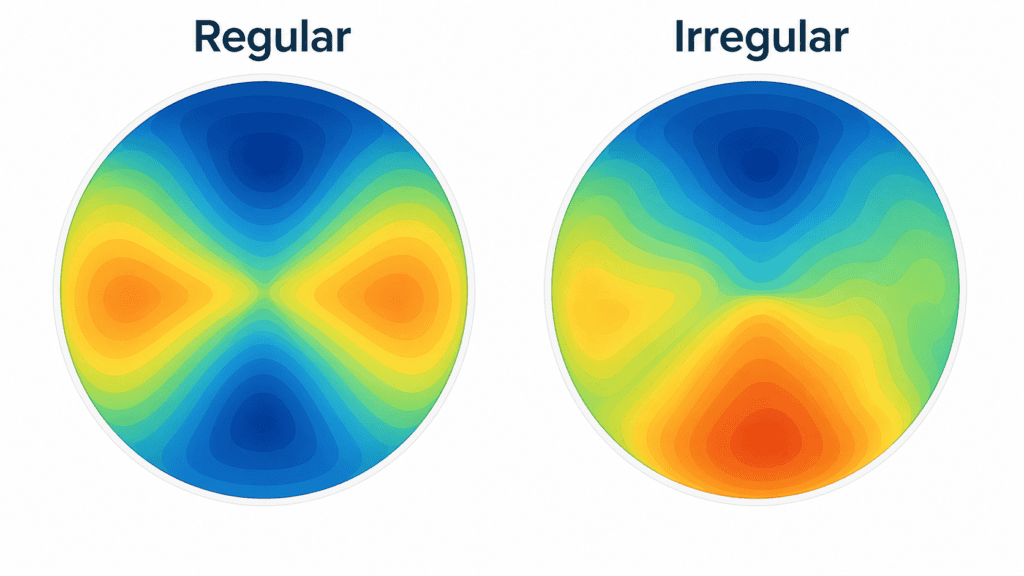
Irregular astigmatism is different. The pattern is less smooth or less symmetrical. It may not behave like a simple prescription number. On a corneal map, the bow-tie pattern may look uneven; in some early keratoconus-type patterns, the lower part of the bow tie may be larger or steeper than the upper part.
That does not mean every irregular pattern is keratoconus. Irregular astigmatism can come from several causes, including keratoconus, corneal scarring, trauma, prior corneal surgery, pellucid marginal degeneration, or other corneal conditions. The word “irregular” means the cornea needs a closer look. It does not mean clear vision is out of reach or that treatment is not possible.
How Corneal Topography Shows the Pattern
The bow-tie patterns shown above are a simplified version of what corneal topography helps your doctor evaluate. In real testing, the map is more detailed and color-coded, but the purpose is similar: to see whether the cornea has a regular, balanced pattern or a more irregular one.
The simplest way to think about topography is like a topographical map in geography. A map can show small hills, larger hills, smooth slopes, and uneven terrain. Corneal topography does something similar for the front surface of the eye.
This test is painless, and in a cornea-focused practice, topography is part of routine evaluation. It helps evaluate the prescription, astigmatism, dry eye, corneal curvature, and whether the patient’s symptoms match the measurements.
Topography becomes especially important if vision does not sharpen as expected with glasses, if the prescription and symptoms do not seem to match, if irregular astigmatism is suspected, or if the doctor is screening for keratoconus. It can also matter when planning specialty contact lenses or evaluating whether a patient is a candidate for surgery.
Corneal vs. Lenticular Astigmatism
Astigmatism can come from the cornea or from the natural lens inside the eye.
Corneal astigmatism comes from the clear front surface of the eye. This is the type most people are referring to when they talk about corneal shape or corneal curvature.
Lenticular astigmatism comes from the natural lens inside the eye. Patients usually do not need to separate this from corneal astigmatism in day-to-day life, because the glasses or contact lens prescription often reflects the combined focusing effect of the eye.
However, this distinction matters in surgical planning, especially during cataract surgery when the natural lens is removed. The doctor needs to understand how much astigmatism is coming from the cornea itself. That is one reason measurements such as keratometry and topography can matter when deciding whether a toric intraocular lens is appropriate.
For routine glasses and contacts, patients do not need to self-diagnose whether the astigmatism is corneal or lenticular. A comprehensive eye exam allows ophthalmologists and optometrists to evaluate both the prescription and whether the astigmatism is coming from the cornea, the lens, or both.
With-the-Rule, Against-the-Rule, and Oblique Astigmatism
With-the-rule, against-the-rule, and oblique astigmatism are direction patterns. They describe the axis of regular astigmatism.
With-the-rule astigmatism means the vertical meridian is steeper. A simple image is a football lying on its side, where the steeper curve is oriented vertically. This pattern is more common in children and younger adults.
Against-the-rule astigmatism means the horizontal meridian is steeper. Using the same image, it is more like the football standing upright. This pattern becomes more common with age.
Oblique astigmatism means the steepest curve is diagonal rather than vertical or horizontal. It is less common, and it may be more sensitive to precise axis alignment, but it is not automatically abnormal or dangerous.
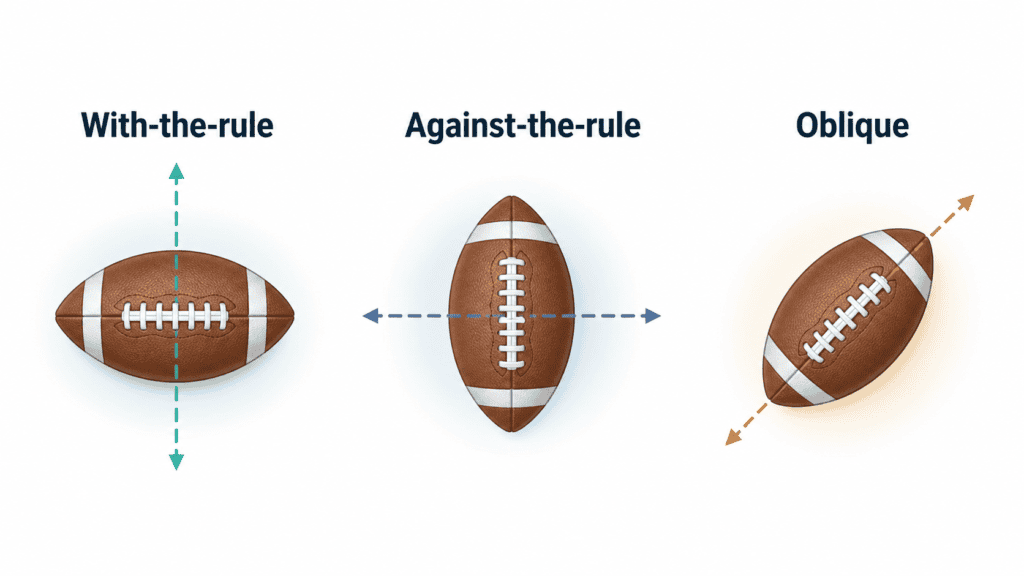
These labels do not describe disease. They describe direction. Over life, many people gradually shift from with-the-rule toward against-the-rule astigmatism. That is usually a normal physiologic change, not a sign that the eye is deteriorating.
The direction also matters because astigmatism correction has to be placed accurately. Doctors are careful not to overcorrect astigmatism in the opposite direction. In some patients, leaving a very small amount undercorrected can feel better than pushing the correction too far and making the visual system adapt to astigmatism in the opposite direction.
Do Different Types Cause Different Symptoms?
Symptoms alone cannot reliably tell you what type of astigmatism you have.
Regular untreated astigmatism and irregular astigmatism can both cause blurred vision, distorted vision, ghosting, shadowing, glare, halos, starbursts, headaches, eye strain, squinting, and night-driving difficulty. A patient may notice that lights smear at night or that letters seem doubled, but those symptoms do not identify the exact type by themselves.
The more useful clinical clue is how well the vision corrects. Regular astigmatism often sharpens predictably with glasses or toric contacts. Irregular astigmatism may leave distortion, ghosting, or blur even after a standard prescription has been tried.
That difference is a reason to examine the cornea more carefully. It is not a reason for the patient to self-diagnose.
Which Types Are Usually Easier to Correct?
Regular astigmatism is usually more straightforward to correct because the pattern is smooth and predictable. With-the-rule, against-the-rule, and oblique astigmatism can all be manageable when they are regular patterns.
Irregular astigmatism may need a more customized plan. That may involve hard contact lenses, scleral lenses, or another approach that creates a smoother optical surface than standard glasses can provide.
Irregular astigmatism is not automatically untreatable. The correction pathway may be more specialized, but many patients can still get meaningful visual improvement with the right plan.
Readers who want a closer look at the subtypes within regular astigmatism, including how astigmatism can combine with nearsightedness or show up as mixed astigmatism, can find that in our guide to regular astigmatism types.
How Keratoconus Fits In
Keratoconus is one important condition doctors consider when corneal topography shows irregular astigmatism, especially in younger patients.
Keratoconus is a corneal condition in which the cornea can become thinner and more cone-like over time. That change can create irregular astigmatism. Early detection matters because progression can be monitored and, when appropriate, treated.
But irregular astigmatism does not always mean keratoconus. Other causes include corneal scarring, trauma, prior surgery, pellucid marginal degeneration, and other corneal conditions. The job of the exam and topography is to sort out which pattern is present.
Family history can matter, but it should not be understood as a guarantee. Keratoconus can run in families as a predisposition. Think of it less like a dominant trait and more like a tendency, similar to how some families are more prone to hypertension. If a parent or sibling has keratoconus, it may make screening more relevant, but it does not mean every family member will develop it.
Patients who search keratoconus online often find the most severe stories first: advanced disease, transplant discussions, and frightening images. Those cases are real, but severe cases tend to be more visible online than early or well-managed cases.
When keratoconus or progressive irregular astigmatism is found early, the conversation is very different. Collagen cross-linking may be discussed to slow or stabilize progression. Glasses, contact lenses, hard lenses, or scleral lenses may be used to improve the vision. One is about stabilizing the cornea, and the other is about helping the patient see.
Common Myths About Astigmatism Types
“Irregular astigmatism means something dangerous is happening.”
False. Irregular astigmatism means the pattern is less predictable and deserves a closer look. It can sometimes be a sign of a corneal condition that deserves evaluation, but the word “irregular” describes a pattern, not a verdict.
“Irregular astigmatism always means keratoconus.”
False. Keratoconus is one important condition doctors screen for, especially in younger patients or when the topography pattern is suspicious. But irregular astigmatism can have other causes.
“Oblique astigmatism is a disease.”
False. Oblique astigmatism describes a diagonal axis pattern. It is less common, but it is not automatically abnormal.
“With-the-rule or against-the-rule means my eye is worsening.”
False. These are direction labels. A gradual shift from with-the-rule toward against-the-rule astigmatism can occur with age and is usually not disease progression.
“Symptoms tell me exactly which type of astigmatism I have.”
False. Symptoms overlap. Topography and exam findings are what distinguish the pattern.
“Irregular astigmatism means there are no correction options.”
False. Irregular astigmatism may require a more customized approach, but hard lenses, scleral lenses, and other options can often improve vision.
“All astigmatism types require special contacts or surgery.”
False. Many patients do well with glasses, soft contact lenses, or toric contacts. Specialty lenses or surgery may be appropriate for selected patients, but the type of astigmatism does not automatically mean the most complex option is needed.
“Astigmatism type alone decides whether surgery is possible.”
False. The type matters, but it is not the whole decision. Regular astigmatism may be compatible with refractive surgery such as laser vision correction, including LASIK, in the right candidate. Irregular astigmatism may rule out some laser-based procedures, but selected patients may still have non-laser options such as ICL (implantable collamer lens) or RLE, which stands for refractive lens exchange. Those decisions require a full exam and careful surgical evaluation.
What to Ask Your Eye Doctor
If you have been told you have astigmatism and want to understand the type, useful questions include:
- Is my astigmatism regular or irregular?
- Is it mainly from the cornea, the lens inside the eye, or both?
- Did my corneal topography look regular or irregular?
- Does my axis pattern matter for my correction?
- Has my astigmatism changed since my last exam?
- Is there any sign of keratoconus, scarring, or another corneal condition?
- If my vision is not fully corrected with glasses, what is the next step?
- Does my astigmatism type affect glasses, contact lenses, or future surgery eligibility?
The goal is to understand whether the label is simply describing a prescription pattern or whether the cornea deserves a closer look. For most people, astigmatism is a manageable prescription finding. It is a number that can be measured, followed, and often corrected. Even when the pattern is irregular, there is usually a path forward, whether that involves glasses, soft lenses, hard lenses, scleral lenses, or, in selected patients, a surgical discussion.
FAQs
What is the most important type of astigmatism to understand?
For most patients, the most useful distinction is regular versus irregular astigmatism. Regular astigmatism is usually a predictable prescription pattern. Irregular astigmatism means the corneal shape needs closer evaluation, often with corneal topography.
Is irregular astigmatism the same as keratoconus?
No. Keratoconus is one condition that can cause irregular astigmatism, but it is not the only cause. Irregular astigmatism can also be related to corneal scarring, trauma, prior surgery, or other corneal conditions.
Can I tell what type of astigmatism I have from my symptoms?
Usually not. Blurry vision, ghosting, glare, halos, and night-driving difficulty can occur with more than one type of astigmatism. An eye exam, refraction, and corneal topography are more reliable than symptoms alone.
What does with-the-rule astigmatism mean?
With-the-rule astigmatism describes the direction of the astigmatism. It means the vertical meridian is steeper. The term helps your doctor place the correction accurately; it does not mean the eye is unhealthy.
Does the type of astigmatism affect treatment?
It can. Regular astigmatism is often corrected with glasses or toric contact lenses. Irregular astigmatism may need a more customized plan, such as hard or scleral lenses, and sometimes closer evaluation for corneal conditions.
About the Author