
Cataract surgery addresses vision loss caused by a cloudy lens that can no longer transmit light clearly. Before surgery is recommended, an eye exam evaluates how changes in the natural lens are affecting vision and daily function. During the procedure, the eye surgeon removes the cloudy lens and replaces it with a clear artificial lens, allowing light to focus properly again and supporting gradual visual recovery.
Recovery from cataract surgery is best understood as two processes unfolding at the same time. One is what you notice day to day, such as vision clarity, comfort, and light sensitivity. The other is the biological healing happening inside the eye, which continues quietly even when symptoms are minimal or absent.
These two processes do not always move together. Vision may feel clear before healing is complete, and internal inflammation can persist even when the eye feels comfortable. This is why recovery cannot be measured by how you feel on a given day or reduced to a fixed timeline.
Healing after cataract surgery is a process, not an event. Each eye responds differently based on anatomy, surgical factors, and pre-existing conditions. Understanding this early helps prevent unnecessary worry, reduces overinterpretation of normal symptoms, and sets realistic expectations for how recovery actually unfolds.
In this guide, we explain how healing progresses in the days and weeks after surgery, what symptoms are normal versus concerning, why recovery rules exist, and how timelines genuinely vary between patients so you can approach recovery with clarity rather than guesswork.
Table of Contents
The First 24 Hours: How Healing Begins
The first 24 hours after cataract surgery are when patients most often feel anxious, even though most early symptoms are part of normal healing. The most common sensation during this period is a gritty or foreign-body feeling, which often causes more concern than blurry vision, light sensitivity, tearing, or mild redness.
This sensation occurs because the cornea has one of the highest concentrations of nerve endings in the body. Even minor surface irritation from fluid use and gentle manipulation during surgery can feel intense, despite being medically mild and temporary.
Blurred or fluctuating vision on the first day is also common. Residual pupil dilation, medicated ointment placed in the eye at the end of surgery, and early surface irritation are frequent causes. Early improvement followed by temporary blur does not mean healing is going backward.
What matters clinically is not how strong a symptom feels, but how it behaves over time and what accompanies it. Gradual improvement, even with day-to-day variability, is expected.
That said, the following symptoms should be evaluated by your ophthalmologist the same day:
- Worsening eye pain rather than irritation
- Sudden vision loss rather than fluctuation
- Pressure accompanied by nausea or vomiting
- Yellow or mucus-like discharge
- New flashing lights or a dark curtain over vision
Understanding this early healing process helps keep concerns proportional and separates mild discomfort from true warning signs that need attention.
Recovery Restrictions and the Science Behind It
Post-operative care and restrictions exist to reduce risk during a short but important healing period. The goal is to limit brief spikes in eye pressure that can increase inflammation or interfere with early healing.
Strenuous activities that involve sudden physical effort should be avoided, including:
- Bending at the waist
- Heavy lifting
- Forceful coughing
- Straining from constipation
These actions can cause short pressure increases inside the eye. Avoiding these spikes matters more than limiting sustained, low-effort activity. This is why guidance focuses on how movements are performed rather than eliminating movement altogether.
Many activities patients worry about are generally low risk to eye health, including:
- Walking
- Light household tasks
- Reading
- Screen use
- Showering (usually okay, but avoid getting water directly in the eye)
- Most gentle activities
These do not meaningfully raise eye pressure and are typically safe. By contrast, behaviors that are often underestimated, especially eye rubbing and inconsistent drop use, pose a greater risk to recovery than most physical activity.
Eye doctors generally individualize restrictions based on surgical complexity, the amount of energy used during surgery, and any pre-existing eye problems. When all restrictions are communicated as equally important, patients may become overly cautious without added benefit. A clearer hierarchy helps patients focus on the behaviors that truly protect healing while minimizing unnecessary impact on quality of life during recovery.
Why Recovery Timelines Differ And When That Matters
Recovery after cataract surgery does not follow a single timeline. Visual clarity and physical comfort often improve at different rates, and neither reliably predicts the other. Some patients see clearly within days but notice irritation or light sensitivity. Others feel comfortable early on, while vision fluctuates. Both patterns can be part of normal healing.
Fluctuation is common, especially in the first few weeks. Vision may improve, blur, and then sharpen again as inflammation settles and the ocular surface stabilizes. This variability does not mean recovery is failing or that something was done incorrectly.
Certain factors make recovery slower or more uneven. These include dry eye or ocular surface disease, diabetes, prior uveitis or retinal inflammation, denser cataracts requiring higher surgical energy, and a history of macular swelling. In these cases, healing still progresses, but stabilization takes longer.
Faster recovery is more common when surgery is uncomplicated, inflammation is low, the ocular surface is healthy, and post-operative drops are used consistently. These patients often reach stable vision earlier, though some variability is still normal.
What matters clinically is not how fast recovery occurs, but how it trends. Gradual improvement with occasional fluctuation is expected. A lack of progress, worsening symptoms, or increasing asymmetry between eyes warrants closer monitoring.
Holistic Recovery: What Influences Healing
Everyday habits play a meaningful role in how recovery feels and progresses. Some factors consistently influence healing, while others are commonly overstated.
| Factor | Impact on Recovery | Practical Guidance |
| Prescribed eye drops | High | Use consistently with proper timing and technique |
| Routine consistency | High | Keep drop schedules and daily habits predictable |
| Eye rubbing | High risk | Avoid entirely during early healing |
| Sleep protection (early) | Moderate | Protect the eye for the first few nights by using a hard plastic eye shield to prevent accidental rubbing during sleep |
| Hydration and general diet | Moderate | Maintain normal hydration and balanced meals |
| Anxiety and over-monitoring | Affects perception | Focus on trends, not moment-to-moment changes |
| Supplements | Low | Not needed unless specifically prescribed |
| Eye makeup | Moderate (early period) | Avoid during early healing to reduce contamination and accidental eye contact |
| Rigid activity restrictions | Low after the early period | Resume normal activity gradually |
Small, practical habits often make the biggest difference. Correct drop technique, hand hygiene, avoiding eye rubbing, and attending scheduled follow-up appointments contribute more to recovery quality than most lifestyle changes patients focus on.
Preventing Common Complications Before They Start
Most post-operative complications are preventable and are more closely tied to behavior than to the eye surgery itself. Consistent drop use, good hygiene, avoiding eye rubbing, and attending follow-up visits remain the most reliable protective factors.
What matters more than isolated symptoms is how things change over time. Gradual improvement with some fluctuation is expected. Concern rises when symptoms worsen, stall, or appear in combination, particularly when vision plateaus, light sensitivity increases, or discomfort persists.
Patients should feel comfortable calling when symptoms change direction or do not improve. Early communication allows small issues to be addressed before they escalate and helps avoid both unnecessary worry and delayed care.
Long-Term Vision Optimization and Neuroadaptation
Even after the eye looks healed and vision measures well in the office, many patients notice that vision continues to evolve over weeks or months. This process, known as neuroadaptation, reflects the brain adjusting to a new lens inside the eye. Vision often improves gradually rather than reaching instant perfection.
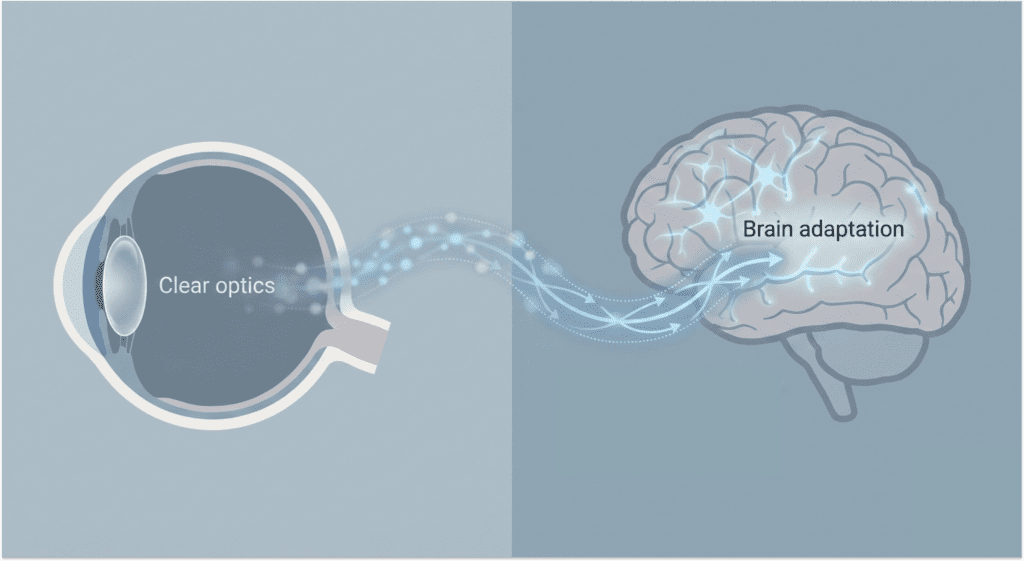
Neuroadaptation is more noticeable with presbyopia-correcting lenses, including trifocal or multifocal lenses such as PanOptix and PanOptix Pro, as well as extended depth-of-field lenses like the Johnson & Johnson Odyssey lens. These artificial lenses reduce dependence on new glasses but often require a longer adjustment period, sometimes up to a month or more.
Changes in depth perception, fluctuating clarity, and increased awareness of floaters are common during neuroadaptation. Glare and halos are not part of neuroadaptation but can be a known optical side effect of presbyopia-correcting lenses and are discussed before surgery.
Recovery Phases: What You Feel vs. What Is Happening
The recovery process after cataract surgery is often confusing because how the eye feels does not always reflect what is happening biologically. While cataract surgery recovery time varies by individual, the phases below separate subjective experience from internal healing so patients can place symptoms in the right context and avoid misinterpreting normal recovery changes.
| Phase | Your Experience | The Biological Reality |
| Day 1 | Grittiness, “sand” in the eye, mild blur, and light sensitivity. | The cornea is settling from surgical manipulation; the incision is beginning to self-seal. |
| First week | Vision begins to “pop” or sharpen, though it may fluctuate. Irritation decreases. | Inflammation is being actively managed by steroid/NSAID drops. Surface cells are regenerating. |
| Weeks 2–6 | Vision feels stable. You may forget you had surgery. | Internal structures are fully quietening. The intraocular lens (IOL) is settling into its permanent position. |
| Months 1–3 | Subtle improvements in depth and clarity. | Neuroadaptation: The brain is fine-tuning its response to the new light signals and lens optics. |
This helps explain why recovery can feel complete before healing is finished, or why subtle changes continue after vision seems stable. Both processes move forward together during the recovery period, but not at the same pace. Knowing where you are in recovery helps keep expectations realistic and decisions measured as full recovery progresses.
Confidence, Not Caution Fatigue
After cataract surgery, the most important factors for a smooth outcome are consistency, patience, and communication. Perfect behavior is not required. What matters is using prescribed drops as directed, allowing healing to progress naturally, and staying engaged with follow-up eye care.
Many patients remain overly cautious weeks after surgery, continuing to monitor every sensation or limiting activity out of fear of doing something wrong. This is rarely necessary. Once early healing is on track, returning to normal daily activities supports both physical recovery and visual adaptation.
Cataract surgery is not one-size-fits-all. Some eyes settle quickly, others more gradually, but recovery follows a predictable process. The goal is not constant vigilance, but informed confidence, knowing what to expect, when to wait, and when to call.
If patients carry one principle forward, it should be this: trust the process, follow guidance consistently, and allow both the eye and the brain the time they need to adapt.
About the Author