
Cataracts are not a disease in the traditional sense. They are a normal, age-related change of the eye’s natural lens, similar to other signs of aging, such as wrinkles or graying hair. Everyone who lives long enough will develop some degree of cataract, regardless of how healthy their lifestyle is.
Because cataracts develop slowly and unpredictably, patients often struggle to interpret what they are feeling. Long periods of stability can be followed by noticeable changes that seem sudden, even though the underlying process has been gradual. This pattern can make patients feel that something is “going wrong,” when in reality the lens is following a normal but variable course.
Misunderstanding is also fueled by the belief that cataracts are largely preventable or reversible. Diet, exercise, supplements, and eye drops are often assumed to play a major role, but their impact on cataract development is limited. When patients expect control that does not exist, normal progression can feel like failure or neglect.
Online information further complicates this picture. Many sources emphasize urgency, prevention claims, or unproven treatments, which can heighten anxiety and push patients toward premature conclusions about surgery.
The goal of this guide is to replace fear and uncertainty with a clearer understanding of how cataracts affect vision, how they progress, and when they become a treatment issue. By doing so, patients can observe changes calmly and make decisions based on function rather than alarm.
What Cataracts Do to Vision
Cataracts affect vision in specific and fairly consistent ways, but those effects are often misunderstood. Knowing what changes are typical helps distinguish true cataract-related symptoms from visual problems that come from other causes.
As cataracts develop, vision usually changes gradually. Common changes include:
- Colors appearing duller or less vibrant
- Reduced contrast, especially in low-light conditions
- Increased glare and halos, particularly around headlights at night
- Greater need for brighter light when reading or doing close work
These changes tend to creep in slowly. Because cataracts do not progress in a straight line, patients may feel stable for years and then suddenly realize their vision is worse. This does not mean the cataract changed overnight. It reflects how gradual changes become noticeable only once they cross a functional threshold.
What cataracts do not typically cause is just as important. They do not lead to:
- Sudden or overnight vision loss
- Significant day-to-day vision fluctuation related to sleep, screen use, or stress
- Worsening due to blue light exposure or screen time
- Improvements, or slowing from diet/supplements/exercise once formed
Cataracts also cannot be corrected with stronger glasses. While prescription changes may help early on, cataracts scatter light inside the eye. As this scattering increases, the benefit of refraction diminishes, which is why patients may feel that “no prescription quite works anymore.”
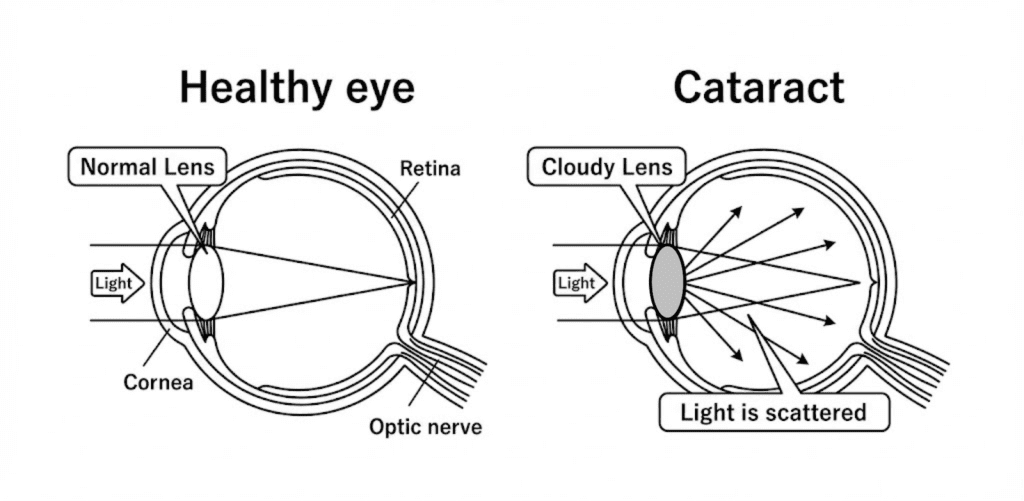
A cataract turns a normal, clear lens within your eye cloudy and opaque
Another common misconception is that cataracts follow a predictable timeline. In reality, progression varies widely between individuals and even between the two eyes of the same person. One eye may worsen faster than the other, and there is no reliable way to predict who will progress quickly or slowly at any given stage.
Understanding these patterns helps set realistic expectations. Cataracts cause slow, structural changes in vision quality, not dramatic daily swings. When vision feels inconsistent or erratic, the cause is often something else, even when cataracts are present.
Symptoms Commonly Blamed on Cataracts but Often Caused by Something Else
Many of the visual symptoms that concern patients most are not driven by cataracts, even when cataracts are present. They often originate from conditions that affect how the eye functions moment to moment rather than from structural changes in the lens.
One of the most common contributors is dry eye. Screen use reduces blink rate, destabilizing the tear film and leading to intermittent blur, eye strain, and discomfort. These symptoms can feel dramatic and unpredictable, but they reflect surface instability, not cataract progression.
Fatigue, stress, illness, and dehydration can also degrade visual quality. These factors influence how efficiently the visual system processes information, making vision feel unreliable without any change in the cataract itself.
Patients frequently worry that blue light exposure from screens is damaging their eyes or accelerating cataracts. There is no evidence that blue light causes cataracts. Screen-related discomfort is typically due to dryness and visual fatigue rather than lens damage.
Another source of confusion is the expectation that diet, supplements, or eye exercises should improve cataract-related symptoms. When vision continues to fluctuate or decline despite these efforts, patients may assume something is being missed. In reality, cataracts cannot be treated or stabilized this way, and persistent or variable symptoms often point to a different cause.
Recognizing these patterns helps patients and clinicians focus on the right problem. When symptoms are variable, strain-related, or linked to daily conditions, addressing non-cataract factors often brings more relief than focusing on the cataract itself.
Why Vision Can Feel Unreliable Even With “Good” Test Results
Many patients are confused when they are told their vision tests as “good,” yet their day-to-day experience feels anything but. Standard vision testing is designed to measure how clearly someone can read high-contrast letters in controlled lighting. It does not fully capture how the eyes perform in real-world conditions, such as driving at night, reading in dim light, or coping with glare and visual fatigue.
Cataracts often affect vision quality before they significantly reduce measured sharpness. Reduced contrast, increased glare, and duller colors can make vision feel unsafe or unreliable even when eye-chart results appear reassuring.
Vision can also feel worse outside the exam room because everyday environments place higher demands on the visual system. Lighting is uneven, tasks are sustained, and visual processing must adapt continuously. These factors can expose limitations that brief testing does not detect.
For patients, the most important takeaway is that test results and lived experience are both valid. A good eye-chart score does not invalidate functional difficulties, and functional complaints often guide monitoring and treatment decisions more than a single number.
Bilateral Differences and the Psychology of Visual Asymmetry
Many patients are surprised by how unsettling it feels when one eye seems worse than the other. Even relatively small differences between the two eyes can create significant discomfort, eye strain, or a sense that vision is “off,” despite similar measurements on testing.
Cataracts rarely progress at the same pace in both eyes. One eye may remain stable for years while the other changes more quickly. This asymmetry is common and expected, and it does not follow a predictable pattern.
The brain works hard to combine input from both eyes into a single visual experience. When one eye delivers a slightly degraded image, the visual system struggles to reconcile the mismatch. This can amplify symptoms such as blur, glare, or fatigue, even if each eye performs reasonably well on its own.
Asymmetry often becomes most noticeable during tasks that demand precise or sustained vision, such as driving, working at a computer, or navigating low-light environments. These situations expose differences that may not be obvious during brief testing.
In most cases, asymmetry alone is not a sign that something is wrong or that surgery is urgently needed. It is monitored over time, with attention to whether the imbalance is stable or progressively interfering with daily activities. When asymmetry begins to affect safety, comfort, or independence, it becomes more clinically meaningful.
When Cataracts Become a Treatment Issue, Not Just a Finding
The shift from observation to treatment happens when vision changes begin to interfere with daily life. The threshold is different for every person. Difficulty driving, increased glare, trouble reading, or limitations at work or in hobbies often signal that cataracts are becoming functionally significant.
Cataract surgery is not recommended based on how a cataract looks alone. While the density and appearance of the lens are part of the evaluation, the most important factor is how vision loss affects a person’s ability to function safely and comfortably.
Progression is also unpredictable. Some people remain stable for years, while others experience a noticeable decline over a shorter period. Because of this variability, regular monitoring is essential, and decisions are made over time rather than at a single visit.
Although there is usually no emergency deadline for surgery, waiting indefinitely is not ideal. Very dense cataracts can make surgery more technically complex and may increase inflammation or recovery time. For this reason, cataract care balances careful monitoring with timely intervention rather than urgency or indefinite delay.
Ultimately, the decision to proceed with surgery is individualized and shared. Visual demands, lifestyle, safety considerations, and personal tolerance for change all matter. Cataract surgery is a proactive decision made to restore function and quality of life, not a response to failure or neglect.
Non-Surgical Management Before Surgery Is Considered
Before cataract surgery is considered, attention is often given to optimizing overall eye health and addressing factors that can influence visual symptoms. These measures do not remove cataracts or stop them from forming, but they can reduce symptom burden and improve visual stability.
| Factor | Why It Matters | What It Can and Cannot Do |
| UV exposure | UV light has a cumulative lifetime effect on the lens and is one of the strongest environmental risk factors for cataract progression. | Sunglasses that block UVA and UVB rays and wearing hats can help slow progression, but cannot prevent cataracts entirely. |
| Metabolic health (diabetes) | Poor blood sugar control can cause the lens to swell and accelerate cataract changes. | Optimizing glycemic control may reduce acceleration but does not reverse existing cataracts. |
| Smoking | Smoking increases oxidative stress on the lens and is associated with earlier cataract development. | Quitting reduces a known accelerator of cataracts but does not guarantee a different outcome for any individual. |
| Steroid exposure | Long-term steroid use, especially eye drops or ointments, is linked to specific cataract types. | Steroids should not be avoided when medically necessary; exposure can sometimes be minimized with physician coordination. |
| Dry eye and ocular surface health | Tear-film instability causes fluctuating blur, glare, and discomfort often mistaken for cataract progression. | Treating dry eye can improve symptoms and visual stability, and may delay surgery, but does not change the cataract itself. |
| Lifestyle changes and supplements | Often promoted as preventive or stabilizing strategies. | No strong evidence shows they prevent or slow cataracts once formed; they may support general health but are not cataract treatment. |
Non-surgical management is therefore about optimization, not cure. It helps ensure that when surgery is eventually considered, it is addressing the right problem at the right time.
Cataract Surgery: What It Solves, What It Trades Off
Cataract surgery is the only definitive treatment for cataracts. Once the natural lens becomes cloudy, it cannot be cleared with medications, eye drops, supplements, or lifestyle changes. Surgery removes the cloudy lens and replaces it with a clear artificial one.
Modern cataract surgery is most commonly performed using phacoemulsification, a technique in which ultrasound energy is used to break the cloudy lens into small fragments that are gently removed through a very small incision. This approach allows for precise lens removal, rapid visual recovery, and a low complication rate in routine cases.
After the cataract is removed, an intraocular lens (IOL) is implanted to replace the eye’s natural focusing lens. The IOL becomes a permanent part of the eye and determines much of the postoperative visual outcome. Standard monofocal IOLs are designed to provide clear vision at a single distance, while other IOL designs may aim to reduce dependence on glasses at multiple distances, each with specific optical trade-offs.
When cataracts are the main cause of vision loss, surgery reliably improves clarity, contrast, glare sensitivity, and color perception. For most patients, this translates into safer driving, easier reading, and improved day-to-day visual function.
There is usually no emergency deadline for surgery. Cataracts are monitored over time, and surgery is recommended when vision changes begin to interfere with daily activities. While waiting is often appropriate, excessive delay is not ideal, as very dense cataracts can make surgery more technically complex and recovery less predictable.
Cataract surgery delivers highly consistent results, but it is not designed to create perfect vision. Outcomes fall within a predictable range, and satisfaction is highest when expectations are realistic and aligned with functional goals and IOL selection.
Needing cataract surgery does not mean prevention failed. Cataracts are a normal part of aging, and surgery is a proactive decision to restore visual function and quality of life.
Fear, Anxiety, and Decision Paralysis Around Surgery
Many cataract decisions are driven by fear. Anxiety can distort how patients interpret symptoms, timelines, and recommendations, leading either to premature surgery or prolonged avoidance. Addressing these fears directly helps patients regain clarity and confidence.
The following are some of the common fears and how they are addressed in practice:
| Patient Concern | What Patients Often Fear | How Clinicians Frame It |
| Fear of blindness | Cataracts will suddenly cause permanent vision loss if not treated immediately. | Cataracts progress slowly; sudden blindness from cataracts alone is extremely rare. Decisions are usually not urgent. |
| Fear of surgery itself | Pain, loss of control, or being awake during the procedure. | Modern cataract surgery is brief, outpatient, and uses minimal anesthesia; discomfort is typically mild and short-lived. |
| Fear of complications | A single mistake could permanently damage vision. | Complications are uncommon, and most are treatable when identified early. Risk is discussed without alarm. |
| Decision paralysis | Choosing surgery too early or too late will lead to regret. | There is usually a wide and flexible window for surgery; decisions are based on function, not perfection or timing pressure. |
| Mistrust from mixed messaging | Conflicting advice or online information makes it hard to know whom to believe. | Clear explanation of reasoning, monitoring plans, and what actually changes outcomes helps restore confidence. |
| Loss of autonomy | Feeling pushed toward surgery without understanding the rationale. | Surgery is framed as a shared, function-based decision, not a requirement or failure of prevention. |
Anxiety often amplifies symptoms and urgency, while reassurance and understanding restore perspective. When patients understand what cataracts can and cannot do, fear becomes easier to manage. Most people do not need to decide immediately. They need clarity, monitoring, and a sense of control over timing.
Recovery Expectations, Complications, and Long-Term Outcomes
Most patients recover smoothly, but improvement is gradual rather than instantaneous.
What Patients Commonly Experience After Cataract Surgery
| Phase | What Is Typical | What Patients Often Misinterpret |
| First days | Mild irritation, light sensitivity, temporary blur | Assuming surgery “didn’t work” because vision is not immediately perfect |
| First weeks | Gradual sharpening of vision and improving comfort | Worrying that slow improvement signals a complication |
| Stabilization period | Vision settles as the eye heals and adapts | Expecting instant or permanent perfection |
Complications: Real but Uncommon
| Concern | Clinical Reality |
| Infection or inflammation | Rare, monitored closely, and usually treatable when identified early |
| Macular swelling | Uncommon and often temporary with appropriate treatment |
| Retinal issues | Unlikely, but risk is assessed individually based on eye history |
Long-Term Outcomes
| Topic | What Patients Should Know |
| Visual results | Most patients achieve lasting improvement in function and quality of life |
| Posterior capsule opacification | A secondary membrane may cloud vision later; this is not a “return” of the cataract and is treated easily with laser |
| Expectation alignment | Satisfaction is highest when recovery timelines and trade-offs are understood in advance |
Second Opinions, Trust, and Decision Confidence
Uncertainty around cataract decisions often reflects gaps in communication rather than disagreement about diagnosis. This section helps patients understand when a second opinion is useful, how trust affects outcomes, and how confidence is built over time.
How Ophthalmologists Address Concerns and Support Decision Confidence
| Clinical Situation | Common Patient Concern | How Clinicians Typically Respond |
| Perceived urgency around surgery | Fear that delaying surgery will cause sudden or permanent vision loss | Explain the slow, variable nature of cataract progression and emphasize that most decisions are not time-critical |
| Anxiety about the surgical experience | Worry about pain, awareness, or loss of control during surgery | Describe the procedure clearly, including anesthesia, duration, and what patients actually feel |
| Fear of complications | Concern that a single complication could permanently damage vision | Discuss real risks in context, noting rarity, monitoring, and the ability to treat most issues when identified early |
| Uncertainty about timing | Worry about choosing surgery too early or too late | Frame surgery as a function-based decision with a flexible window rather than a narrow deadline |
| Conflicting advice or online information | Confusion caused by mixed messages from different sources | Clarify clinical reasoning, distinguish evidence from marketing, and refocus on functional impact |
| Reluctance or hesitation to proceed | Concern about regret or making the wrong decision | Reinforce shared decision-making, outline next steps, and confirm that waiting with monitoring is a valid option |
When a Second Opinion Is Reasonable
A second opinion can be helpful when symptoms and exam findings do not seem to match, when recommendations feel unclear, or when a patient is facing a major decision without feeling confident. Seeking additional input is not a sign of distrust; it is often part of informed decision-making.
Building Confidence Over Time
Trust grows when patients understand why recommendations are made, what is being monitored, and what changes would prompt action. Clear communication, realistic expectations, and a shared approach to timing allow patients to feel comfortable whether they choose to wait or proceed.
Decision confidence comes from understanding trends rather than reacting to single visits. When patients know what matters and what does not, they are better able to move forward without pressure or doubt.
From Symptom Anxiety to Informed Control
Cataracts are common, gradual, and manageable. They do not develop overnight, and decisions about treatment are rarely urgent. Most cataract decisions are not about choosing the “right moment,” but about recognizing when vision changes begin to interfere with daily life. When surgery is needed, it is a planned and effective step to restore visual function, not a failure of prevention or delayed action. With realistic expectations and clear communication, patients can approach cataract care with confidence, flexibility, and control rather than fear.
About the Author